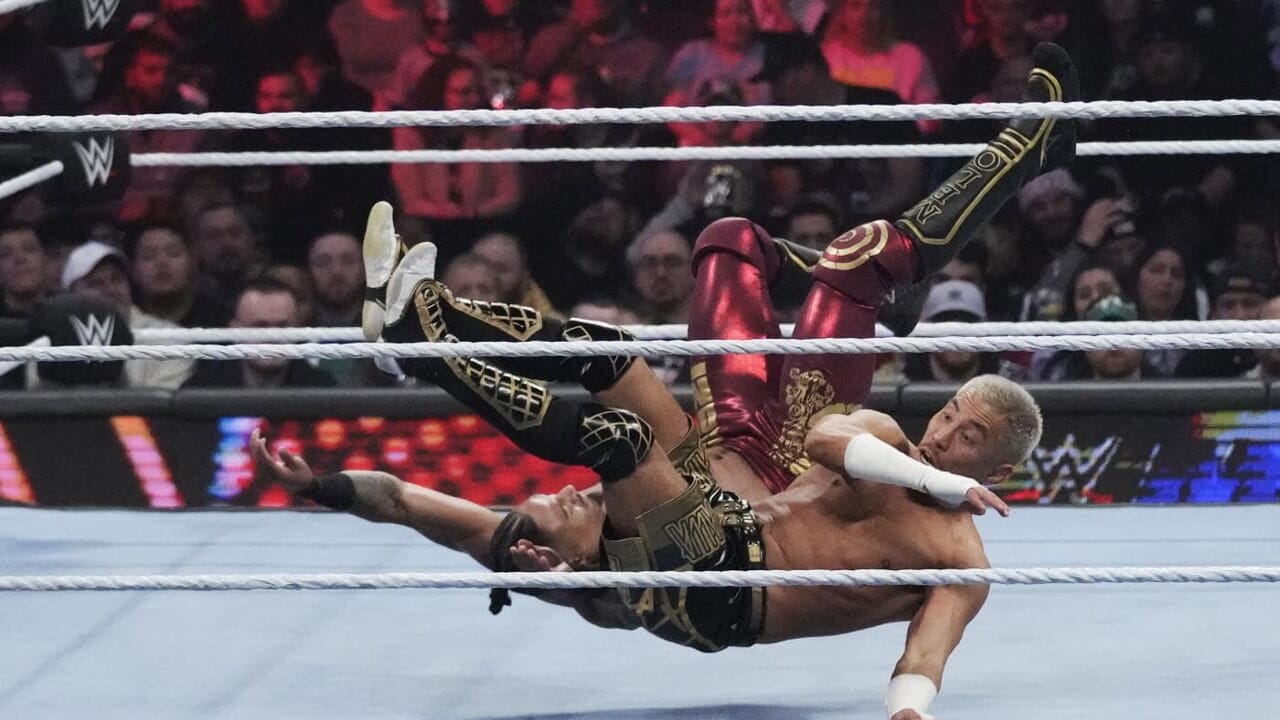
Wrestling as we’ve never seen it: WWE on Netflix is a revolution we’ve been waiting for for years
April 1, 2026 is no joke. It is the date on which WWE will also change its home in Italy, leaving Discovery+ and DMAX after several years of free-to-air exposure to arrive exclusively on Netflix. For those who have followed wrestling for years, for those who have spent sleepless nights in front of a television waiting for the giants of the ring to enter between Raw, Smackdown and what were once called pay per views, it is a step that goes far beyond distribution logic. It is an epochal change of character.
An epochal change
The official announcement came through a video by Paul Levesque, who is recognized as such only when he signs contracts as executive vice president of the company – because for everyone he is actually the multiple world champion Triple H – published on the social channels of the platform and on those of WWE Italia. A way of communicating designed specifically for Italian fans, not for sponsors nor for investors or financial analysts. And this already says something important about how WWE is looking at the Italian market: not as a territory to be covered, but as an audience to definitively conquer.
The weekly shows will be available on Netflix – Raw, Smackdown and NXT – all the in-depth magazines as well as the entire calendar of Premium Live Events, including the big four, WrestleMania, Summerslam, Survivor Series and Royal Rumble, all without subscriptions or additional tickets. All in one place, accessible to anyone who already has an account on the platform. For a discipline that in Italy has always suffered from fragmented distribution and often hostile to the general public, this is a leap in accessibility to be appreciated and underlined.
It is also worth remembering that after the live broadcast the shows will be uploaded to the archive and will be visible at any time, as already happens with series and films on the platform. A trivial convenience on paper, revolutionary in practice for those who work and can’t stay up until three in the morning every Monday and want to enjoy the show by separating themselves from their cell phones for a few hours and avoiding spoilers, something that in truth the wrestling public sees as extremely polite. Indeed… perhaps WWE fans were the first to understand and respect the spoiler.
Italy to Italians
Particularly significant is the recognition received by Luca Franchini and Michele Posa, official WWE commentators ever since the products were broadcast on the old Stream, before moving to Sky and then to Discovery. The two doyens of wrestling commentary in the official announcement video were not only mentioned but profiled with their own voices: a gesture that celebrates 25 years of activity as official voices of WWE in Italy. Anyone who has ever heard the voice of Bardo Posa or Godzilla Franchini in a moment of tension in the ring knows very well that they are not simple commentators, a supporting voice. They are themselves part of the experience, of the collective memory of a generation that has wrestling in its blood, a further definition of the show.
What is wrestling, for those who don’t know yet
It is worth stopping for a moment for those approaching this world for the first time, perhaps attracted by the Netflix news without having the tools to orient themselves. Professional wrestling – and WWE in particular – represents a physical-athletic and narrative spectacle at the same time. There is a lot of discussion about pre-established results and this has branded wrestling as a ‘fake discipline’. Nothing could be further from the truth. Just as cinema, theatre, or any artistic representation is not false. With the difference that on a stage and on a set you can do and redo, try and try again. Not in the ring. It’s all live. And if you make a mistake, a matter of centimeters, the risk is enormous. All in a dialectic that is at least as physical as it is narrative with characters built over time, rivalries that last for years, betrayals, alliances, titles that change from hand to hand in unpredictable ways and artists often linked to their character for their entire lives. Just think of Undertaker, or John Cena, who recently retired.
The audiences who fill the arenas are not fooled about what they are watching. He knows very well that there is a script, in jargon storyline. But he has no idea where or how it will end. One of the exercises of the wrestling people is precisely to understand the developments of the challenges and their long-term component.
Yet he screams, cries, rejoices. Because the suspension of disbelief – the same one that makes us move in front of a film – works here in an even more powerful way: the bodies that collide are real, the fatigue is real, the pain is real, the risks and traumas are the most dramatic aspect. What changes compared to traditional sport is only the implicit agreement between the product and its audience. An unwritten pact that everyone respects.
Raw is the weekly Monday show, the longest-running program in the history of American cable television: it has been on the air without interruption for over thirty years. SmackDown is the equivalent of Friday, younger but equally central to the overall narrative. Premium Live Events – once called pay-per-view – are the highlights of the calendar, the ones in which stories close or open, in which titles change hands, in which history is written. WrestleMania is the most important of all: two nights, an eighty thousand seat stadium, decades of sporting iconography and pop culture that overlap until they become indistinguishable. Think of it as a cross between the Super Bowl and a Hollywood blockbuster with the difference that the protagonists risk themselves.
Italy as protagonist
And then there’s what will happen in Italy very soon. Between May and June our country will host five stages of the WWE European tour: a Premium Live Event, two television episodes and two house shows, distributed between Turin, Bologna, Rome and Florence. Nothing like this has ever happened, and those who downplay this news have probably never understood what it means for an Italian enthusiast to see their city become an American province in all respects.
Clash in Italy will be staged on May 31st at the Inalpi Arena in Turin, the first WWE Premium Live Event ever organized in Italy. The following day, an episode of Monday Night Raw will be held in the same arena. Direct consequences of the PLE to fuel new chapters.
On June 5th it’s the turn of Bologna with SmackDown, then Rome and Florence with the shows of the European Summer Tour. Five evenings in just over a week: a density of events that until a few years ago would have seemed like science fiction, and which is remembered only on the sidelines of the legendary 2005 tour, the one unfortunately marked by mourning for the sudden death of Eddie Guerrero. Twelve shows: the first time Raw live in Milan and eleven house shows.
Today’s signal is simply the reflection of how much Italy counts in the international strategy of the Stamford company.
The Clash in Italy card has not yet been officially announced – it will also depend a lot on what happens at WrestleMania 42 in Las Vegas and the subsequent Backlash – but it is reasonable to expect a top-level billboard. A PLE is not brought to a country for the first time with second rate names. Turin, in this sense, deserves something memorable.
The television production will also be of an absolute level: between special effects, digital production, technical personnel, employees, WWE will arrive with an impressive mass of means second perhaps only to those seen for the Coldplay and Taylor Swift tour. Which however were not broadcast live all over the world for millions and millions of connected people. At a rough estimate we’re talking about a thousand people just to stage the shows on Sunday and Monday in Turin.
Ticket prices are not affordable for everyone and unfortunately follow the logic of the price increases suffered for large entertainment events, in particular concerts: they range from 92 euros for basic Clash in Italy seats up to over 2,400 euros for premium experiences, with VIP packages that can reach up to 11,500 dollars.
They are exponential figures that say two things at the same time: that WWE knows well how much its product is worth, and that there is a solid enough demand to support similar prices on the Italian market. The rush for tickets in the days following the opening of sales confirmed that those shows are close to being sold out. It’s not a coincidence. It is the sign of a community that has been waiting for this moment for decades.
Orders for the most popular seats immediately sold out, sending touts and digital secondary ticket professionals into a frenzy. Although the company is on the front line to tackle this plague, it is an extraordinary event that saw a real assault in the first minutes of online sales with tens of thousands of connections in just a few minutes. True fans had to fight against bots and artificial intelligence to get a ticket: just take a look online with a VPN and tickets can be found, but at shameful prices: in particular in Russia, Germany, the United States, South Africa. Unfortunately, the risk of scams is high.
A community that has never disappeared
Italian wrestling has never ceased to exist, even in moments of lesser television visibility. There is a lively independent scene, there are local federations that work with passion and little means, there are enthusiasts who have continued to follow everything – even the longest nights, even the most inconvenient subscriptions, even the live streaming – because the fever caught them once and never let go.
It is a community that recognizes itself, that talks to each other, that knows how to use social media better than many traditional sports editorial offices. A community that in recent years has also seen the growth of the media ecosystem around the discipline between sites, communities and a network of highly informed and authoritative podcasts. The average age of analysts and commentators is very low.
Wrestling Time, the in-depth periodical by Alessandro Bosio and Luca Carbonaro, has just started free-to-air on Canale 61, every Thursday at 11.15pm. An Italian match is broadcast on Telecity every Sunday, at the same time. Small signs, of course, but indicative of a vitality that cannot be improvised. Every month there are many shows from the Italian federations in a constantly updated calendar and with an increasingly large and informed crowd of fans who demonstrate that they also know the local stars well. Maybe waiting to see some young talent in WWE.
Netflix and WWE’s summer tour don’t create this community: they find it already there, formed, passionate, ready. What they do is finally give it the visibility it deserves, lower the barriers to access, open the door to those who were curious but didn’t know how to enter. It’s the moment in which those who have always followed the show can finally raise their voices and say: I told you so.
For those who already know that world, April 1st is not the beginning of something. It is the recognition of something that has always been there.
