Early afternoon, you have just finished lunch and you would pay an amount you don’t even have to take a nap. Instead you force yourself to sit in the chair for a few minutes at most. But then the weakness starts to get the better of you, and you find yourself in that situation sleep-wake limbo eternal who “generates monsters” (paraphrasing a famous work by Francisco Goya). A recent research published by the Paris Brain Institute focuses precisely on this state Cell Reports who revealed that our mind can enter authentic “dream states” even when we are awake. The study analyzes dozens of people in the moment of “limbo”, discovering that thoughts can become dreamlike well before falling asleep. Until now, science and our daily experience have accustomed us to think of the mind as a switch which can only be on or off, alert or dormant. THE dreams they were studied as a phenomenon exclusive to the night, while daydreaming was considered an entirely separate daytime process. This study proposes a third way that unifies these two worlds, highlighting how our spontaneous experiences are not divided by a clear border, but belong to a single fluid spectrum.
Can we dream even when we are awake?
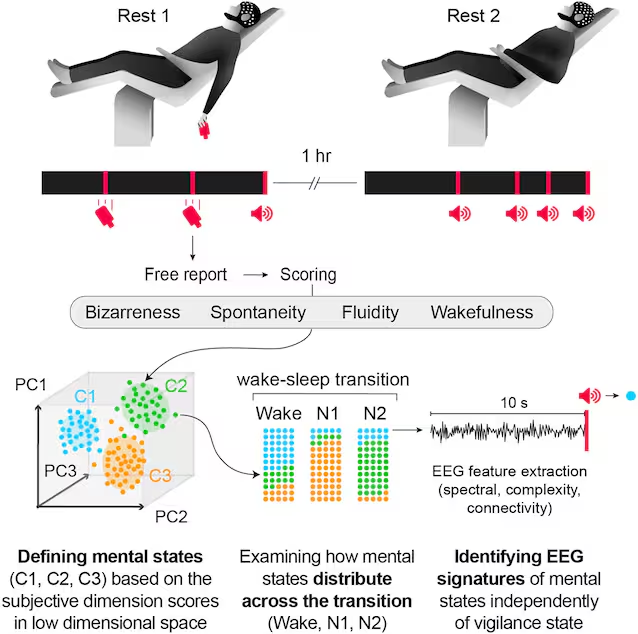
To understand if i dreams appear only when we sleep, a team of scientists analyzed dozens of volunteers, asking them to relax on an armchair in a dark and silent room. For capture thoughts at the exact moment of falling asleepthey used an ingenious trick which, legend has it, was originally conceived by Thomas Edison: holding a bottle in your hand which falls at the first sign of muscle relaxation, therefore at the critical moment before sleep. The noise of the falling bottle woke up the participants and, immediately afterwards, they were asked to describe their mental experience evaluating its strangeness, fluidity and degree of spontaneity.
By combining the descriptions with brain, muscle, heart and eye data, they grouped the experiences into four mental states.
- been fleetingmade up of thoughts that emerge spontaneously but fragmented, made up of short personal memories;
- alertin which the mind is fluid but anchored both to the external environment (attentive to the noises in the room) and to bodily sensations, well aware of being awake:
- state bizarrefull of surreal and dreamlike images, such as seeing little aliens or imagining ants climbing on your body with crossword puzzles in the background. It is the state that comes closest to dreams, and in fact it has many unmistakable characteristics: surreal scenarios, extreme fantasy and illogical combinations of elements.
- state voluntaryin which the mind focuses logically to plan future actions.
The astounding discovery is that these four states they are not not at all pigeonholeable in the labels of “wake up” or “sleep“. Scientists recorded unequivocal waking brain traces in subjects who reported being immersed in dreamlike and bizarre visions. On the contrary, it was discovered that it is possible to carry out completely logical and voluntary reasoning, such as organizing the work day, despite already being sunk in the first stages of sleep.
What happens in the brain during these “limbo dreams”?
If being asleep or awake does not determine what we think, what are the scientific causes of these phenomena? The answer lies in microscopic variations in electrical activity of the brain, which give each specific mental state its own neurological “signature”. Let’s take the example of the moments in which we live experiences bizarre and dreamlike when awake. The electroencephalogram records in this case a collapse of the so-called “functional connectivity” between different brain areas and a reduction in a parameter of electrical activity called spectral offset. Let’s imagine the brain like a big one orchestra: in the logical vigil, all sections communicate led by a vigilant conductor, represented by the frontal areas responsible for executive control. When the bizarre thought triggers, the orchestra loses its synchronization. Frontal control loosens (the cerebral cortex, seat of executive control, is “discharged”), leaving the visual areas free to improvise. This generates alocal electricity business that it produces spontaneous imagestotally disconnected from the surrounding reality.
In contrast, when participants were in the mental state of “alert” (close to sleep but still attentive to the environment), their brains showed an increase in entropy, indicating a very high signal complexity: it means the brain is actively processing sensory stimulimaintaining a solid contact with the physical world before falling asleep completely.
