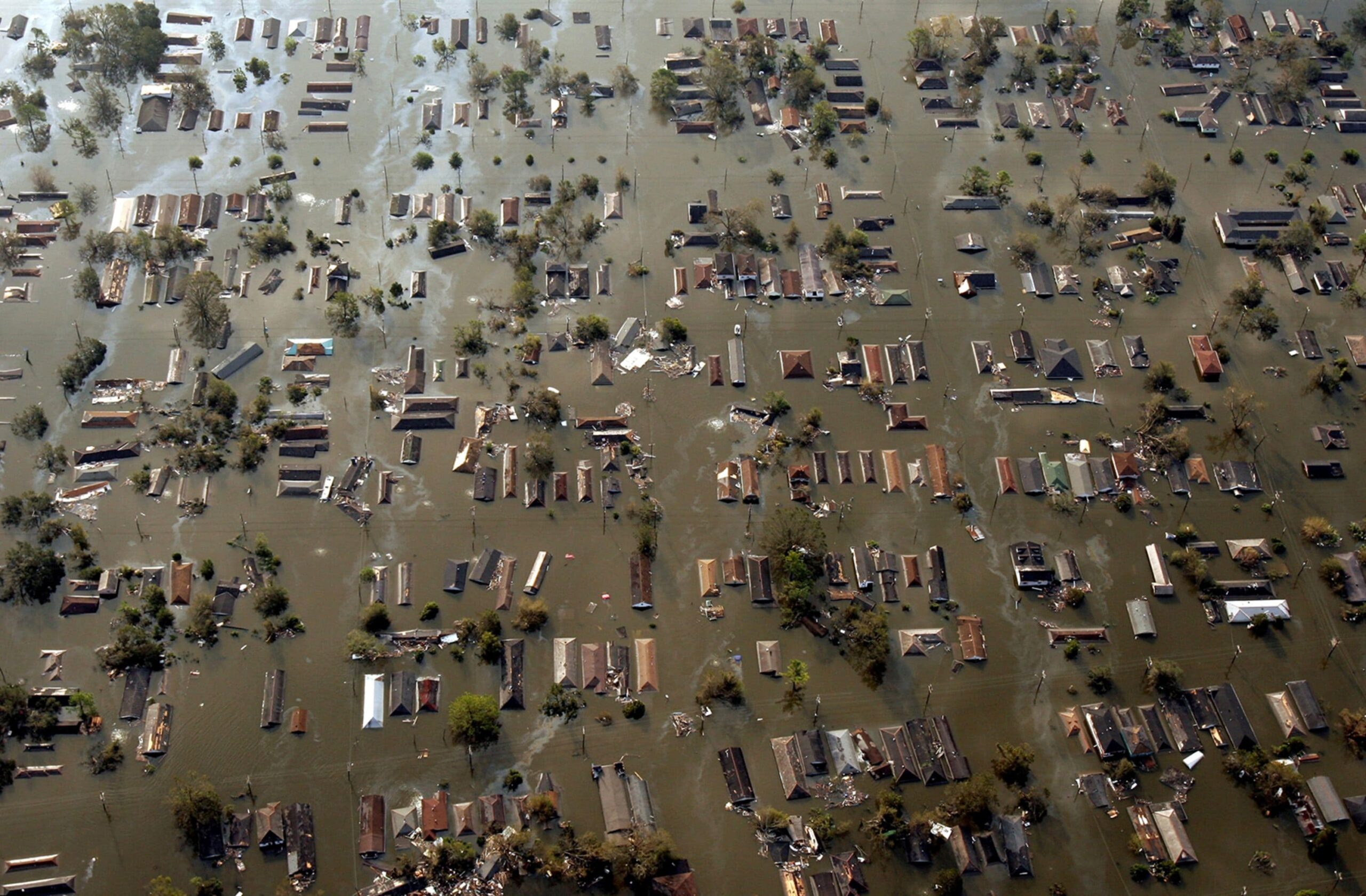
THE’hurricane katrinawho hit Florida, Louisiana, Mississippi and Alabama in late August 2005, was themore destructive hurricane ever recorded And the most expensive natural disaster in the history of the United States. Even if it has not been the most violent ever observed (the primacy goes to the 1980 Eragano Allen) nor the one that caused the most ascertained victims, is the hurricane that caused more damage, with a budget of approximately 125 billion dollars of the time (over 200 billion current) and 1836 victims To which are added beyond 700 missing. The devastation caused by Katrina was such that this name cannot even be assigned to a hurricane: a real “perfect storm” which owes its destructive capacity to a series of nonsense Not only of a purely meteorological nature, but also engineering and social. Twenty years after the tragedy we retrace its meteorological history and its dramatic effects on the United States, in particular for the city of New Orleans.
Katrina’s weather history
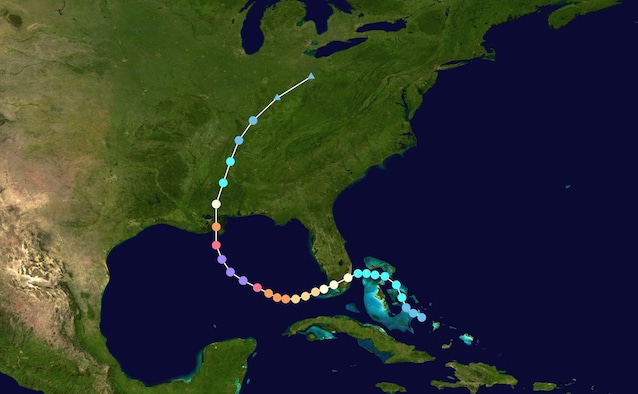
Like many hurricanes, the story of Katrina begins with one tropical depressionthat is, a low pressure area not yet organized with a rotation motorcycle and a “eye”, with twenty up to 63 km/h. Depression, formed off the coast of West Africa, reaches the conditions to evolve in Hurricane the August 23, 2005when it is located off the Bahamas about 560 km from the city of Miami.
The next day, August 24ththe speed of the winds “promoting” what was a tropical depression in one tropical stormthat is, a stormy system with twenty between 63 and 118 km/h. It is at this point that the disturbance officially takes the name Katrine.
As he heads west in the direction of the Florida coast, Katrina continues to grow also fueled by the Gulf current, and the August 25th is classified as category hurricane 1 Just two hours before his first meeting with the mainland, in the southern tip of Florida. Incidentally, the “categories” of the hurricanes refer to the SAFFIR-SMPSON scale On the intensity of tropical cyclones: in category 1, which is the lowest, hurricanes are included whose winds go from 119 and 153 km/h.
But the worst is destined to arrive starting from August 26thafter the Landfall In Florida, when Katrina enters the Gulf of Mexico. Here the high temperature of the water acts as a fuel that feeds the oragan engine: the August 27th Katrina reaches the Category 3 (twenty between 178 and 208 km/h) and the August 28th there Category 5the maximum of the Saffir-Socson scale with twenty over 252 km/h: qui twenty of Katrina have reached a maximum of 278 km/h.
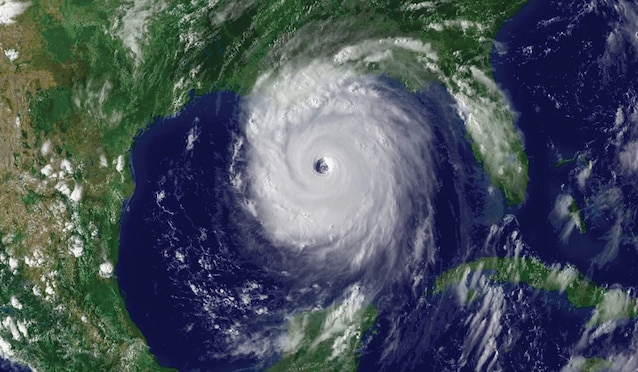
It is at this point that the hurricane deflects north, driven by atmospheric currents. Fortunately, in the Gulf of Northern Mexico The waters are colder Even 1 ° C compared to the rest of the gulf: it is as if the flow of fuel in the engine decreases, thus weakening the fury of Katrina. The winds go down to a maximum 205 km/hbringing Katrina to Uragano of Category 3. This weakening is a fortune, because Katrina is about to reach Earth again. At 4:10 in the morning of August 29th The hurricane breaks out on the coasts of Louisiana and Mississippi, with a new one Landfall to Burassmall town 100 km south of New Orleans.
The most populous city of Louisiana and its 400,000 inhabitants are almost on the trajectory of what at the time was the third most violent hurricane to hit the United States coast. And it is here that Katrina brings her more devastating effects. Once the soil is reached, without the “fuel” represented by the water, the hurricane slowly turns off in about 15 hours before being Tropic storm down Having already traveled about 240 km inland of the state of Mississippi. The disturbance continues to end completely almost at the gates of the large lakes.
The damage produced from the Hurricane to New Orleans
When a violent hurricane strikes a coast, the last thing you would like is that on that coast there is a populous city whose surface is located 80% below the sea level. Yet this was precisely the situation at the time of Katrina’s entry into the east coast of the USA: the metropolitan area of New Orleans It stands in fact in one Natural depression of the soil located between the Atlantic Ocean and the Pontchartrain lake, protected by both sides thanks to Argini about 7 meters high.
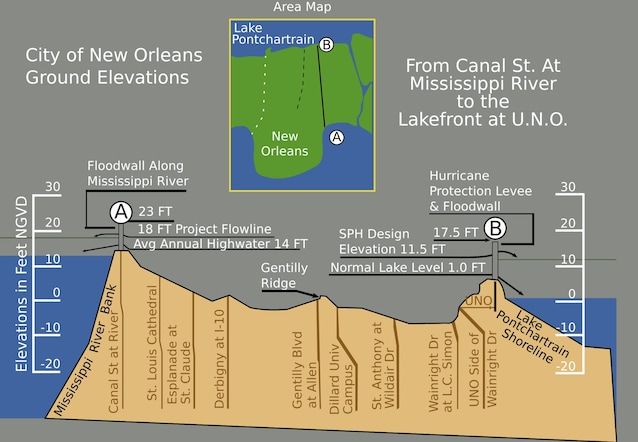
This particular circumstance was fatal for the city. A strong hurricane can in fact produce the so -called Storm wavesa phenomenon for which the strong winds and low atmospheric pressure have as its effect a significant raising of sea level. From a physical point of view, in fact, low pressure means precisely this: the atmosphere offers a pushing down weakest to the surface of the water, which is therefore freer to rise for the action of the intense winds.
Well, the storm wave produced by Katrina was exceptional, also because Katrina’s trajectory was almost perpendicular to the coast. We are talking about theStorm wave higher ever recorded in the USAwith a height that also reached the 8.5 metersmore than enough to break through the arguments of New Orleans and allow the Atlantic to invade the city. To this must be added the approximately 25 centimeters of rain who rushed to the city.
The consequences were devastating: The banks broke in 53 points el ‘80% of the New Orleans metropolitan area was violently flooded. This did not only happen in New Orleans, but on all the coasts of Louisiana, Mississippi and Alabama. The water penetrated until 10 km inland. In short, Katrina’s damage did not come directly from the winds, but from their effect on the sea level.
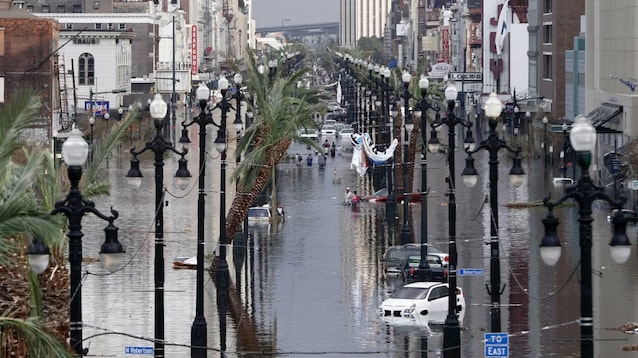
New Orleans, however, was the main victim of the disaster. On the whole area there was an evacuation order, which took away from their homes 1.2 million peoplebut in tens of thousands of not abandoning the city, by their will or because the evacuation operations – according to different critical voices – took place too slowly. The result was that Over 1200 people died drowned during the flood In New Orleans alone: about two third thirds of the total victims of the hurricane, not to mention the hundreds of bodies that were never found.
After the disaster, The water remained on the city for 43 daysuntil 11 October, making it difficult for access to basic necessities such as drinking water, food and shelter during the first few days. The National Guard intervened to distribute water and food only on September 2nd. In the meantime, the bacteria contained in the waters that had invaded New Orleans created anHealth emergency among the population.
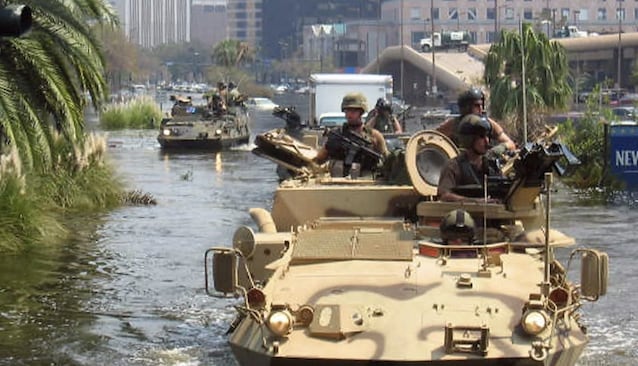
Countless buildings were destroyed: about a million people remained homeless and were forced to move. The New Orleans alone lost about the 30% of its population. And the damage would have been far worse if the city had found itself right along the trajectory of the Hurricane.
