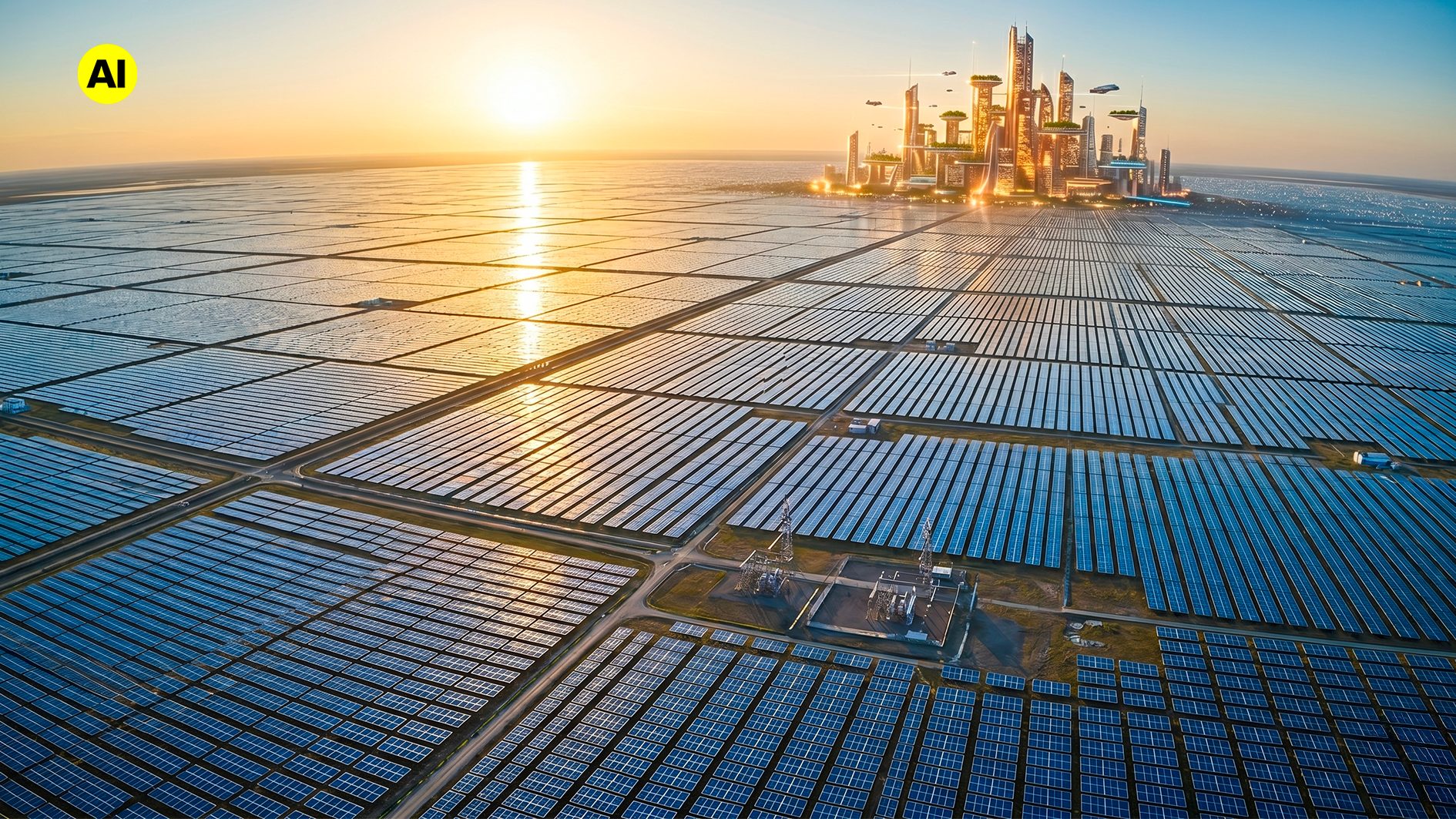
Imagine covering the entire area occupied by the city of Paris with photovoltaic panels. This is one of the Indian government’s most ambitious projects: to achieve an annual production of well 5GW of clean electricity by 2030 with 110 km² of solar panels. The chosen location is part of the Dholera Special Investment Region (DSIR)an industrial area where a technological “smart city” will be built in the Ahmedabad district, in Gujarat.
Unprecedented dimensions
A total of 11,000 hectares entirely covered with photovoltaic panels. This is what the Indian government has decided to do, in order to ensure an annual production of well 5 GW of clean energy to the Indian population. In this mega project, the main engineering challenge that the designers found themselves facing was, without a doubt, managing the transmission of such a large amount of energy without excessive losses along the cables.
The geophysical characteristics of the area also represented an important challenge, which required the designers to adopt interesting engineering solutions. The Dholera area is located in Gulf of Khambhat, an area characterized by muddy soils, salt marshes and frequent flooding during the monsoons.
Unlike solar farms in rocky deserts, on this project engineers had to design mounting systems that could withstand the extreme salt corrosion. The support structures of the photovoltaic panels are then treated with hot galvanizing reinforced to prevent the salt from crumbling in a few years.
To anchor the panels to the muddy ground, a series of poles were used, driven at specific depths in order to avoid “lifting” or sinking during the rainy seasons.
How the system works: high efficiency technology
Dholera is, without a doubt, and rightly so, a real testing ground for the latest technological solutions in the field of photovoltaic panels. In this sense, in fact, many of the sections used use bifacial panels capable of capturing not only direct solar energy, but also that reflected from the ground. This is because, from a chromatic point of view, the ground is characterized by light shades, and therefore capable of reflecting a lot of light, with a drastic increase in the electrical energy produced.
To maximize exposure, the panels rotate following the sun’s path from east to west. Another problem that the designers have solved is undoubtedly that of dust. In fact, it must be said that, thanks to the dust which is certainly present in large quantities in desert areas, there is a risk of a reduction in efficiency of at least 25-30% after just a few days of cleaning. In order to solve the problem, therefore, the designers decided to make the cleaning operations of the panels completely mechanical, with the use of terrestrial drones. In fact, these drones slide over the panels during the night and, using micro fiber brushes and ultrasonic vibrations, are able to remove accumulated dirt.
The economic impact
Posted in Dholera Special Investment Region (DSIR)this project is conceived as the engine that will power the country’s first true industrial “smart city”, this project does not only concern the production of electricity, but is part of a broader, and certainly deeper, transformation of India’s industry.
The project has indeed already attracted well 250 billion rupees of investments, approximately 3 billion dollars. In this sense, companies like Tata Power And Gujarat Urja Vikas Nigam have already chosen to establish their industrial plants in the area, attracted by the possibility of drawing on clean and constant electricity.
Another great economic advantage induced by the realization of this mega project is that relating to the creation of jobs. It is estimated that the entire Dholera ecosystem will create further 20,000 direct jobs and induced. It’s not just about panel maintenance, but about research and development, smart grid management and AI monitoring of energy production.
