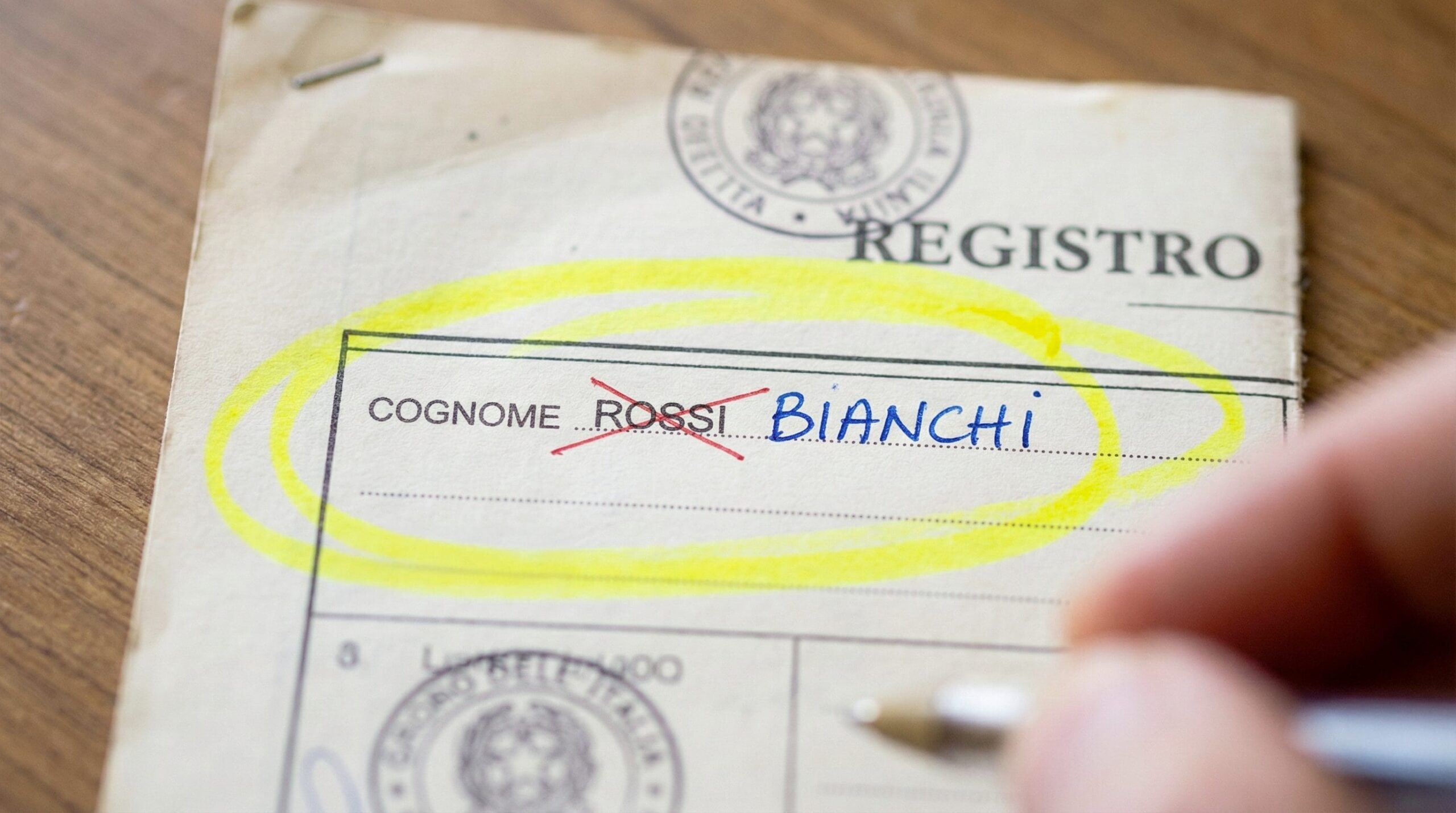
In the last few hours the topic of the change surname, after three brothers from Rimini requested and obtained the possibility of change the paternal surname (replacing it with that of the mother) because it is considered embarrassing and cause for ridicule. But in Italy can it really be done? Well yes, the legislation allows holders of Italian citizenship to change their personal details (therefore both names and surnames), as long as there are reasons “objectively relevant”.
In no case, however, can one’s surname be changed by attributing surnames of historical importance or linked to particularly illustrious or well-known families.
From 2022, among other things, newborns can receive the double surname (the maternal one and the paternal one), after a sentence of the Constitutional Court declared the automatic attribution of the father’s surname is unconstitutional.
How the procedure for changing your surname works and the reasons
First of all, it should be specified that an Italian citizen can request to change his surname – or to add another one to his own – only in the presence of objectively relevant situations and valid and significant reasons. This is the case, for example, of:
- Potentially embarrassing last names: it is the case in which the current surname may be embarrassing, offensive or reveals the natural origin (for example in the case of children of unknown parents).
- Emotional or family reasons: in fact, it is possible to request the change or addition of another surname (for example, the maternal one or that of the person who raised the applicant) if there are emotional, family or social reasons of particular importance, which must be supported by adequate documentation.
Among the requirements, clearly, there is also the obligation to possess citizenship Italian: in no case, however, can the attribution of surnames of historical importance or which could mislead one into believing that the applicant belongs to illustrious or particularly well-known families be requested.
At this point, the applicant will have to submit therequest, which must be authorized by the Prefect of the province of residence or birth: in the event of a positive outcome, the citizen will have to have a notice of his request to change his surname posted on the notice board of the municipality of birth and of residence for 30 consecutive days. The aim is to allow anyone who is interested to oppose the change of surname.
If no one objects, then the Prefect will thus sign the decree which authorizes the new surname, which will not come into force automatically, but only after transcription into the official registers.
What has changed in Italy with the introduction of the double surname
Among other things, the issue of the surname has returned to the center of Italian attention after a ruling from the Constitutional Court in 2022 established the unconstitutionality of the automatic attribution of the paternal surname to children, thus introducing the possibility of giving the double surname for newborns.
In practice, therefore, children born after 1 June 2022 can have both the father’s and mother’s surnames: parents can, however, decide to give their son or daughter only one of the two surnames, while in the case of a double surname the order must be decided by both in a manner consensual.
According to the latest ISTAT report on birth rate and fertility of the resident population, approximately 7% of newborns in Italy have acquired a double surname, a figure that has almost tripled compared to 2020, when the share stopped at 2%. Several interesting data emerge from the analysis: double surname is more common in Northern and Central Italy (8%) than in the South (6%), it is more frequent among firstborns (9.2%) compared to second (4.7%) and third – or subsequent – children (3%) and is adopted much more by unmoved pairs (8.5%) compared to those married (5.3%).
