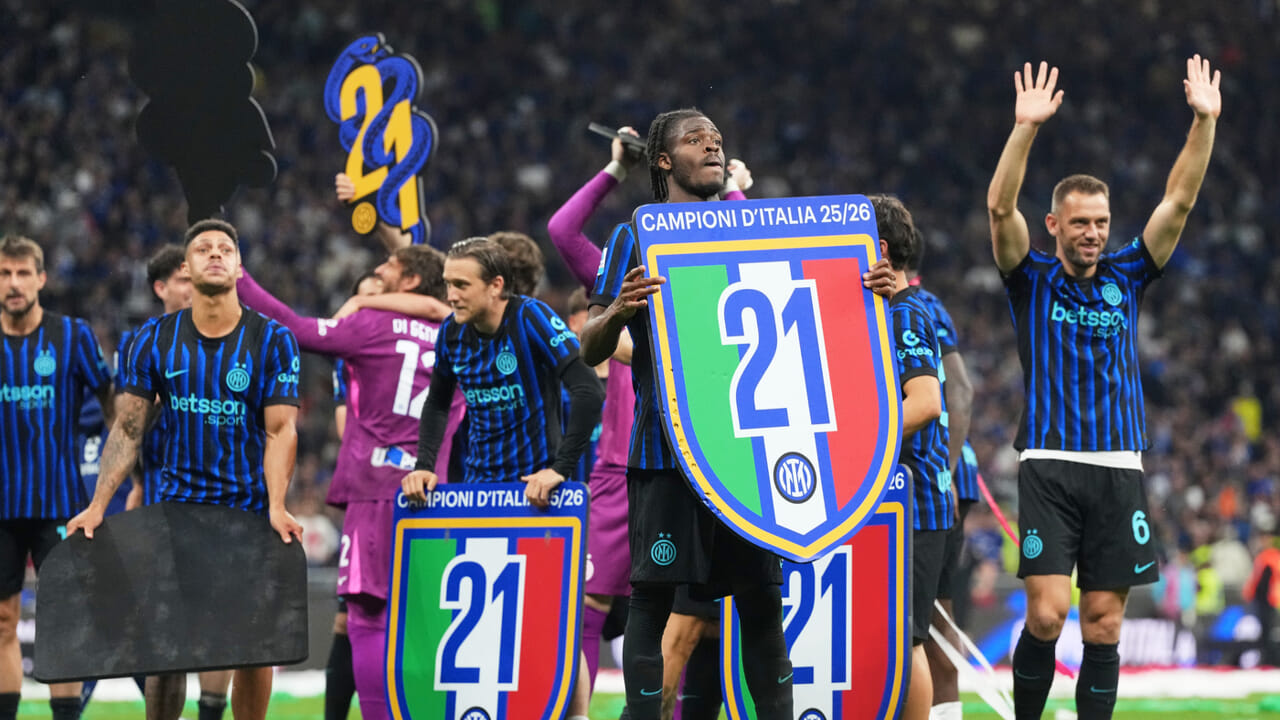
The numbers that no one reads about the Inter scudetto (and that “capped trophy”)
Let’s start with a fact that no one wants to put at the center of the party. Bodø/Glimt, the Norwegian team that eliminated Inter from the Champions League in February, would not even have reached safety in Italy. In the group stage of the most important cup the flashes, this means Glimt, had finished with nine points from eight games: an average of less than a point per game, qualifying for the playoffs just right, from the bottom of the grid. Yet they beat the Italian champions in both matches: 3-1 in Norway, 2-1 at San Siro. Even with relative comfort, without Inter ever really seeming capable of reversing the result.
Why analyze the championship from here, from a defeat in another competition? Because it is precisely that double defeat that is the true document of this season. Not the 2-0 against Parma which mathematically and with full merit delivered the twenty-first championship to Chivu’s team. Not the twelve points gap over Napoli, not the 82 goals scored, not Dimarco’s records. Unfortunately, Bodø/Glimt is the mirror not only of Inter, but of Italian football, the one we would never want to see, the reflected image that we refuse to recognise: especially at the time of celebration.
Inter and the Italian capped trophy
Inter won a real, deserved scudetto, built with continuity and tactical intelligence by a coach – Cristian Chivu – who was greeted with great distrust at Inter (“They only want it because it’s cheap” wrote the Nerazzurri fans on the Curva forums at the beginning of the season), going on to take the title with a team that everyone thought was finished after the Champions League final lost 5-0 against PSG. A victory that is worth a lot, at least in Italy, and which is not in question also considering the potential double of the Italian Cup.
If anything, the value of the championship in which that result was obtained is in question. They are two different things, and confusing them is the mistake that Italian football regularly makes every time someone lifts a trophy.
What Inter won is called, for lack of a better term, a capped trophy. A trophy with a built-in ceiling. Win what the system allows you, not what you could win under different conditions. It’s a subtle but crucial distinction, and the numbers make it brutally clear.
A smaller championship
Inter dominated Serie A, winning only one match out of six in direct clashes with Napoli, Milan and Juventus and losing both derbies. He built his advantage – twelve points at the moment, we’ll see how many there will be in the end – by systematically beating the middle and lower ranking teams, the ones he never lost against. A legitimate strategy, it’s what great teams do when they understand where and when they can make a difference. But that also says something about the level of those mid- and low-ranking teams: low enough to allow a team that struggles in head-to-head matches to win the championship with three matchdays to spare and a twelve-point margin.
Como could finish fourth. Como promoted to Serie A two years ago, led by Cesc Fàbregas with an Indonesian ownership that brought fresh money and modern ideas: “The only team that could play in the Premiership without making a fool of itself”, says a serious analyst listed among insiders as Ted Knutson. A good story, for goodness sake. But Como fourth in Serie A is also the snapshot of a championship in which the average rate of competitiveness has dropped to the point that a newly promoted team with ambitions, funds but only two Italians in the squad can place itself ahead of Juventus, Atalanta, Fiorentina and Roma. And no one is scandalized by it, because in Italy we have become accustomed to reading Serie A as if it were always the same. It isn’t anymore. Serie A has contracted.
Inter’s goal difference at the end of the season reads +51 in thirty-eight games. It would be a number for absolute domination, for a championship won without handbrake. And in fact it is like this: Inter scored 82 goals, over 20 more than the second best attack ever, which is that of Como. In a competitive championship, with stronger teams on average, that gap shouldn’t exist. And yet it is the reality of this Serie A.
The numbers that no one reads aloud
The Premier League distributes 9.55 billion euros in revenues to its twenty clubs. Serie A’s share is worth less than half: 4.04 billion. West Ham, who are third from last and risk relegation, earn much, much more from television rights alone than Italian champions Inter. This sentence should be read twice, slowly: even while uncorking the sparkling wine for the championship.
Serie A television rights are worth 900 million euros a year. Here too the Premier League is worth more than double: 1.91 billion. The Bundesliga 1.06 billion. Italy is also fourth behind Spain, hot on the heels of France who is about to overtake them. In a market that decides who can afford the best players, who can build deep squads, who can sustain the double championship-cup commitment without collapsing in February. And it is not a distance that can be recovered with a good summer transfer market or with a better coach. It is now a congenital and structural gap, it widens every year, and none of the reforms discussed in the last ten years – including the eternally blocked reform that Gravina bequeathed as the seventeenth draft never approved – has affected it by an inch. A reform which is otherwise inadequate and already old because our football is experiencing a dramatic contraction.
Winning the Serie A scudetto is worth around 61.5 million additional TV rights compared to second place. It is a figure that seems important until you compare it with what Inter lost after being eliminated from the Champions League playoffs: between missed UEFA prizes and lost stadium revenue, Football and Finance he says between 20 and 30 million euros. And therefore, in summary, one more match in the Champions League is worth almost as much as going up three positions in the league. The hierarchy of economic priorities is there, written in the numbers, and tells us that winning Serie A is less important – financially – than reaching the quarter-finals of the Champions League. Inter did the opposite. They dominated in Italy and went out in the Champions League playoffs against Bodø/Glimt. An excellent season at home but one to forget in Europe. A capped trophy, which will end up costing us dearly and forcing Inter ownership, more interested in making ends meet than in making the team competitive, to cut costs and maximize revenues.
The ranking that doesn’t lie
Italy ends this European season without any team in the noble stages of any European cup. With Inter, Napoli eliminated in the Champions League group stage. Juventus out of the playoffs with Galatasaray. Atalanta kicked out of the playoffs by Borussia Dortmund. Bologna and Roma out of the Europa League like Fiorentina in the Conference. In the seasonal UEFA ranking by nations, Italy finished with 19,000 points, fourth, behind England (26,569), Spain (21,405) and Germany (21,214). The practical consequence is that in the next Champions League Serie A will once again have four representatives instead of five – the fifth place achieved two years ago thanks to Gasperini’s Atalanta and Fiorentina is already a memory. In Europe exploits don’t count, what is needed is continuity of which our shrinking football seems incapable.
It is worth remembering that the UEFA ranking is calculated on the basis of five seasons. What we are accumulating now – or rather, what we are not accumulating – will also weigh on us for the next four years. Every early elimination is not just a sporting disappointment: it is a point that is not counted, one less place in future cups. And therefore less money for the clubs, more difficulty in competing in Europe. A vicious circle that is not a metaphor but the only real mechanism on which Italian football has been screwed in the last ten years.
The Marotta paradox
There is a character who runs through this season with a very evident consistency. Beppe Marotta, president of Inter – the man who is orchestrating Giovanni Malagò’s candidacy for the presidency of the FIGC – implements his sporting policy with the concreteness of someone who knows that this is how Italian football is governed. He is also the man who leads the strongest club in Italy, the one that has won three championships in six years with three different coaches. But he is the same man whose club was eliminated by Bodø/Glimt in front of a half-empty San Siro, on an evening in which Inter never really seemed to believe they could overturn the 3-1 deficit from the first leg. Obviously the first one who celebrated yesterday by saying: “Good, but we will have to do better in Europe”.
Marotta is the perfect symbol of Italian football in 2026: dominant at home, irrelevant away. Very powerful in the Roman buildings where it is decided who will lead the FIGC, powerless in front of eleven Norwegians who press high and run faster. This is not a personal criticism – Marotta is probably the most capable manager that Italian football has at the moment. Indeed, he is the only one to have understood how to navigate in shallow water, making it his only possible strong point.
The criticism is of the system: the best one we have produces results that are not enough in Europe. And in the meantime he deals with federal presidencies.
What to celebrate, what not
Inter won deservedly. Chivu did an amazing job taking a traumatized team and turning them into a goal machine. Dimarco rewrote the absolute record for assists in a Serie A season. Lautaro Martinez confirmed that he is one of the best attackers in the world in the perimeter where he is allowed to demonstrate it, proving himself to be a leader, capable of transforming the team also in terms of assists and supports.
Zielinski reinvented himself, Calhanoglu proved wrong those who thought he was finished, Akanji raised the level of the defense, proving himself to be the best in the role on his debut. There is therefore much to celebrate, and it would be dishonest not to.
But celebrating the scudetto without celebrating the championship is not contradictory: it is honest. The 2026 Serie A is a tournament in which the strongest team dominates with twelve points behind despite losing most of the direct matches, in which a newly promoted team could finish fourth, in which no club has reached the decisive phase of any European cup, in which television rights are worth less than half of those in England and almost the same amount as those in Germany, in which seventeen out of twenty clubs have net capital in the negative axis. Not to mention the foreign ownership, including funds, which make all the monitored clubs special when faced with bills that don’t add up and won’t add up for a long time.
Inter hit the ceiling by winning with authority, with merit, during a season that will remain in the club’s annals. But the ceiling is dramatically low. And lowering your head to get under it, as we have been doing for years, is not a strategy. It’s a surrender.
