The Trump administration he asked to the European Union and, in particular to Germany and France, of unlock from the stocks strategies of diesel to contain the global price of fuel. Alternatively, according to sources cited by Reuters, the US would apply a ban on the export of diesel fuel lasting 90 daysin an effort to reduce the cost of fuel in the United States ahead of November’s midterm elections, which are crucial for President Donald Trump’s Republican Party.
A move, which sounded almost like an ultimatum, which immediately set the European diplomatic machine in motion to find a common position: more specifically, the request would be to release 120 million barrels of diesel reserve over the next six months. The point is that Europe has become more and more dependent from US oil exports, after strong restrictions on Russian oil (as a sanction for the Russia-Ukraine war) and the collapse of imports from Middle Eastern countries following the blockade of Strait of Hormuz.
In particular, the EU matters about the 97% of the crude oil it consumes. According to the latest data provided by the Council of the EU (and referring to 2025), the Union has acquired approximately 435 million tons of crude oil for a value exceeding 212 billion euros. And the top three suppliers were, not surprisingly, the United States (14.6% of total imports), the Kazakhstan (12.8%) and the Norway (12.8%).
An extremely different picture compared to a few years ago, when the Russia covered the 25.8% of European imports: it was the Americans who filled the void left by Moscow, who almost doubled their exports to the EU (from 37.1 to 63.5 million of tons between 2021 and 2025).
The US government’s request, however, does not concern crude oil in general, but the dieselthat is, a already refined product. And this is where the dependence European Union from the United States becomes even more more marked. According to data from the analysis company Kpler reported by Euronews, the USA today supplies approximately 180,000 barrels per day of diesel to the EUon a total of approx 580,000 barrels per day imported from countries outside the 27 bloc. Let’s talk about the 32% of European diesel importsalmost double the 17% in 2025, and in north-western Europe the percentage even rises to 57%.
According to the position of Washington, France and Germany they would not have fully complied the commitments undertaken last March (after the outbreak of the US-Israeli and Iranian war and the closure of Hormuz) when the International Energy Agency (IEA) established the coordinated release of emergency supplies equal to approximately 400 million barrels (of which 172 million from the USA and approximately 20% from the EU).
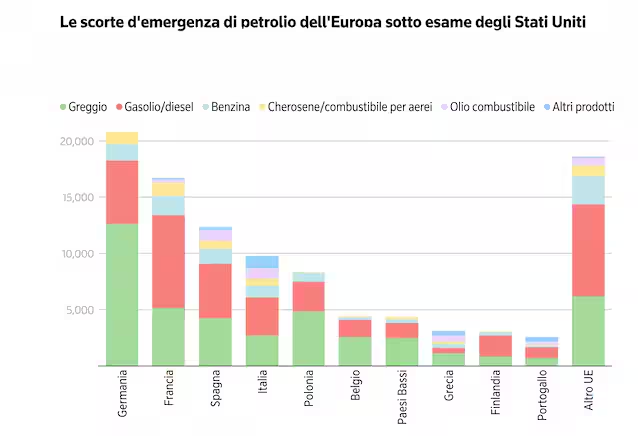
The request directed mainly to Paris and Berlin, however, is not accidental: the two states they hold together about the 35% of the strategic diesel reserves of the entire EU (respectively approx 8.2 million tons France e 5.6 million Germany). As of May 2025, EU countries held a total of 108.6 million tonnes of emergency oil stocks, of which approximately 39 million tonnes were diesel.
Over the last year, i prices of diesel I am in Italy increased than 40%: diesel, in fact, being an already refined product, is particularly sensitive to what happens along the supply chain, especially when refining and transport become complicated. Even in the United States, in reality, diesel has passed in some cases $7 a gallon (around 1.64 euros per litre, last year 3.74 dollars per gallon) and the price of Brent has fluctuated between 97 and 102 dollars per barrel since the end of September. And these increases weigh on theAmerican electorate who, as anticipated, will go to the polls next November for the mid-term elections and express his opinion on the work of the Republican Party in Congress.
Generally speaking, France risks being the most exposed country: again according to data provided by Kpler, the State imports approximately 63,000 barrels per day of diesel (36% of its diesel imports), and the shutdown of the Grandpuits and Donges refineries has left it structurally deficient. The United Kingdom depends on American supplies for 26% of diesel imports, Spain for 19%. Italyinstead, it matters about the 4% of the total.
It must be said, however, that diesel is among the most stored petroleum products in Europe and all IEA countries are required to hold a minimum oil supply equal to at least 90 days of net oil imports (or 61 days of consumption), with the reserves being in the form of either crude oil or refined products.
This means that even in case of a stop or a restriction on US exports, if any diesel shortage would not be immediate, but it would force Europe to quickly look for alternative supplies in a market already under pressure, with the risk of further price increases. The news then triggered an immediate response from EU leaders, with the European Commission already holding a meeting with Germany, France, Italy, Ireland and the UK to discuss the possible need for a stockpile release.
