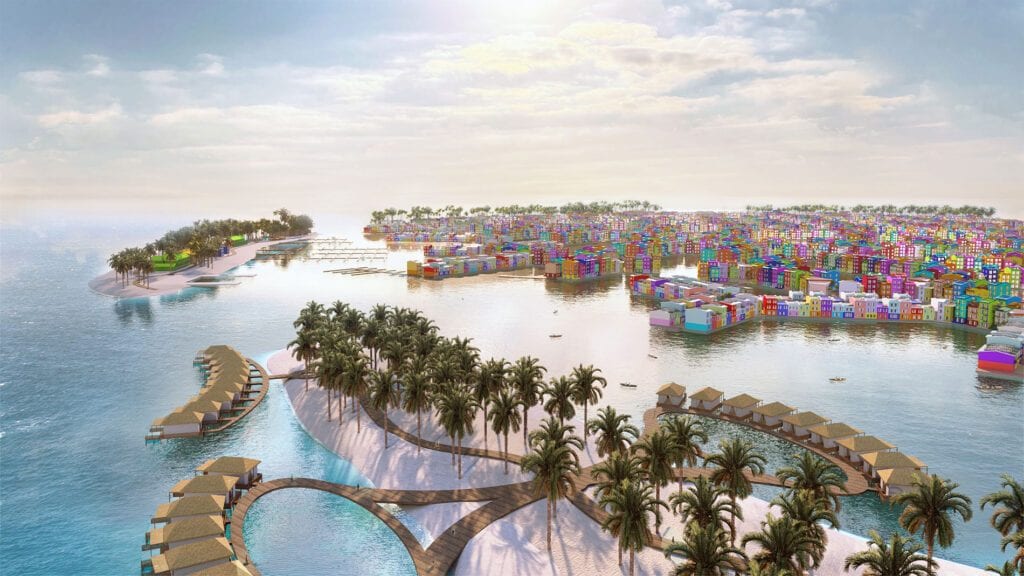
The Maldives Floating City It is a project developed by Dutch docklands Together with the architect Koen Olduis and consists of one island made in an atoll near the capital of the Maldives, Spite. The city will have a form that recalls that of a coral And the intent is to give a tangible response to the raising of the seas and the demographic density of the city, offering 5,000 luxury housing unitsfor a total of 20,000/30,000 inhabitants. The project is obviously not exempt from both environmental and economic criticisms.
The characteristics of the maxi-project in the Maldives
The maxi-project will be composed of the set of multiple modules, many of which will be housing. Each of these will have an area of approx 100 m2with a further area of 40-50 m2 intended for private green. Each module will be equipped with 2-3 bedrooms, with open space living rooms, kitchen and bathroom, to which will be added a veranda on the sea, to allow those who will live there enjoying the beauty of the Maldive sea at any time of the day.
According to market forecasts, the price for each housing unit will be around 250,000 dollars for basic real estate units, up to 1 million and a half dollars For the largest and best finished ones.
As for the floating surface, however, each module will extend under water for about 1.5-2 meters, while 300/400 square meters will be intended for areas of public utility (squares, parks, places of aggregation in general).
The modules, then, will be spaced together by “channels” of water, with a width that varies from 4 to 8 meters, sufficient to allow the movement of small boats. One of the primary advantages of the hexagonal module, also used in other floating cities projects, is the possibility of being able to connect them with others without leaving “empty spaces” and having a very large total contact and connection surface.

From an energy point of view, sustainability will be guaranteed by the massive use of solar panelssea energy cooling (a technology that uses the wave to produce electricity) and natural ventilation.
The latter technologies will also be used in the design of other subsequent modules, more or less wide according to the needs, and intended for commercial establishments, to the educational ones (with schools and university research workshops) and to the agricultural modules, on which hydroponical crops will arise.
Innovative and sustainable materials
One of the most interesting things in Malding Floating City is the design: The particular lines of the project find inspiration in the brain corala particular type of coral (in reality a family of corals) who recalls precisely the shape and lines of the human brain. Innovation will also concern the choice of materials, such as Biorock, also said Seacrete.
The technology through which it is possible to produce this material from properties similar to those of cement It is really interesting: first of all, a metal wire in the waterwhose direction is chosen on the basis of what you want to “build” and form. A continuous current is then passed on this thread, which involves the precipitation of minerals which are already present in themarine environment (mainly football and magnesium hydroxide). The rhythms are certainly not very fast: we are talking about about 3-5 cm per year. It attracts a remarkable marine biodiversity – hard and softcars, sponges, tunicas, bivalves, young fish and crustaceans.

Another interesting material that will be used is the so -called Concrete epic floating (innovative floating concrete). This type of concrete has been specially designed to be used in marine ecosystems. From a structural point of view it is certainly a safe and stable materialnot toxic, and designed to encourage the colonization of submarine ecosystems.
Costs and times of realization
As regards the costs of carrying out this project, organizations and the government estimated a cost of 1 billion dollars For the realization of the first 5,000 units, together with the central infrastructures of greatest importance. Funding will come mostly thanks to public-private partnership between the Maldive government and Dutch docklands.
In the project There are no environmental reclamation works: If on the one hand this certainly involves great savings in economic terms, on the other it raises great doubts about the possible environmental impact of this work. Between the 2019 and the 2021 The first housing units have been authorized, as we have already explained, with a concession of 15 hectares of aquatic surface.
