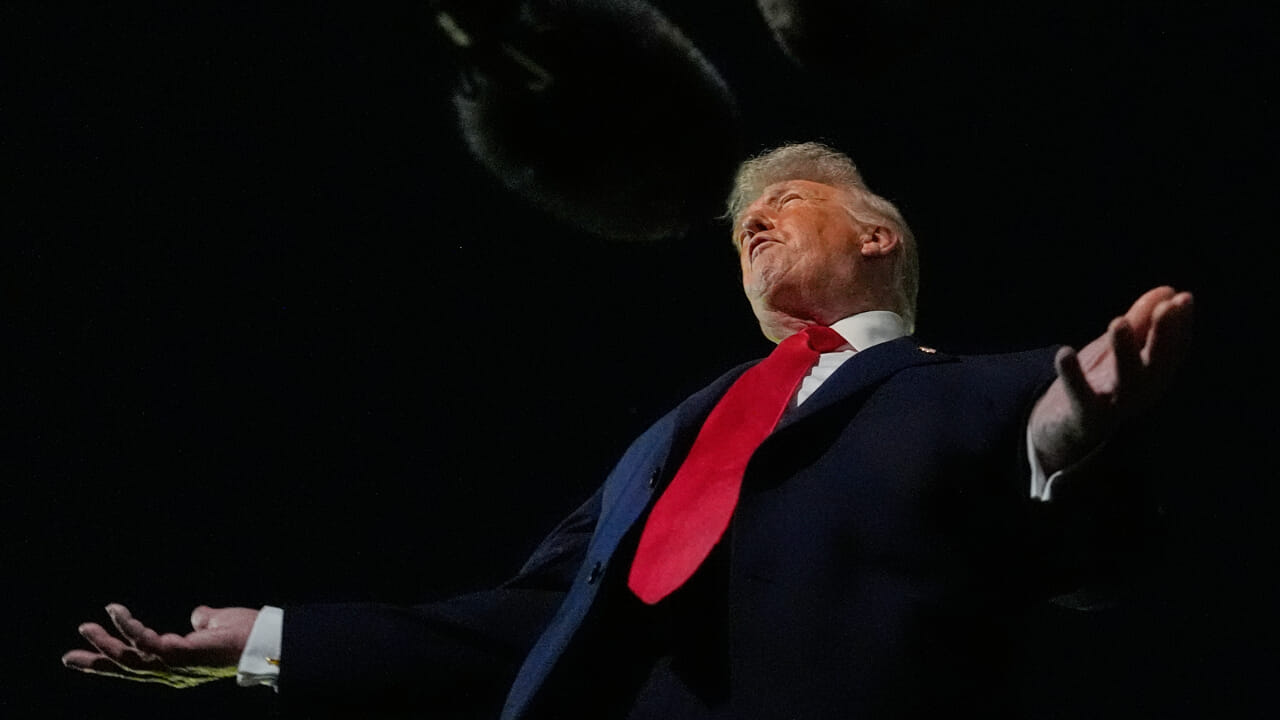
A year of Trump: allies and enemies, it’s the same for Washington
If, when Donald Trump was sworn in as the 47th president of the United States a year ago, someone had told us that today we would be here talking about the sending of troops from various European countries to Greenland to defend it from the USA, we would have thought him crazy. Just as if they had told us that, in recent months, Trump would have ordered raids against Iran without a truly triggering reason, attacked the presidential residence in Caracas, started a trade war with half the world… All without a prior vote of Congress, using “simple” executive orders. Yet all this has happened and who knows, the list may grow even longer, perhaps with much more serious consequences for us and for the world order.
Blame the ego
There are many explanations for the chaos that the US president contributed decisively to creating, often conflicting with each other. There are those who have seen a strategy in it, attempting to outline its salient elements; those who instead traced everything back to a psychological dimension (the very authoritative US analyst Ian Bremmer, for example, said that “geopolitics has nothing to do with it, it’s just the ego and old age to blame”); who has, between the lines, alluded to personal interests of Trump and his clan, overshadowing business with the Russians or in the bitcoin sector.
Be that as it may, the essence is that the world is profoundly different compared to a year ago. The first thing that catches our European eyes is the posture that the US president has towards the West and NATO itself. It almost seems that, for some time now, the administration has not made too many distinctions between allies and enemies (or former enemies?), considering them all in the same way: people on the other side of the fence, from whom America must guard itself. For us, accustomed to considering Americans as friends (the “good guys” in Western films), those who had freed us from Nazi-fascism, it is a sort of “betrayal” that is both undeniable and unexpected.
America Trump first
By putting the MAGA (“America first”) mantra into practice, Trump has effectively dug a new furrow between the United States and the rest of the world, with the Europeans playing the part of the “rest of the world” no more and no less than Russia, Saudi Arabia or India. There is no longer an idea of shared values with that large community that we generically identified with the term “West” (freedom, democracy, economic initiative…), but only the willingness to consider the possibility of doing business together: business which, in the end, must produce an immediate profit for the United States – and for companies close to the president. Singular, for example, is the claim to collect a billion dollars from every single country that intends to sit on the board for Gaza, as if we were at an electoral finance dinner.
The practical consequences of this new “isolationism” are the weakening of transatlantic relations (there are those who foreshadow the beginning of the end of NATO, and already in 2019 Macron defined it as “brain dead”), the abandonment of Europe to its own destiny and the progressive withdrawal – or, better, the growing concentration – in the sphere of influence of excellence of the United States, their home garden: the American continent. For the geopolitics of the last hundred years, a triple leap.
Hence the crude and hasty clampdown on Venezuela, carried out without having too many scruples about stepping on the toes of that Putin whom Trump has never imposed sanctions on (unless there is a secret pact between the two: in exchange for the green light in Venezuela I will leave the field open to you in Ukraine); hence the sights on Panama, Canada and – obviously – Greenland. The Greenland story is almost grotesque (“it seems like a joke”, Minister Crosetto said with some reason) and gives a clear idea of a change in horizon, language and posture. In other eras (until Biden, including all his Republican predecessors) the United States would have done everything to make advantageous agreements, military and civil; now they have no hesitation in talking openly about acquisition, to be obtained by hook or by crook.
To what extent
At this point we have to ask ourselves how far Trump’s offensive can go. If it is a question of “ego and old age”, as Ian Bremmer says, one must think that the president will continue as long as he is allowed to do so: the ego is not destined to deflate and old age can only increase. In June Trump will turn 80, and will be the second oldest president in American history, behind Biden. If, however, there is some strategy involved, then several aspects need to be considered.
The polls are not going well, both on individual issues (for example the management of immigration, which has always been one of his strong points) and in the popularity index, which fluctuates around 40 percent (at the beginning of the second term it was around 50). The November elections in some important states (Virginia and New Jersey) went terribly for the Republicans. And extensive criticism also comes from various sectors of the Republican right, in particular on the Greenland case and more generally on the excessively aggressive posture of the new administration. No one will forget the glacial climate that the president found himself facing last September 30th in Quantico (Virginia), when he brought together for the first time hundreds of generals and high ranks of the army: people who had grown up with stars and the Atlantic Alliance, who had studied, trained and served in dozens of military bases in Europe, the Middle East or the Far East, and who suddenly found themselves faced with a completely new perspective.
Towards the midterms
They, like the most astute analysts even within the GOP, realize that the isolationism towards which Trump has turned may please the MAGA base which does not want to spend American dollars around the world, but believes that in the not too distant future it would end up backfiring on the interests of the United States. Abandoning Europe to itself would mean handing it over militarily to the Russians and commercially to the Chinese; and losing Europe means losing the Middle East and Israel. In short: a disaster that America – not even MAGA, not even that of Vance’s American Elegy, the rust belt that hates Europe – can afford.
In short, Europe will end up appearing to be a necessity not only to Europeans but to Americans themselves, at least those with more sense. There aren’t many: because, objectively, Americans are divided on many things but in their intolerance towards Europe they find a certain unity. But there is someone.
Will they be the ones to save us, the good ones, like they did 80 years ago? Maybe. However, there is no reason to be optimistic: we Europeans are once again giving a terrible performance. The double fracture – between the transatlantic architecture and that within Europe itself – seems too difficult a test to overcome, and when it comes to joining forces, to talking about common defence, everyone speaks a different language. The world is in flames and we still play with mutual vetoes, petty jokes, spite.
We can only hope for old Churchill, when he said that the worst crises are the ones that are wasted: and then maybe, from all this chaos, we will finally emerge as adults.
