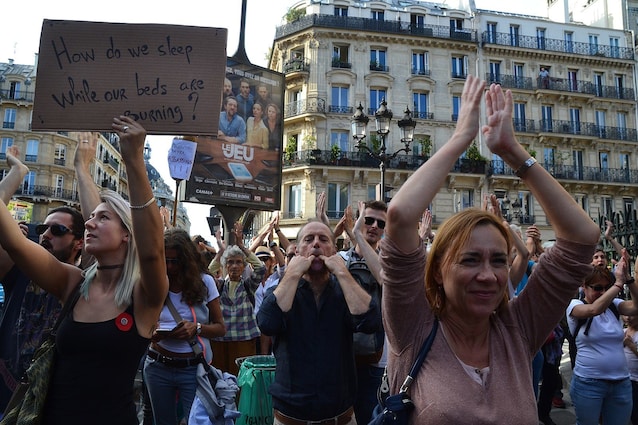
The French national assembly has the government disheartened led by the Prime Minister François Bayrouwho presented his resignation to the President of the Republic Emmanuel Macron. The vote of trust on Monday 8 September ended with 364 contrary votes194 in favor and the 15 abstentions. Bayrou is the third head of the government forced to leave his assignment in just over a year, after the predecessors Gabriel Attal And Michel Barnier. The foreseeable development and fall of the fragile French minority government (mainly linked to the financial law project for 2026) is only the last episode of an unprecedented crisis in the history of Fifth French Republicwhich now forces Macron to look for a new candidate without planning early elections, already excluded a priori by the president.
A fragmented parliament
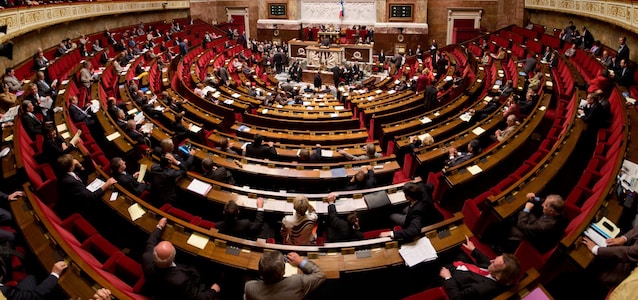
The Bayrou government was in office since 13 December 2024 and was supported by a coalition of parties formed by the Centrist Democratic Movement – often abbreviated in Modem – from that of President Macron Renaissance and by the Republicans (historic center -right party in profound acclaim crisis). Overall He could count on 210 parliamentarians out of 577relying from time to time to support the opposition parties to approve the individual laws on the agenda.
Here is the first element of instability of the current French political situation: theabsence of an absolute majority in Parliament since 2022. This parliamentary fragmentation makes it very difficult to approve divisive laws such as budget maneuvers. The vote of trust on Monday 8 September ended with 364 contrary votes194 in favor and the 15 abstentions: for the first time in the history of the fifth French Republic, a government has been disheartened.
To determine the defeat of Bayrou It was the compactness of the opposition, composed of the Rassemblement National Party of Marine Le Pen And Jordan Bardella And from the new popular front, the left alliance that brings together socialists, the France Insoumise, ecologists and communists.
An unpopular budget law
Bayrou’s fall is mainly linked to financial law project for 2026. The text included a cut in public spending from 44 billion euros to try to bring the accounts of the state under control.
The now former prime minister had tried to justify the sacrifices and austerity measures with tones at times catastrophic, speaking of a “dramatic” economic situation. To support these statements there is in fact the stress situation of the French public finances: at the end of the first quarter of 2025, in fact, the country debt was 113.9% of GDP (about 3,345 billion euros). For France it is a record percentage, which in the Eurozone is second only to those of Greece and Italy.
Also the state deficitthat is, the difference between revenue and exits, remains very high: 5.8% in 2024, almost double compared to the European limit of 3%. It must be said that, despite the alarmistic tones, the last balance of the budget for Paris dates back to 1974 and from that year the deficit grew constantly, with a surge due first to the pandemic emergency of the Covid-19 and then to the increase in the costs of the energy triggered by the Russian invasion war in Ukraine.
Despite the suspension of the deficit containment measures by the European Union during the Pandemic years, France is now under procedure for excessive deficit by Brussels for his inability to arrest excess expenditure, also continued at the end of the health emergency.
Spreads and debt costs
In a spiral that is self -altered, the tender of the French accounts has serious repercussions on French political stability, which in turn has a significant impact on public finance and the agility with which the country can obtain money on international markets.
By simplifying a lot, the more a country is perceived as unstable, the more investors ask for high interests to buy its government bonds. For this it is easier to understand why In 2025 rates on French ten -year titles reached levels similar to Italian oneshistorically risky. Even more alarming is the spread with the German bunds, which in 2024 ranged around 45 basis points and in recent months almost touched the 80. For France this is an absolute novelty, given that traditionally it was considered among the most reliable countries of the Eurozone. Now, however, it will be forced to pay higher interest to finance their debt, further aggravating public spending.
Despite the difficulties, many economists exclude extreme scenarios such as a commissioner by the Troika (the economic control body formed by the European Central Bank, International Monetary Fund and European Commission) as happened for Greece in 2015, threatened by Bayrou himself in one of his interventions. France for the moment It remains a country with great ability to attract investments And with a more solid economy than Athens of a decade ago. But the combination of high deficit and minority governments risks weakening its political weight and the ability to affect European decisions, given that Paris represents the second economy of the Eurozone and one of its most influential political actors.
Macron’s next moves
The distrust of Bayrou is also an indirect vote against the president Emmanuel Macron. The opposition parties have in fact accused the president of being the true head of instability, in some cases to ask for their resignation. However, Macron has categorically excluded this possibility, remembering that his mandate ends in 2027 (and that cannot be re -candidate, having reached the limit of the two mandates). For this, the next few weeks and the management of the after-Bayrou will be particularly delicate.
Macron doesn’t want to dissolve the national assembly and convene early electionsbecause the risk is to deliver the majority to an even more fragmented parliament, where the weight of the far -right party Racinganment National and the coalition of France Insoumise could grow, provided that it does not implode before any early elections. But finding a new prime minister will not be simple. The socialists ask for a head of government from their area, while France Insoumise and the Rassemblement National invoke elections as soon as possible. Macron is currently evaluating Three possible roads: the first is to appoint a new premier inside the its political areamaybe looking for a suitable candidate among the newly fallen government ministers. The second is to try an opening to center-leftlooking for a compromise with the socialists or with independent figures close to their political area. The third is to rely on a technical government In charge of voting the most urgent measures, including the approval of the Budget Law for 2026, for example by appointing the current governor of the Bank of France as Prime Minister François Villeroy de Galhau. None of the three options appears solid, a factor that in the coming months will further aggravate the difficulties of the French economy and public accounts.