
Punctual as every year is the meteoric swarm of the Perseids, the “tears” of the Night of San Lorenzo. Although traditionally the “falling stars” (they are not stars but small meteors) are associated with the night of San Lorenzo of 10 August, in reality the peak of weather activitywith tips of 100 meteors per hour, is scheduled for the Night between 12 and 13 August. There Perseus constellationthe radiant (celestial direction) from which the meteors seem to come, will reach the 30 degrees of height on the horizon Around midnight towards north-eastso it is from that hour that we advise you to look at the sky to see these fleeting objects. Did you know that there is a little Italy behind the Perseids? And that this year there will be two guests of honor during the peak of weather activity? In this article we see some together curiosity notes (and less known) on the celestial show of the year.
5 curiosities about the celestial show of the summer
How and when to observe the Perseids
The peak of the Perseids He falls this year in the Night between 12 and 13 Augustprecisely to 22.00 on 12 August According to astronomical calculations. The Perseids are Visible practically all night and essentially in every direction, although it is advisable to point the gaze towards north-east In the direction of origin of the swarm, the constellation of Perseus. The latter is low on the horizon at the beginning of the night, so the best time to enjoy the show goes from about midnight up to an hour before dawn. As with any celestial event, the first advice is to go to areas as much without possible light pollution and with free horizon, so as to maximize the possibilities of sighting. This year the advice is particularly important since the night between 12 and 13 August the moon will be illuminated at 90%thus making the luminous sky and preventing the sighting of the smaller and weaker meteors. The Perseids are absolutely visible to the naked eye and indeed it is strongly The use of binoculars or telescopes not recommended Because of their small field of view and the impossibility of following the meteors in the eyepiece given their high speed.
Because the night of San Lorenzo is not the best day to observe them
Traditionally, the Perseid Meteoric Swarm is associated with August 10, the day of San Lorenzo. The association has its roots in the Christian tradition: the martyr San Lorenzo is in fact celebrated on August 10 and the “shooting stars” were interpreted as tears paid during his martyrdom. Actually the August 10 is not the best night to observe themsince the Perseid Meteoric Swarm reaches his maximum activitywith peaks of 100 meteors per hour, between 11 and 13 August. Even more interesting is the observation that the Perseids are not limited only to days between 10 and 13 August, but they are actually active since much earlier. The Perseids in fact begin to appear in the sky, although with low frequency, already Starting from mid -Julythen continuing until the end of August.
The duration of this swarm is due to the mechanism behind the “falling stars”. Every year, between mid -July and late August, the land crosses the wake of debris left by the passage in the internal solar system of the Comet Swift-Tuttle. This trail of debris has an extension of Tens of millions of kmso several days are required of the earth to cross it in full. Furthermore, The trail does not always have the same density; Where the latter is greater, so it will be the frequency of meteor. The peak of the weather swarm therefore coincides with the region with the greater density of the wake of debris of the comet.
How the meteors are formed
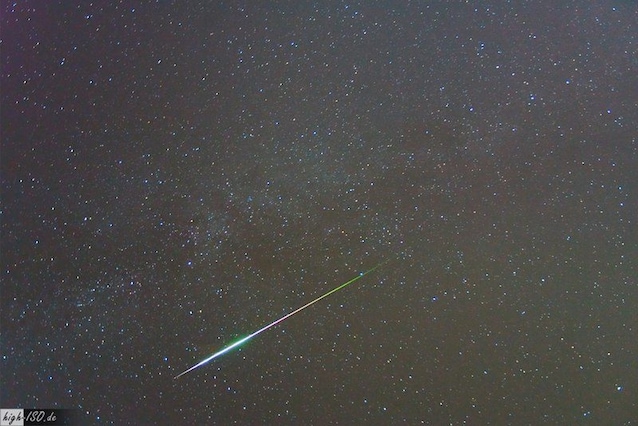
While they orbit around the sun, the comets they gradually lose material. The larger the comet, the more frequent it is its passage in the internal solar system, the greater the deposit of material along the orbit of the comet. The Swift-Tuttle comet has created one Band of debris millions of millions of km that the earth crosses every year. In doing so, debris of various sizes enter the atmosphere to the frightening speed of 260,000 km/h. THE’friction with air particles gene temperatures of the Order of 1700 degrees Centigradi, ionizing (snatching electrons) the surrounding air to form a sort of plasma Canaleso. This process usually begins around 100 km of altitude and then create the characteristic “shooting star” around 80 km in height. Most of the objects disintegrate, generating a more or less bright trail depending on the size of the meteor and only a tiny fraction manages to get to the ground in the form of meteorite. The luminous trail produced by Perseid can have different colors ranging from green to pink/violet. These colors are not casual but they are the “signature” of specific chemical elements present in the meteors: Green for magnesium, pink/violet for calcium. Unless the “shooting star” that furrows the sky is not a fireball, that is, a high brightness meteor with a pre-entrusted mass in the atmosphere of 100 kg, with the naked eye the typical Perseids will appear white.
It was an Italian to discover its origin
It was the Italian astronomer Giovanni Schiaparelli In the 1865 to discover the origin of the Perseid Meteoric Swarm. The astronomer of the Brera Observatory (Milan) was the first to notice the correlation between the orbital elements of this meteoric swarm and those of the swift-tutor comet, discovery a few years earlier in 1862 From Lewis Swift and Horace Tuttle. Initially, the estimate of the astronomers of the era of the orbital period of this comet was about 120 years old, for which his return was expected in 1982. With great surprise of all comets did not present himself to the appointmentthus earning the title of ghost comet. It was only the September 26, 1992 that the Japanese amateur astronomer Tsuruhiko Kiuchi He sighted the comet in the evening sky just north of the constellation of the great wagon. It was thus possible to finish the orbital parameters of the comet that we now know how to have a period of about 133 years (It will be sisted again in 2125). From historical reports, we know that the Perseids have been spotted for at least two thousand years, making this meteoric swarm one of the longest -lived. This is also due to the quantity of powders and large ice that the comet leaves behind each passage in the internal sun system. Swift-tutor is in fact one large comet: its nucleus has a 26 km diameter (more than double the dimensions of the object that hypothesizes it caused the extinction of the dinosaurs).

The “celestial kiss” between Jupiter and Venus to accompany the Perseids
Jupiter and Venus will make the night of the Perside peak of the Perseids further spectacular. The two planets, in fact, Venus with magnitude -4 and Jupiter -1.9 will be engaged in a Long Celeste “Kiss” Starting from their raised onEast/North-East horizon at 03:20. The two objects will be very close to heaven, separated by half a degreeappearing with a naked eye almost like a single brilliant object in the constellation of the twins. The two objects will find themselves more or less in the same direction as Perseo’s constellation, only lower on the horizon. As a result, while we will be busy observing them, we will certainly see some lost people darting in the sky in our field of view.
