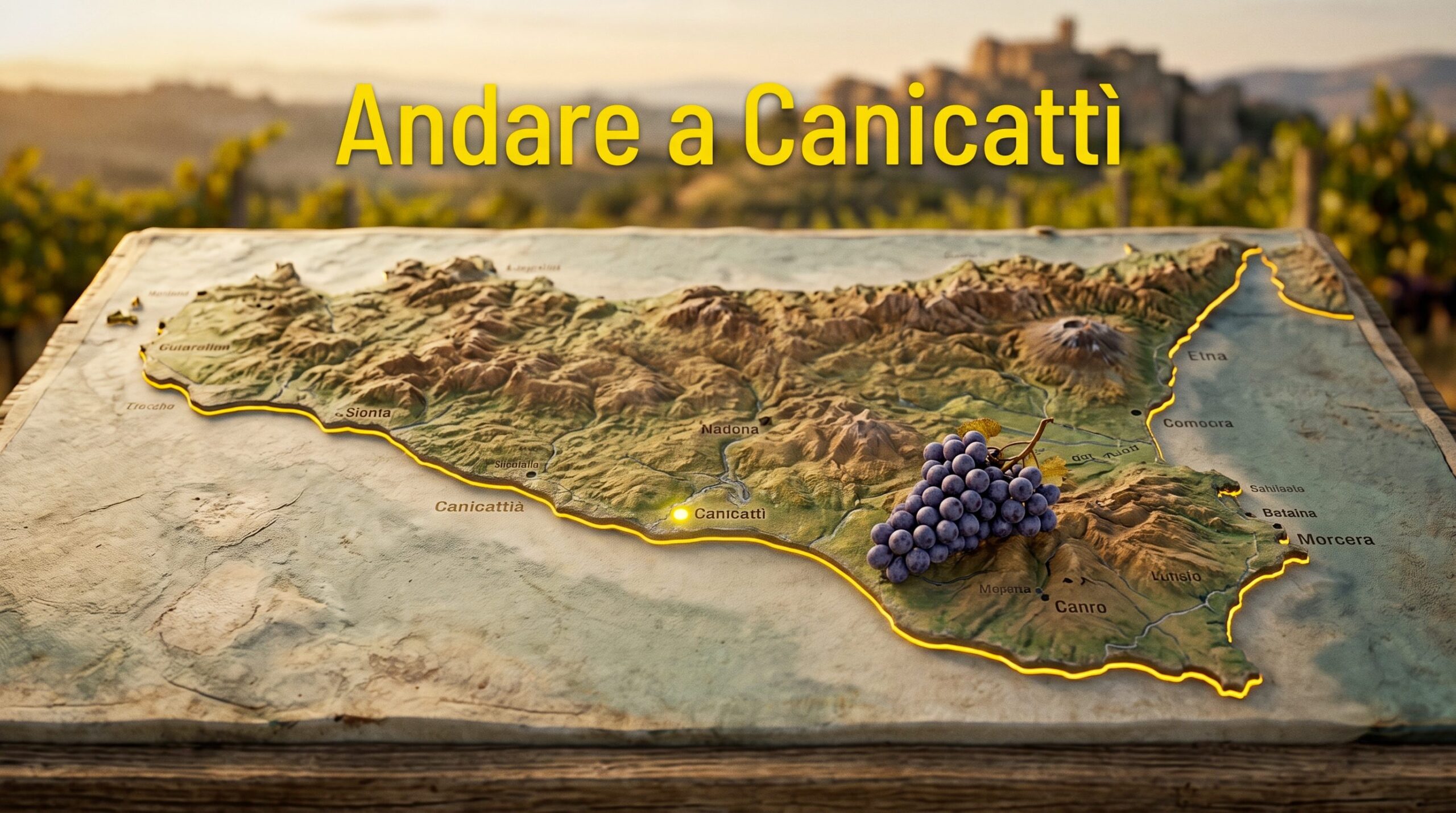
The expression «go to Canicattì» is used in the Italian vocabulary to indicate a remote place and almost unattainable. Although for many inhabitants of the Centre-North this Sicilian town – located in the province of Agrigento – is located on the edge of the Peninsula, the reality offers an urban center with a thousand-year history and a economic role crucial.
Through toponymy and folklore, we will understand how Canicattì went from being a thriving commercial hub to transforming itself into a powerful linguistic metaphor of a place far and remote.
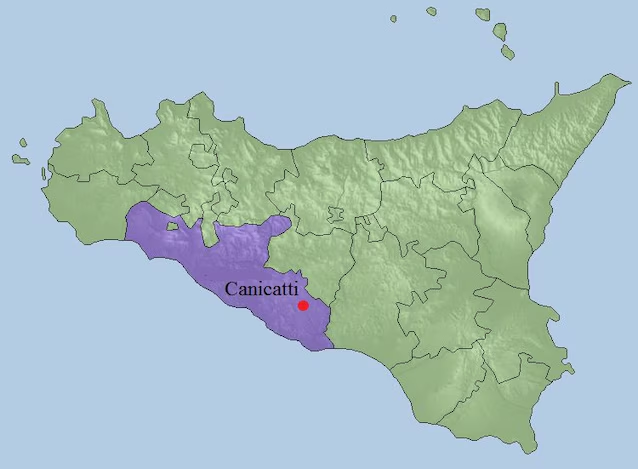
Where Canicattì is located:: 34 thousand inhabitants in the province of Agrigento
Rather than being a desolate outpost lost in nowhere, Canicattì is a populous urban center of approximately 34,000 inhabitantsnestled in the heart of Sicily, in the province of Agrigento. Strategically positioned on a fertile hillside at around 465 meters above sea level, halfway between the provinces of Agrigento and Caltanissetta, the town has represented an important commercial and road hub for centuries. He is famous for his extensive vineyards and for the prized production of table grapes, an inestimable agricultural wealth that has allowed it to evolve and become anything but a forgotten place.
The origins of Canicattì they date back to the 5th century BC. with settlements linked to the fortress of Mozio, around which the legend of the Arab tyrant flourished Vito Soldanodescribed in popular narratives as a ruthless tyrant. However, documented history is consolidated in 1089, with the Norman conquest of Sicily when the hero Salvatore Palmeri he defeated the Saracen feudal lord in an epic duel, becoming the first Christian baron of the village.
Evolution of the toponym
But it is the study ofetymology of the name of the city to hide the most interesting linguistic secrets about Canicattì. As often happens in toponymy, the original name has undergone a complex phonetic evolution and has been the continuous target of reinterpretations by the people, fueling false etymologies (like the belief that the name derives from the union of “dogs” and “cats“).
Historical sources, among which the work of the famous Arab geographer Edrisi in the 12th century stands out, document the presence of a farmhouse known as Al-Qattàa word that in Arabic indicates the figure of stone cuttersuggesting the presence of ancient mining quarries on site. The form would then derive from this root Ayn-al-qattìtranslatable as “stone cutter’s source”.
The most accredited etymology, however, derives from Arabic Handaq-attinor “mud ditch” or “clay”. The name described the geomorphological conformation of the area, a depression where the Naro river flowed, then evolving phonetically from Handicapped children in the current Canicattì.
Birth and origins of the saying
How, then, did such a concrete and industrious civic reality transform itself into an abstract and proverbial symbol of inaccessibility? The answer would lie in a mixture of geographical perception and linguistic-cognitive mechanisms. First of all, from a purely spatial point of view, for a native speaker residing in the regions of Northern or Central Italy, the province of Agrigento represents a very distant destination and radically detached from their usual sphere of life. But geography alone is not enough.
The key to Canicattì’s success in figurative language is entirely inherent in its peculiarity morphological structure e phonological. Canicattì is one truncated word (tonic accent on the last syllable); this, combined with a tight consonantal alliteration and the aforementioned assonance, makes it acoustically fun. Furthermore, the similarity to “dogs and cats” makes it a musical and bizarre word, making it instantly imprinted in the memory and creating an almost iconic and surreal effect in the listener’s mind.
The evocative power and musicality of the name have made Canicattì a symbol of mass culture, as demonstrated by the famous song of Gold Zecchino from 1977 entitled “The castles of Brisighella” which uses it as an archetype of a remote and isolated place:
If instead they were in Canicattì
It is certain that they would not be there
From Canicattì to the exotic Timbuktu
The Italian language often uses real or imaginary toponyms to recall remoteness or irrelevance. To give particular importance to these concepts, the human mind relies on names with peculiar or funny phonetics; there are famous examples of words such as Roccacannuccia, Casalpusterlengothe exotic Timbuktu or even Fuck youused not only to indicate an undefined and remote place, but also to underline the uncertainty or impossibility of tracing a precise origin.
Therefore, citing Canicattì to indicate a remote destination does not mean evoking a fictitious place, but rather a city with a thousand-year history. Thanks to a peculiar mix of phonetics and folklore, this Sicilian center has become an example of our rich daily linguistic production.
