
THE earthquakes related to bradyseism occurred so far Phlegraean Fieldsalthough very numerous, have had for the most part low magnitude, less than 3. A new study published on explains why Nature Communications Earth & Environmentconducted by researchers from the “E. Pancini” Department of Physics of the University of Naples Federico II, the University of Padua and Vienna. Analyzing 56 seismic events occurred between 2020 and 2025researchers found that most of the energy released by the Campi Flegrei does not propagate in the form of seismic waves, but it disperses limiting the magnitude of earthquakes. This happens thanks to rocks of the calderawhich due to their particular characteristics absorb part of the energy. Despite this, it is possible that earthquakes with a magnitude of up to 5 may occur in the future, which is why the prevention of seismic risk in the Campi Flegrei remains a priority.
The mechanism that limits the magnitude of earthquakes at the Campi Flegrei
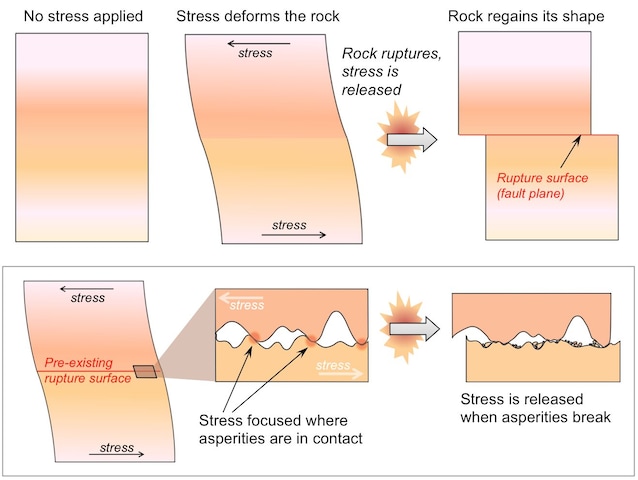
The researchers analyzed 56 seismic events occurred between 2020 and 2025 at the Campi Flegrei, using an interdisciplinary approach that involved the integration of data obtained with seismic monitoring, laboratory experiments and numerical simulations. They thus estimated that less than 10% of the energy released in the caldera, when the stresses applied to the rocks exceed their resistance, it propagates in the form of seismic waves: the result is that the magnitude of earthquakes is in most cases low. To analyze the phenomenon, a model was developed that quantitatively describes theinteraction between two parameters: lo stress drop (literally “reduction of effort”) and the breaking speed along the faults. The stress drop indicates the quantity of elastic energy, previously accumulated in the rocks subjected to stress, which is released along a fault during an earthquake (more precisely, it is the difference between the stress present on the fault before the earthquake and the residual stress after the rupture). Rupture velocity is the rate at which rupture propagates along the fault surface and is closely related to friction along it, the strength of the rocks, and the geometry of the fault. The researchers discovered an inverse relationship between the amount of stress released and the rate of failure: when the stress released is greater, the fracture propagates more slowly. This seemingly counterintuitive behavior is due to intense damage to the rock in the fault zone, which absorbs energy and slows the propagation of the rupture. It is a mechanism that at the Campi Flegrei prevents the development of long fractures and consequently the occurrence of earthquakes with high magnitudes.
Caldera rocks cause energy dissipation at Campi Flegrei
In the Campi Flegrei caldera area only a small part of the energy released propagates in the form of seismic waves because here, between 2 and 4 km deep, the rocks are fragile and host fluids. This makes it so most of it is lost in the form of heat and fracturing “consuming” itself at a local level in the rocks surrounding the fault and weakening them further. This does not mean that earthquakes of a higher magnitude, up to 5, cannot occur in the future, since two large convergent faults have been identified under Pozzuoli. Certainly, however, the study highlights how local geological structures and the presence of fluids influence seismic danger in volcanic areas. Understanding how different volcanic materials respond to stress could lead to models applicable to similar geological contexts.

