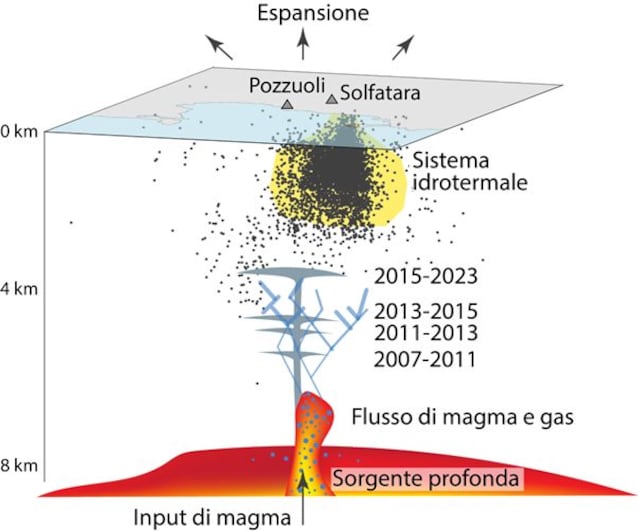
A new study by INGV and the University of Geneva, published in the journal Communications Earth and Environment of Nature, analyzed the possible evolution of bradyseism ai Phlegraean Fields. The researchers developed a model that suggests that currently the volume of magma reservoir is not sufficient to trigger an eruption. However, a similar event could occur in the future, in several decades, if the magma reaches the volume of that which fueled the 1538 eruption.
The assumption on which the model of the evolution of bradyseism is based
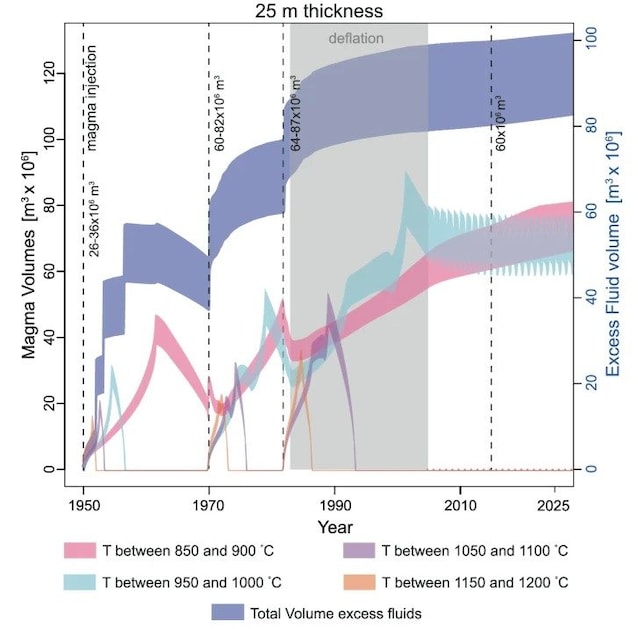
The most recent studies attribute the phenomenon of bradyseism toincrease in meteoric water pressure accumulated underground between 2.7 and 4 km, which expands when heated by the gases released by the magma present at depth. However, the model developed by the researchers in this study is based on what the Anglo-Saxon literature defines “the worst case”the worst case. Even if there is currently no evidence of recent intrusions of surface magma, we started from the assumption that the uplift of the caldera floor which occurred in the years 1950, 1970-1972, 1982-1984 and from 2005 to today is fueled by magma intrusions about 4 km deep and come on fluids released by it.
“We chose to start from this assumption because it is the most precautionary one for the inhabitants of the Phlegraean area subject to volcanic danger and allows, at least, to define a possible evolutionary scenario”
Explains Stefano Carlino, INGV researcher and co-author of the study.
Because an eruption at Campi Flegrei would currently be unlikely
According to the researchers’ calculations, even if potentially eruptible magma was found at a depth of about 4 km, capable of exerting sufficient pressure to fracture the surrounding rocks, the eruption would be hindered by reduced volume of the magmatic reservoir. In fact, a possible escape of magma would rapidly decrease the pressure inside the tank and in this way the magma would not have sufficient energy to reach the surface. Another factor not favorable to the eruption is the fact that the crust surrounding the reservoir tends to deform in a viscous way. As land uplift continues at a rate similar to today (its speed is currently 15 mm per monthafter about two months at 25 mm per month), between a few decades the magma reservoir could reach a size suitable for cause an eruption. In this case the accumulation of magma would have a volume similar to that which fueled the eruption of Monte Nuovo in 1538.
The risk linked to phreatic explosions
According to the most recent studies, the direct cause of bradyseism, and therefore of the associated seismicity, would therefore not be the magma, but the pressure exerted by underground meteoric water heated by gases released by the magma. To confirm the actual source of bradyseism, further investigations are planned which will make use of geophysical, geochemical and geodetic measurements. Although the new study shows that there is no risk of an imminent eruption, the pressure of these fluids could lead to other potentially dangerous phenomena in the future. These are the so-called phreatic explosions, which involve the sudden emission of steam, water and rock fragments to the surface. These phenomena can be accompanied by mudslides at very high temperatures and debris.