
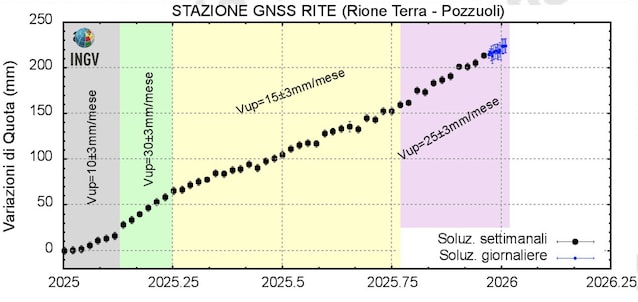
Bradyseism slows down in the Campi Flegrei: the ground lifting speed settles back to a value of 15±5 mm per month after about 2 months a 25±3 mm/month. From a seismic point of view, however, they were located in the week from 5 to 11 January 71 earthquakes – of maximum magnitude 3.1 – of which 42 occurred during 3 seismic swarms. This is what emerges from the latest weekly bulletin of the INGV Vesuvian Observatory, which records a slight increase in tremors compared to previous weeks.
From the point of view of geochemical parametersthe temperature of the fumarole in the Solfatara crater instead shows a increasing trendwith an average value of approximately 173°C.
Based on the current picture of volcanic activity, INGV has not highlighted elements that suggest significant short-term developments.
At the Campi Flegrei 71 earthquakes and three swarms in the week 5-11 January 2026
In the reference week (5-11 January 2026) they were located 71 earthquakes, with a maximum magnitude of 3.1recorded on January 6th. Of these, 42 tremors were detected during 3 seismic swarms:
- Swarm of January 5th: started at 09:33, with 4 earthquakes of maximum magnitude 1.7 recorded in the Pozzuoli Cigliano area.
- Swarm of January 6th: started at 02:19, with 26 earthquakes of maximum magnitude 3.1 recorded in the area between Pozzuoli Gauro and Solfatara.
- Swarm of January 8th: started at 4.27pm with 12 earthquakes of maximum magnitude 2.6 recorded in the Pozzuoli area.
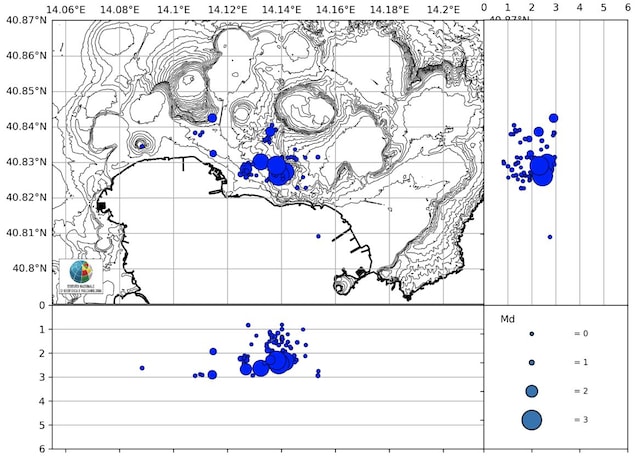
As usual in the Campi Flegrei, the earthquakes occurred at once shallow depthbetween 1.89 km and 2.91 km.
Bradyseism: ground heaving drops to 15 mm per month
The data highlights that, starting from mid-December, the average monthly rate of ground uplift is decreasing a 15 ± 5mm per month, bucking the trend after a 2-month period of increase in bradyseism a 25±3 mm/monthofficially started on October 10, 2025.
The cumulative effect of this speed brought the total lift recorded at the Rione Terra GNSS station (RITE) to approximately 22.5 cm from January 2025.
The geochemical parameters confirm the long-term trend of warming of the hydrothermal system and increase in flows. In particular, the temperature of the main fumarole (BG) in the Solfatara crater shows an increasing trend, with a confirmed average value of approximately 173°C. In the area of Pisciarellithe average temperature is around 95°C.
Summary of the INGV weekly bulletin
In summary, here are the data from the latest bulletin:
- Seismicity: slightly increasing, with 71 localized earthquakes, with a maximum magnitude of 3.1.
- Seismic swarms: three seismic swarms recorded respectively on 05/01 (4 shocks), 06/01 (26 shocks) and 08/01 (12 shocks).
- Bradyseism: Soil heave rate decreasing at 15 ± 3 mm/month with total heave from January 2025 to 22.5 cm.
- Temperatures: Solfatara is confirmed at high values (~173°C).
