The last one weekly bulletin of INGV on the activity of Phlegraean Fields records a decline in seismic activity: in the week between 13 and 19 April 2026the number of shocks dropped to 14 compared to 94 findings the previous week. The intensity of the phenomena also attenuated, with a maximum magnitude that did not exceed the value of 1.8compared to the peak of 3.4 recorded last week.
Despite this relaxation of seismicity, the parameters linked to bradyseism and the geochemistry of the site remain unchanged: the ground continues to rise at a constant speed of 10 mm per monthwhile thermal analyzes at the Solfatara crater confirm a stable average temperature of the fumarole around 173°C. The overall picture therefore outlines a moment of lower release of elastic energy, while confirming the persistence of the deep dynamics that characterize the current phase of uplift of the caldera.
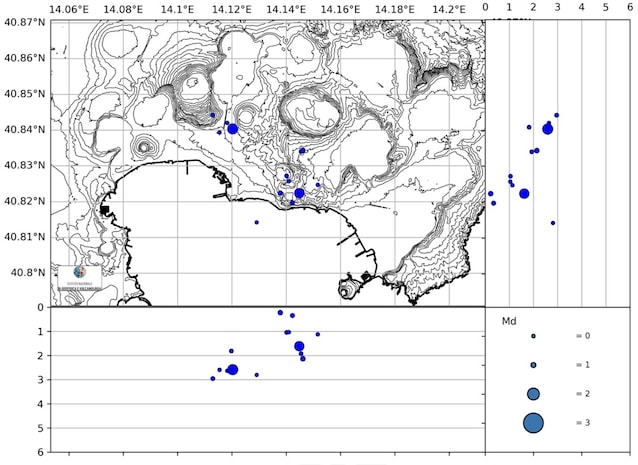
14 shocks with maximum magnitude 1.8: earthquake data
In the week between 13 and 19 April 2026, in the Campi Flegrei area, 14 seismic events with a maximum magnitude of 1.8 recorded on April 13th. As always in periods of bradyseismic uplift, earthquakes are very shallow: the maximum depth recorded is 2.6 km. Overall, seismic activity is contained.
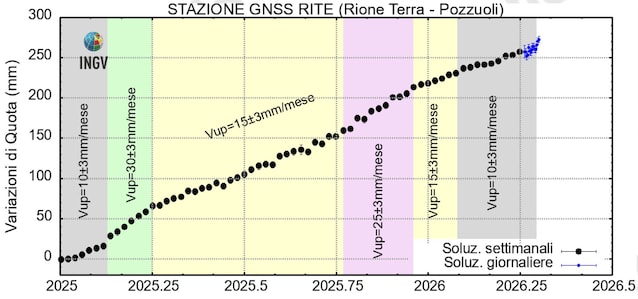
Bradyseism remains stable with soil lifting at 10 mm per month
Starting from February 2026, the average speed of ground lifting, linked to the bradyseism phenomenon, has stabilized around 10 mm per monthdecreasing compared to previous months. Overall, since January 2025, the lift recorded at the Rione Terra GNSS station is equal to approximately 27cm.
The geochemical parameters are in continuity with what was observed in previous weeks, confirming the already known increase trends, both in terms of the flows of gas emitted and the temperatures of the fumaroles. In the period considered, the Pisciarelli fumarole recorded an average temperature of approximately 95°Cwhile for the main fumarole (BG) located in the Solfatara crater, an average value of approximately 173°C.
