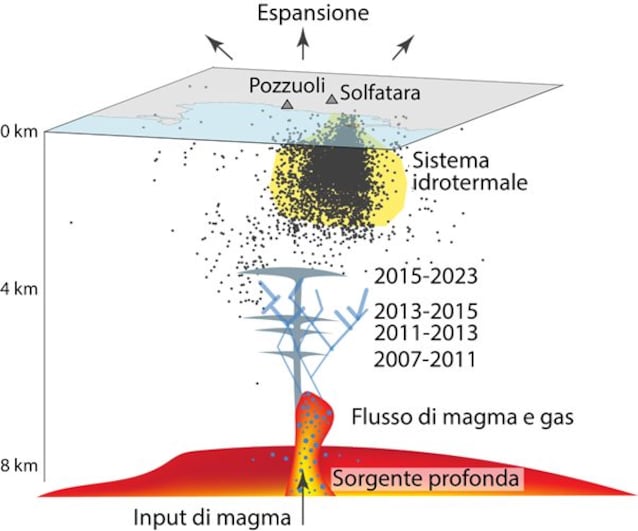
A new study by the Ingv and the University of Naples Federico II analyzed the only historical eruption at the Flegrei Campi, that of Monte Nuovo of 1538. The study provided one new and more reliable reconstruction of the phenomena who in the previous century the eruption affected the caldera, in particular those seismic and lifting of the ground. Thus was highlighted by the similarity between the bradisismic crisis preceding the eruption of 1538 and the current one, even if at the time the lifting of the soil of the area had been greater. As a result, the researchers hypothesized Two different future scenarios: a scenario provides that a volcanic eruption, preceded by earthquakes of magnitude up to the next few years or decades until 5.0; The other scenario instead provides that current disorders related to bradisism can cease before an eruption. In any case, the purpose of the study is to underline the fact that the hypothesis of an eruption to the Flegrei fields it is not entirely remote And that it is necessary to prepare the territory for this possibility.
The phases preceding the eruption of Mount New of 1538
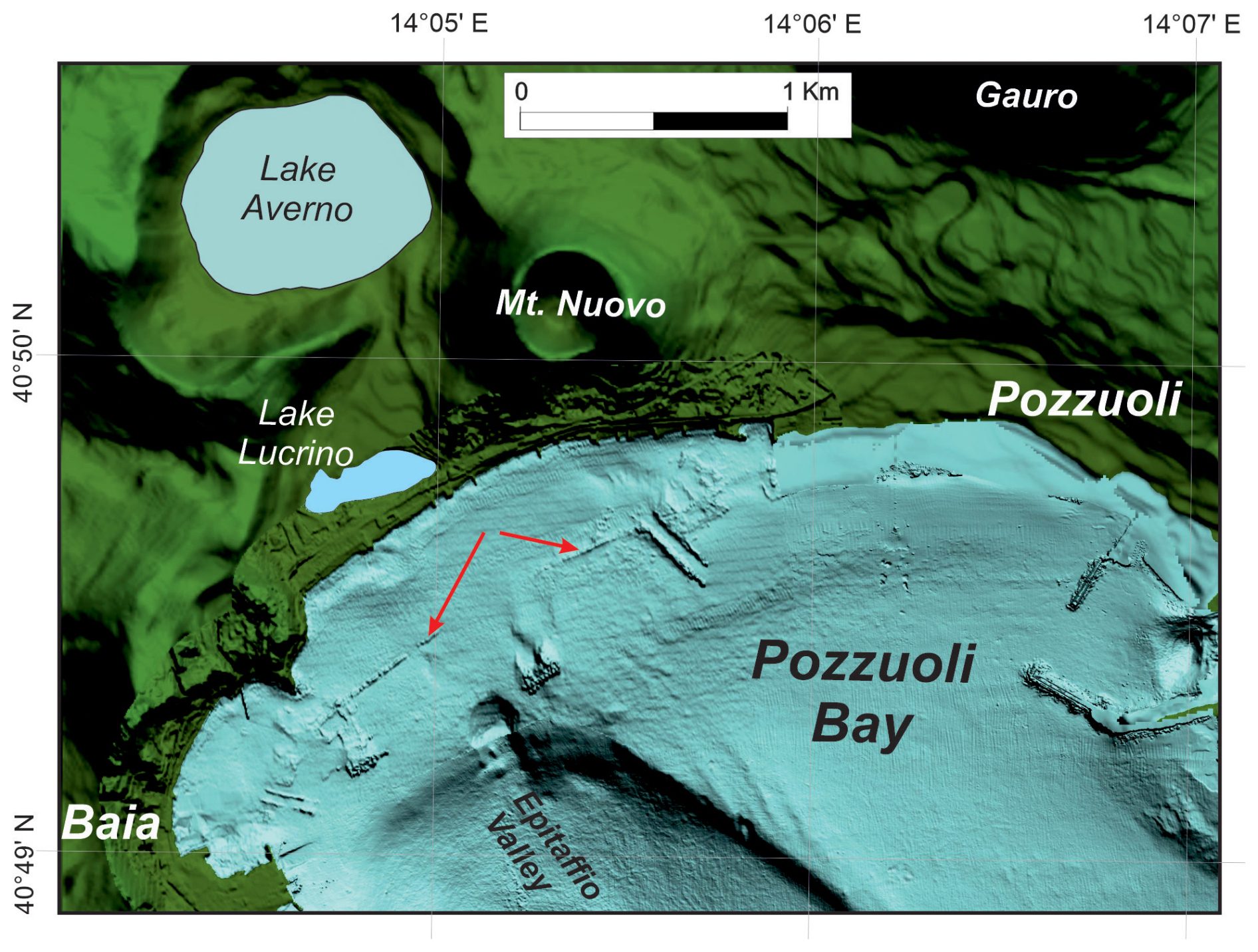
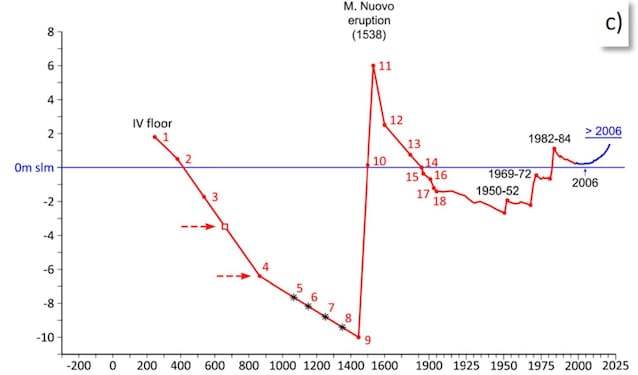
The researchers have reconstructed more precisely than the studies carried out in the past the phases preceding the eruption of Mount New of 1538. Based on the documentation and historical testimonies, they have soil movements in the area reconstructed Since the eighth century AC the analysis of the stratigraphic and geophysical parameters collected in recent times has then provided elements for interpret deformations and seismic events related to the eruption of 1538. It was thus determined that the soil lifting began in 1430about a century before the eruption, and has reached 16 m near Pozzuoli. Shortly before the eruption, in the area where the Vulcanic Mount new building was then formed, there was also a further local lifting. In addition, the magnitude of the strongest seismeswhich was found slightly more than 5.0. The earthquakes, which began around 1470, continued for forty years even after the eruption. As for the erutive event itself, it is known that there was a first so -called phase Freatomagmaticadue to the contact between magma and sea water, with the formation of a Column of ashes and lapilli. The collapse of the column generated pyroclastic flows headed towards Pozzuoli, who deposited within 3 km. The eruption determined the formation of the Monte Nuovo cone.
The comparison with the current bradisismic crisis
The study of the eruption of 1538 is essential to understand the ways in which a bradyseismic crisis can evolve towards an eruption. The current heat lifting phase, in place since 2005, shows analogies With the one before the eruption of 1538. As then, there was a progressive increase in seismicitywhich intensified in terms of both frequency and maximum magnitude (which reached 4.6 on March 13, 2025). However, the soil lifting observed between 1950 and 2024 was only of 4.3 mcompared to the 10 m recorded in an equivalent period of time between 1430 and 1503. These premises allowed to hypothesize Two possible scenarios For the future evolution of B assisism at the Campi Flegrei.
The future scenarios hypothesized to the Flegrei Campi
Based on all these data, two possible scenarios were outlined.
Scenario 1
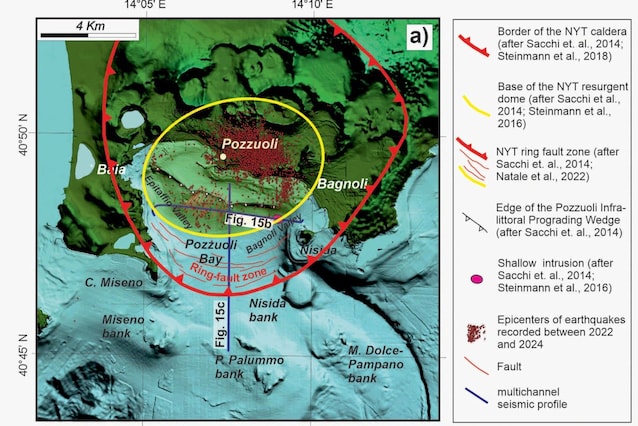
The current bradisismic crisis could evolve into avolcanic eruption. Currently There is no evidence of recent surface magma intrusionsbut these could occur in the future. In particular, during the 1982-1984 crisis he had climbed magmatic material about 3 km deepwith a volume of about 0.03 km3which could be removable by hot fluids from the magmatic chamber. There magma ascent could be very quickanticipated by a further localized lifting of the soil. Before any eruption, seismicity could intensify, with Earthquakes of magnitude equal or even greater than 5. These earthquakes would be superficial (with a hypocenter within the first 3 km of depth) and therefore could cause serious surface damage. In case of eruption, the precise place of opening the eruptive mouth could not be provided. However, this would probably have happened inSolfatara-Agnano areawhich is the most active from a seismic point of view. ATTENTION: the eruption probably would have anmedium-low intensitybut it could still generate dangerous pyroclastic flows.
Scenario 2
There Bradisismic crisis in progress could cease without evolving in an eruption. In support of this scenario there is the fact that the lifting is currently less Compared to that of the phases preceding the eruption of 1538. The stress accumulated in the rocks today would not have reached a critical value which would entail the fracture of the shallow rocks of the crust, with the trigger of an eruption. Also, it stress would be increasing relatively slowly: When this happens, the phenomena related to bradisism can return before an eruption takes place, or the critical phase can be achieved in much longer times. Even without the involvement of magma, the increase in pressure due to the heating of the aquifer under the caldera could produce friezes (sudden emissions on the surface of steam, water and rocky fragments) potentially dangerous.