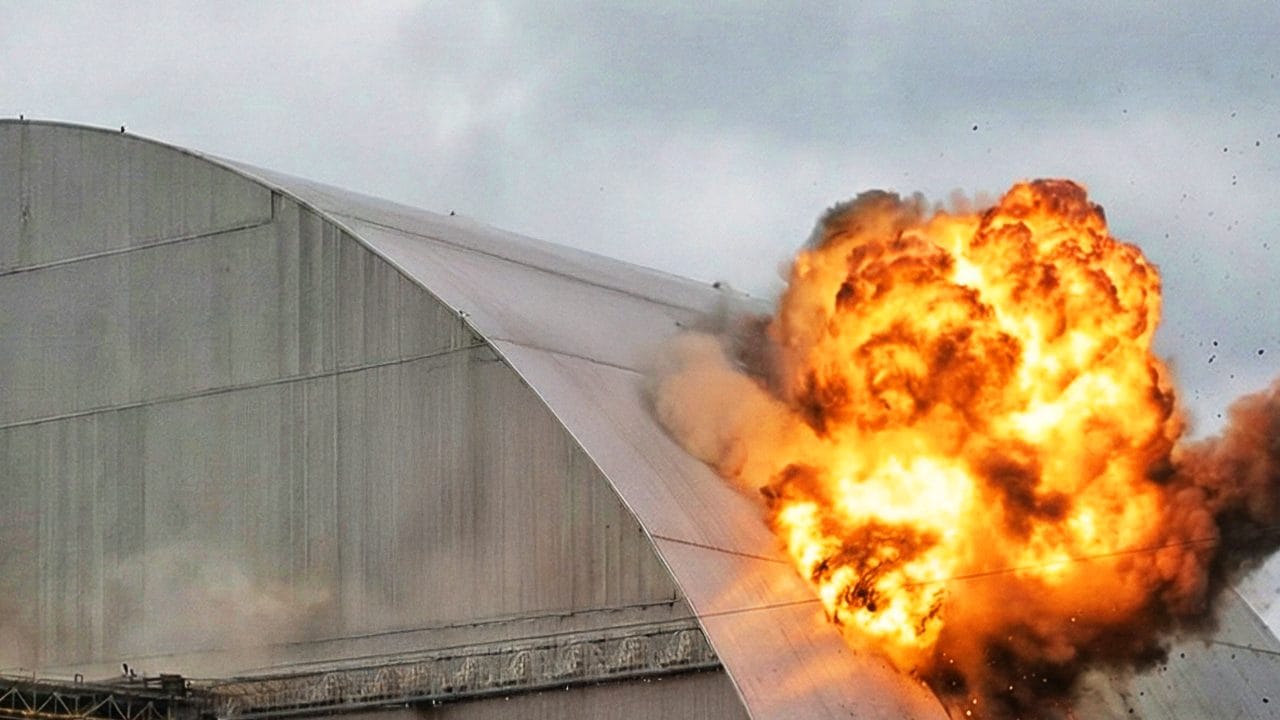
After the attack of a explosive drone which hit the sarcophagus of Chernobyl reactor 4 on February 14, 2025, to 1:50 at night – causing a large fire – the nuclear power plant once again became the center of attention. Despite the extent of the damage, it was not recorded anomalous dispersions Of radioactive material and this is still the situation under control. Why then has the damage to the external cladding caused so much outcry in recent hours? Let’s clarify.
The attack on the New Safe Confinement dome
February 14, 2025. There Chernobyl nuclear power plant was shrouded in silence when suddenly the security guards heard a roar very strong: the power plant – or rather, the external protective sarcophagus of reactor 4 – had been hit by a drone equipped with an explosive charge. It was one Shahed 136a long drone 3.5 meterswith a wingspan of 2.5 meters and capable of carrying an explosive warhead weighing up to 500g between 50 and 90 kg. How do we know that it is precisely this model? Simple, the authorities found the remains, such as the engine.
Who launched it? Ukraine accused the Russiabut the Kremlin denied it. Here, however, we are not interested in understanding who launched the attack, but rather the consequences it brought. In fact the explosion was such that it pierced the sarcophagus and give life to a fire. And clearly in those days newspapers from all over the world had their eyes on the plant, fearful of a possible release of radioactive material… but from the outset no higher than average radiation levels were recorded. And the levels are still up to standard, as reiterated by the IAEA on several occasions. But how is this possible?
To understand this we need to rewind the tape and understand how the protective sarcophagi of Chernobyl work.
The 1986 Chernobyl accident: the most serious in history
The April 26, 1986 the most serious nuclear accident in history occurred. Specifically, the person involved was the reactor 4 of the Chernobyl nuclear power plant. Today I don’t want to go over exactly what happened but what we are interested in knowing is that the priority at the time was to encapsulate the melted kernel and about 200 tons of material highly radioactive.
Precisely for this reason a first was created sarcophagus protective in cement And steel which, however, was not designed with a long life expectancy: let’s talk about approx 30 years. The motivation behind this choice is that the situation was very serious and the priority was not to plan an eternal work, but to limit the problem in the shortest time possible. Precisely for this reason, however, it was decided to also create a new protective sarcophagus, this time with much higher technical properties.
This is how the idea of the was born New Safe Confinementa maxi steel cladding whose life expectancy would have been approximately a century.
What is the New Safe Confinement and what we know
The construction of this new sarcophagus, from an engineering point of view, is incredible: in fact, consider that it cost approximately 1.7 billion dollars and it’s there largest mobile structure in the world. This huge coverage measure 108 meters high For 164 in length And 257 wide and it is considered mobile because it was not built directly on the internal sarcophagus, but was moved here through special devices binaries In the 2016.
This coating is made up of a steel framecovered by further layers of stainless steel And polycarbonate. There is also one membrane whose objective is to guarantee hermetic closure with the original structure and avoid the dispersion of dust. But the sarcophagus does not only serve to limit the damage of a possible dispersion of radioactive material. Its goal is also to ensure that the internal sarcophagus turns out repaired, especially from water. Why from water? Because this one might corrode it.
Precisely for this reason a system has also been installed inside ventilation And air conditioning, so as to guarantee constant control of humidity and temperature. As you may have understood, it is a structure designed down to the smallest detail and which would be able to withstand earthquakes up to magnitude 6.0, hurricanes and sudden temperature variations… even if the builders, unfortunately, did not consider war among the possible sources of damage.
The drone easily managed to pierce the external sarcophagus, while for that more internal we don’t have very clear information. In fact, we don’t know whether it suffered no damage at all or whether it was only slightly damaged – but the fact is that, in any case, no release of radioactive material was observed and for this the radiation levels are in line with the pre-attack ones.
So if the situation seems under control at the moment, why is there all this panic?
Is Chernobyl safe?
It all has to do with the press release number 331 published by IAEA – i.e. the International Atomic Energy Agency – which talks about a mission carried out in recent weeks with the aim of assessing the state of health of the sarcophagus. I quote verbatim:
The mission confirmed that the sarcophagus had lost its primary safety functions, including confinement capability, but also found that there was no permanent damage to its load-bearing structures or monitoring systems.
This is the offending sentence: the sarcophagus has lost its primary security functions. Which is true: as we saw, the drone caused a gash and extensive damage. In recent months, a lot of work has been carried out for repair the damage, but as IAEA President Rafael Grossi recalls – again verbatim:
Limited temporary repairs have been made to the roof, but timely and comprehensive restoration remains essential to prevent further degradation and ensure long-term nuclear safety.
So in short, the damage has been repaired, but it’s not enough, we need a complete restoration to make sure that the structure remains safe in the future. But this – and here is the crux of the matter – it doesn’t mean it exists Now a leak of radioactive material. It seems like a subtlety but it makes a huge difference: the sarcophagus is not safe, but we are far from being on the brink of a new nuclear disaster.
Precisely for this reason various experts have expressed their opinions on the topic in recent hours, such as Shaun Burniean expert in nuclear technologies, who declared to NY Times that at the moment there are no particularly serious problems there; or like the professor Jim Smithan expert nuclear disaster researcher, who declared to the BBC that the risk related to the dispersion of radioactive dust is low.
So, in summary, the sarcophagus is damaged but radiation is under control for the moment. They have put in place a temporary patch – if we can call it that – and are studying ways to make the adjustment permanent, but the IAEA has not said anything that justifies excessive concern. So I would like to reiterate that it is always necessary to pay close attention to what we read online and that especially for news like this it is always good to consult primary sources.
