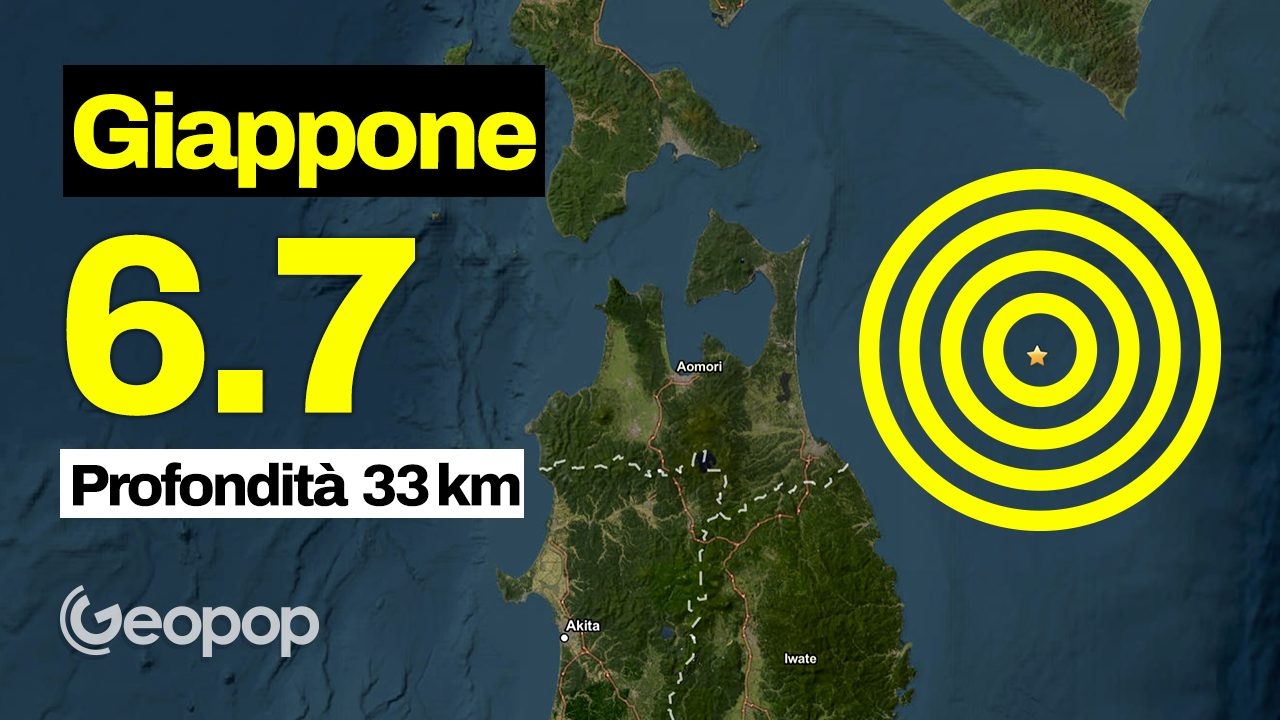
A strong one earthquake of magnitude 6.7 hit the north of Japan at 11.44am (local time, 03:44 in Italy today, December 12. According to what was reported by INGV, the epicenter was located at seaapproximately 122km from the coast of the island of Honshu – Aomori prefecture–, that is the largest island in Japanwhich is home to the capital Tokyo and major cities such as Kyoto and Osaka; the hypocenter, however, was detected at one depth Of 33km. The Japan Meteorological Agency initially issued a tsunami warning for the risk of waves up to 1 meter highrevoked shortly thereafter. The JMA also measured the intensity of the quake at level 4, on a maximum scale of 7.
At the moment no injuries or particular damage have been reported, despite numerous reports on the social media of citizens who warned the earthquake: the earthquake occurred just 3 days after a recorded 7.6 magnitude shock in the same Aomori prefecture and felt as far away as Tokyo, leaving around 30 people injured due to broken glass and falling objects.
From a geological point of view, Japan is an extremely seismic country, being the result of clash of tectonic plates: specifically, it is the Pacific plate, which subducts under the North American plate. This active tectonic context translates into the presence of thousands of compressional faults, the reactivation of which can generate frequent and intense earthquakes.
The country, among other things, is located within the so-called “Belt of Fire”, i.e. the area of the planet most affected by volcanic eruptions and earthquakes.
