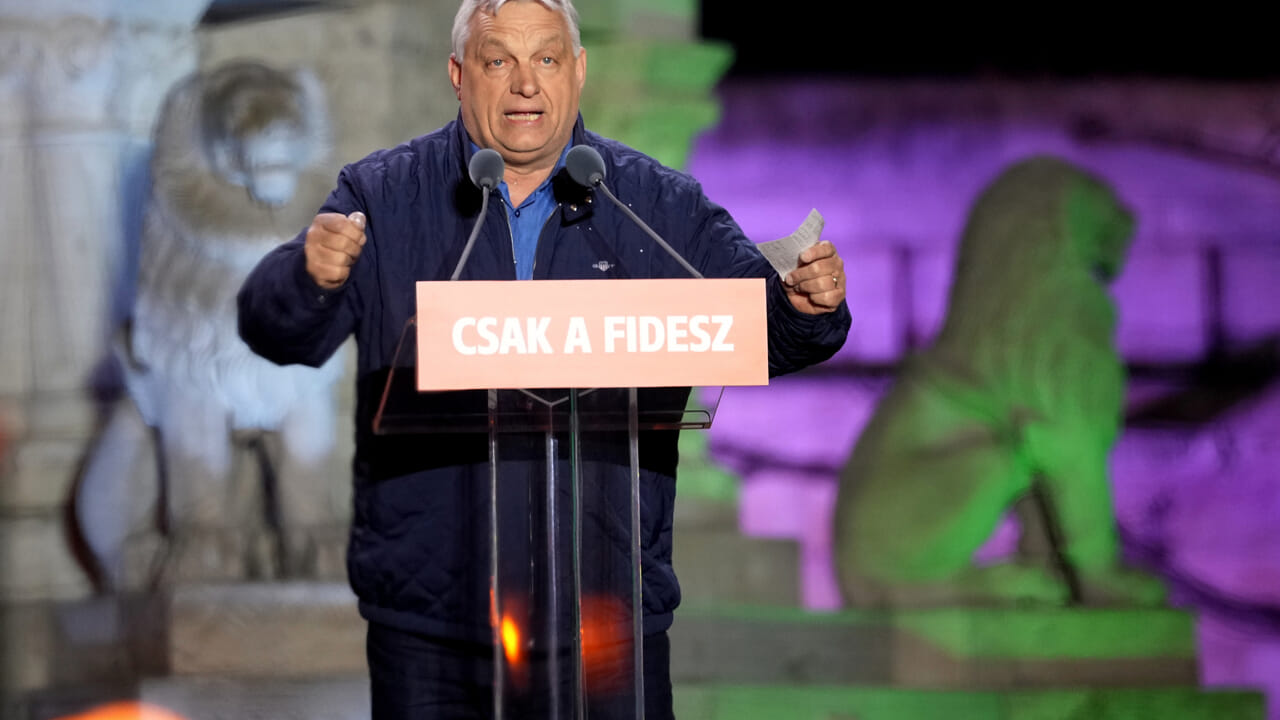
Parliamentary elections are underway in Hungary. They are the most important in the country’s recent history, because they could mark a political turning point with repercussions in Europe and in relations with Russia and the United States. Today 8 million Hungarian citizens are called to the polls, open from 6am to 7pm, to decide whether or not to confirm the mandate of Prime Minister Viktor Orban, who has been in power for 16 years. In addition to voters in the country, another 500,000 residents abroad will also participate in the vote.
Challenge between Magyar and Orban
According to the latest polls, the “Respect and Freedom” party led by Peter Magyar is ahead of Fidesz, the current prime minister’s party. According to polls by independent institutes, a victory is expected for the pro-European conservative Magyar, who in two years has managed to create a movement and an opposition capable of overshadowing the prime minister. However, the result was reversed for the institutions close to power, which predict a victory for the Fidesz-Kdnp coalition with Viktor Orban aiming for a fifth mandate.
The Eurosceptic nationalist leader Orban, 62, has led the country since 2010 and has built a model of “illiberal democracy” – by his own definition – watched with interest by Western conservative circles, including the area close to Donald Trump. In recent years it has had to deal with growing internal dissatisfaction due to economic stagnation, rising costs of living and accusations of corruption linked to oligarchs close to the government.
Challenging him is Peter Magyar, 45, a former ally of Orban and now leader of the centre-right Tisza party, which has capitalized on public discontent, particularly among young people and urban voters. Polls over the last two weeks show Tisza leading between 38% and 41%. The Fidesz party, led by the current Hungarian prime minister, would be 7-9 percentage points behind. But findings vary, leaving several scenarios open, including a possible head-to-head.
The vote is being followed with great attention in Brussels, where several European Union countries accuse Orban of having weakened the rule of law, taken away freedom from the media and the rights of minorities. His eventual defeat could unlock an EU aid package worth around 90 billion euros for Ukraine and reduce Russian influence within the Union, given the close relationship between Orban and Russian President Vladimir Putin.
The words of the two leaders
“Will this be my last election? I’m young, it’s not my last election. I’m here to win,” Orban said, speaking to the press immediately after voting in Budapest. “The people’s decision must be respected”, underlined the Hungarian prime minister. When asked about the possibility of congratulating Peter Magyar in the event of defeat, he replied: “Congratulate me? I always do it, there are civil rules.”
Magyar also voted in the Hegyvideki Mesevar kindergarten polling station in Budapest’s 12th district. “Our party will win, the only unknown is whether with a simple or absolute majority,” he told the press after placing his ballot in the ballot box. “We must strengthen Hungary’s position in the EU and in NATO”, added the Hungarian opposition leader, once again underlining the need to “unfreeze the EU funds” blocked due to the dispute between Brussels and Viktor Orban over the rule of law. In case of victory, he reiterated, “the priority will be to adopt anti-corruption measures”.
In addition to electing the new prime minister, the 8 million Hungarian voters will also have to choose the 199 deputies of Parliament with a mixed system: 106 in single-member constituencies with a majority system and 93 with proportional representation through national and minority lists. The threshold is set at 5%. According to forecasts, a turnout is expected to be even higher than the 2022 vote, when it stood at around 70%.
Five parties in the running
In addition to Orban’s Fidesz and Magyar’s Tisza, the two largest parties, three smaller formations also managed to collect the necessary signatures: the far-right Our Homeland party (Mi hazank), a left-wing party, the Democrats (Dk), and a shareholder and anti-elitist party, the “Two-tailed Dog” party (Kètfarku kutyapart).
According to the polls, of the three, only the right-wing extremists have a real chance of exceeding the 5% threshold, sending deputies to the future Parliament, where they will be able to help Fidesz against the Tisza bloc. Instead, the candidates of the Democrats and the shareholders will compete with Tisza’s in single-member constituencies, threatening the victory of the opposition against the current prime minister.
