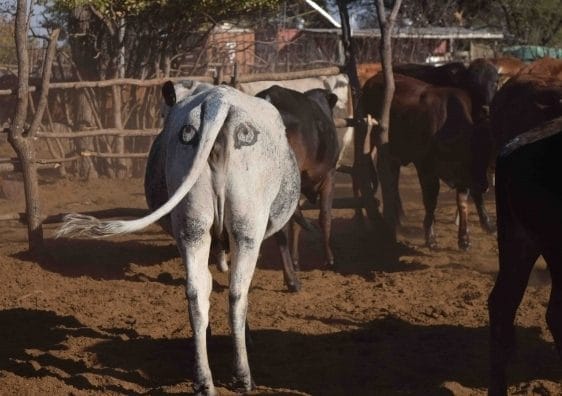
From southern Africa comes a rather promising technique: paint googly eyes on cows’ butts to be able to deceive predators. The study, published in Nature and conducted by the University of New South Wales in collaboration with the Taronga Conservation Society Australia and the Botswana Predator Conservation, reports how this sort of “tattoo” temporary was able to donate a advantage in addition to the 2,061 selected heads of livestock, limiting predator attacks and increasing their survival. There coexistence between breeders and large predators represents one of the most complex challenges in the wildlife conservation: protect livestock and, at the same time, safeguard the often vulnerable carnivore populations. The use of non-lethal and low-cost strategies therefore becomes valuable in contexts where the well-being of local populations depends on the survival of livestock.
How the googly eyes technique works on cows
Cows, sheep and donkeys can do little to avoid being bitten, farmers don’t have control of everything, carnivores have to eat… but researchers can look for a method to help. In 2020 it was published on Communications biology, which is part of the portfolio of the prestigious magazine Natures, a study entitled “Artificial eyespots on cattle reduce predation by large carnivores” which represents the first experimental evidence of artificial visual signs on domestic mammals used as an effective deterrent against large carnivores. The analysis was conducted in rural areas in the region Okavango Delta (Botswana)in contexts where livestock often graze unsupervised and are therefore subject to attacks by predators such as lions (Panthera leo) And leopards (Panthera pardus).
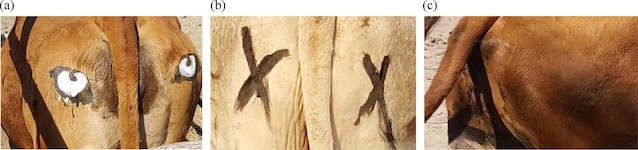
Of an overall sample of 2,061 adult cattle distributed across 14 herds, the researchers applied three treatments: a third of the cattle were drawn artificial eyes on the rear (group eyespots = ocelli), another third was labeled with of crosses in the same area (group cross-marks) and the last third it was not marked (control group). The symbols were painted using molds, brushes and paint directly on the animals’ fur while maintaining a certain visual standard. They have been applied to individuals with light, medium and dark hair contrast colors (mainly black and white) highlighting the shape of the eye and the Xs as much as possible, making the signs visible even from a distance.
Efficacy and results four years after the study
After 4 years of analysis the result obtained is that Nobody of the 683 cattle with painted eyes was killed from predators during the study period. On the other hand, 15 out of 835 unmarked individuals and 4 out of 543 marked with crosses were preyed upon.
No “eyed” cows attacked in four years it means being faced with a potentially promising strategy. However, the fact that even cows with a cross on their bottom had a lower mortality than unmarked ones suggests that shape is not the only important thing: it seems intuitive that any visible and unusual signs it could disturb or frighten the predator, at least initially, with a general effect of “novelty”.
Because eyes are potential deterrents to predators
If you were a lion you would attack your prey knowing they are seen? In some cases discretion is the best assault strategy while for others deception means survival. Convincing predators that they are being watched could put them in a position to desist. In nature we have many examples: butterflies, fish, birds and molluscs are decorated with shapes and colors that recall faces, bodies and expressions that they warn. In some cases, organisms can also take on ad hoc forms at the right time to appear to be what they are not, that is, threats.
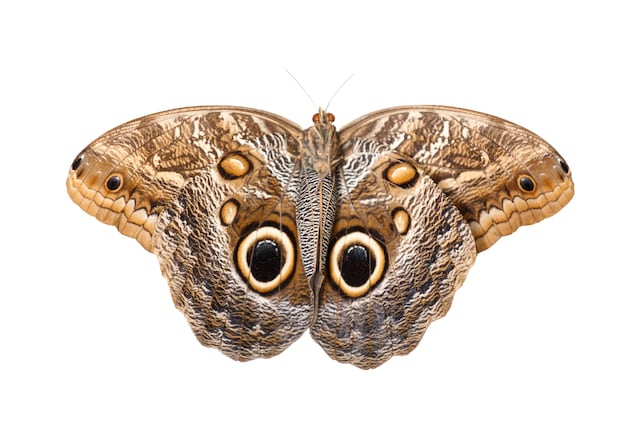
The eye spots they have evolved independently in many taxa as anti-predator signals, but do not occur naturally in contemporary mammals. To understand why these “tattoos” work on herds, it is useful to refer to the mechanisms proposed in the ecological literature. In many species of insects, fish, birds and molluscs the ocelli can confuse the predator, making it believe that the prey is alert, aware or threatening. Other times you just need to create a diversionsomething anomalous or ambiguous therefore the attack should be abandoned. What the right answer is remains a mystery, yet the fact that cows, donkeys and sheep do not use this method does not seem to be a problem. Are the ocelli missing? Not bad: artificially recreate this trait It seems to be paying off.
Limitations and considerations
Despite the good results, we must still take into account that the effect on the entire painted herd was not tested (or much of it), whether the deterrent effect has long-term effects and whether predators can get used to it to this new pattern. It is also unclear to what extent the technique is applicable in other contexts: different predatory speciesdifferent environmental conditions (climate, visibility, stocking density), or intensive grazing with limited surveillance could give different results. Then there is the ethical and animal welfare issue to take into consideration, especially in the application of these methods on a large scale.
That said, the idea of temporarily “tattooing” cows – which may sound bizarre, almost “science fiction” at first – seems to have a solid empirical basis. This approach is part of the broader repertoire of non-lethal techniques for mitigation of human-wildlife conflicts: it is a concrete example of “behavioral engineering” applied to livestock management, which can increase farmers’ tolerance towards predators (often fragile and in numerical decline), if appropriately associated with good breeding and animal welfare practices. In a world where the mortality of large predators is largely due to conflicts with humans and populations need subsistence, every instrument simple, effective and evidence-based becomes precious.
