
The circuit of Lusailin Qatar, is a “young” track as far as Formula 1 is concerned. Inaugurated in 2004 to host the MotoGP races under the name of “Marlboro Grand Prix of Qatar”only entered the F1 calendar in 2021when it took the place of the Australian Grand Prix which was not held that year due to the pandemic. Since 2023 it has entered the calendar on a permanent basis an agreement that will see him as a protagonist until 2033. The track recalls its motorcycling soul, in fact we find many long-distance curves, mostly which follow one another in a short time and only one straight, the main one, which measures 1088 meters. The layout produces one of higher average speeds among non-European circuits, with values approaching 230 km/h, The 71% of time on a lap with the foot pressed on the accelerator: a surprising figure considering the almost total absence of long straights. Since 2008 it has become the first world championship circuit to be equipped to host night races thanks to a lighting system with over 3600 bulbs. Furthermore, the track is adorned with artificial grass, to contain the influx of sand from the nearby desert.
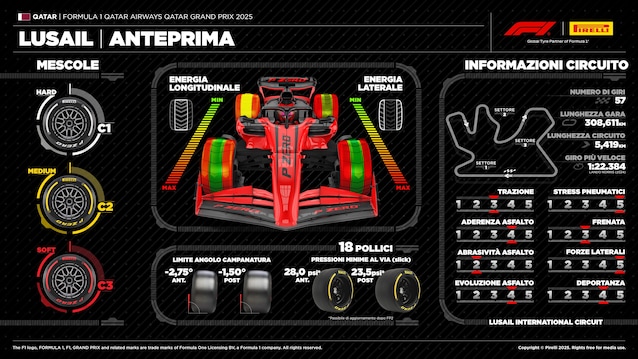
The track measures 5419 metersthere are 16 curves that compose it, 10 of which are on the right and 6 on the left. On this track, given the presence of long and fast corners, the single-seaters are required to have a set-up of medium-high aerodynamic load. The riders will race on Sunday 30 November, one week after the Las Vegas GP 57 laps for a total distance of 308,611 km. The record lap in the race belongs to Lando Norris which in the 2024 edition marked the time of 1’22″384 with the McLaren having an average speed of 236.8 km/h.
Inside the Lusail circuit: analysis of the Qatar track
The Lusail circuit is a track that seems designed specifically to test the precision and consistency of the single-seaters. The first section shows it immediately: from the grid to turn 1 they are there approximately 370 metersan important break but not “easy to overtake”. Here we find the harder braking of the entire route: you pass through 310 at 146 km/h in just 2 secondscovering 118 meters with a deceleration of 4.1 G. Although the straight measures just over 1km, top speeds are not very high due to the medium-high aerodynamic load that the cars have to carry to tackle the fast corners. The DRS is available only in this sectionwith activation point immediately after curve 16 and detection positioned before the last curve. This is also the stretch most likely for overtaking: in the edition 2023 they were good 108 against them 81 edition overtakes 2024 but despite this, qualifying in Qatar is fundamental.
The large radius of Turn 1 requires a very precise front end: the driver must set the car in support throughout the bend while gradually regaining the throttle. Turn 2 arrives immediately afterwards, you brake 50 metersalways at high speed: these two corners combine a strong increase in tire temperature, so much so that in the short sprint towards turn 4 the drivers “cool down” the tires and brakes before the next section.
Turns 4 and 5 have a similar radius and are taken as one fluid trajectory, braking only for the first. The central sector begins with the slowest corner on the circuit6, where traction and a stable rear axle are needed, here the speeds drop below 100 km/h. Immediately afterwards comes turn 7, another fast corner in support: exiting in the right place is essential to proceed curves 8 and 9 completely in full.
Turn 10 is another very significant braking: from 269 to 140 km/h in just 1.86 seconds and 93 meters of space, with a maximum deceleration of 4.1 G and a brake pedal load of approximately 125kg. Here emerges those who have a precise car in insertion: after many fast corners the front tires tend to overheat, and going out of the ideal temperature window means starting to suffer from understeer.
The third sector is a Lusail signature: three right turns above the 260 km/hto be tackled without braking and with your foot down. To do this you need a stable aerodynamic platform and a very low ride height, made possible by the smooth conditions of the asphalt. The last two turns, 15 and 16, are very different from each other. The 15 is quick and requires only light throttle modulation. The 16th is one of the most demanding braking sections on the track: you go through 287 to 157 km/h in 95 metres, with a deceleration of 4.1 G. It is the last opportunity to lose or gain time, and above all to best prepare the exit towards the main straight.
In total, an F1 car uses brakes for about 12 seconds per lapequal to 15% of the overall time. A MotoGP, on the other hand, almost comes close 40 seconds per lap (34%)more than triple. Over the course of the entire F1 race, the total load exerted on the brake pedal is 46 tonsa value comparable even to Monza despite the track being much more guided.

The new Pirelli directive on tires in Qatar and possible strategies
If in Las Vegas the pilots had to live with the cold, in Qatar the scenario is completely opposite: the air is hot and humid almost as much as in Singapore, and even at night the asphalt retains some of the heat absorbed during the day. A physically demanding context for the pilots, but above all critical for the tyres. Lusail is a route dotted with curves traveled in support that impose one lateral stress comparable to that of Suzuka or Silverstone. Particularly the stretch 12-13-14 it’s a real test for the front tyres, especially the left.
Although the asphalt is rather smooth, the energies transmitted to the tires are so high that they can generate crash phenomena graining and significant degradation, accentuated by the sand that the wind can deposit on the runway. For this reason Pirelli has chosen the most robust combination in its range C1, C2 And C3, respectively Hard, Medium And Soft.
But the real peculiarity of the Qatar GP is the extraordinary measure adopted by the FIA and Pirelli for the 2025 edition: each set of tires can be used for up to 25 laps. The count applies to all sessions on the track, including neutralizations and laps under the Safety Car regime (but not for reconnaissance, formation or laps following the checkered flag). It is a rule created to prevent the teams push tires beyond their useful lifeafter what emerged in 2023 and 2024 with wear levels at the limit of safety.
Considering that the race is tough 57 laps the strategy will inevitably be a two stopswith the management of the stints becoming the real key to the weekend. The experience of 2024 confirms this: the majority of pilots chose the Medium to start, extending the first stint beyond half the race, also taking advantage of the three Safety Cars and fitting the tyre Hard. Some teams attempted a sprint finish with the Softbut the degradation proved to be too high to be competitive.
The average time lost in the pits, including entry and tire change, is costly about 26 seconds also given the length of the pitlane 502 metersthe third longest of the entire World Championship.
The statistical side of Lusail: the “few” but good numbers of the Qatari track
Despite its recent history, Lusail has already built a small archive of interesting data. In the three editions held so far, on two occasions he triumphed Max Verstappen with Red Bull (2023, 2024), while at the circuit’s debut on the calendar he triumphed Lewis Hamilton on Mercedes. The Dutch pilot also corresponds to the track record on the flying lapwith a time of 1’20″520 scored during the 2024 qualifying, at an average speed of 242 km/h.
Curiously, no team has ever managed to score a one-two in a race, while McLaren remains the only one to have brought both cars to the podium during the 2023 GP. The statistics also speak clearly about the gaps: the largest margin remains the +25.7” of Hamilton in 2021, while the smallest one is the +4.8” of Verstappen in 2023, for an overall average of approx 12 seconds.
On the race front, come on 171 total laps held in the history of the GP, only three riders have completed them all: Verstappen, Alonso And Leclerc. Verstappen also leads the lead laps statistic, with 114 rounds in the head. The Safety Car made its debut in 2023, while there is no red flag interrupted edition yet.
