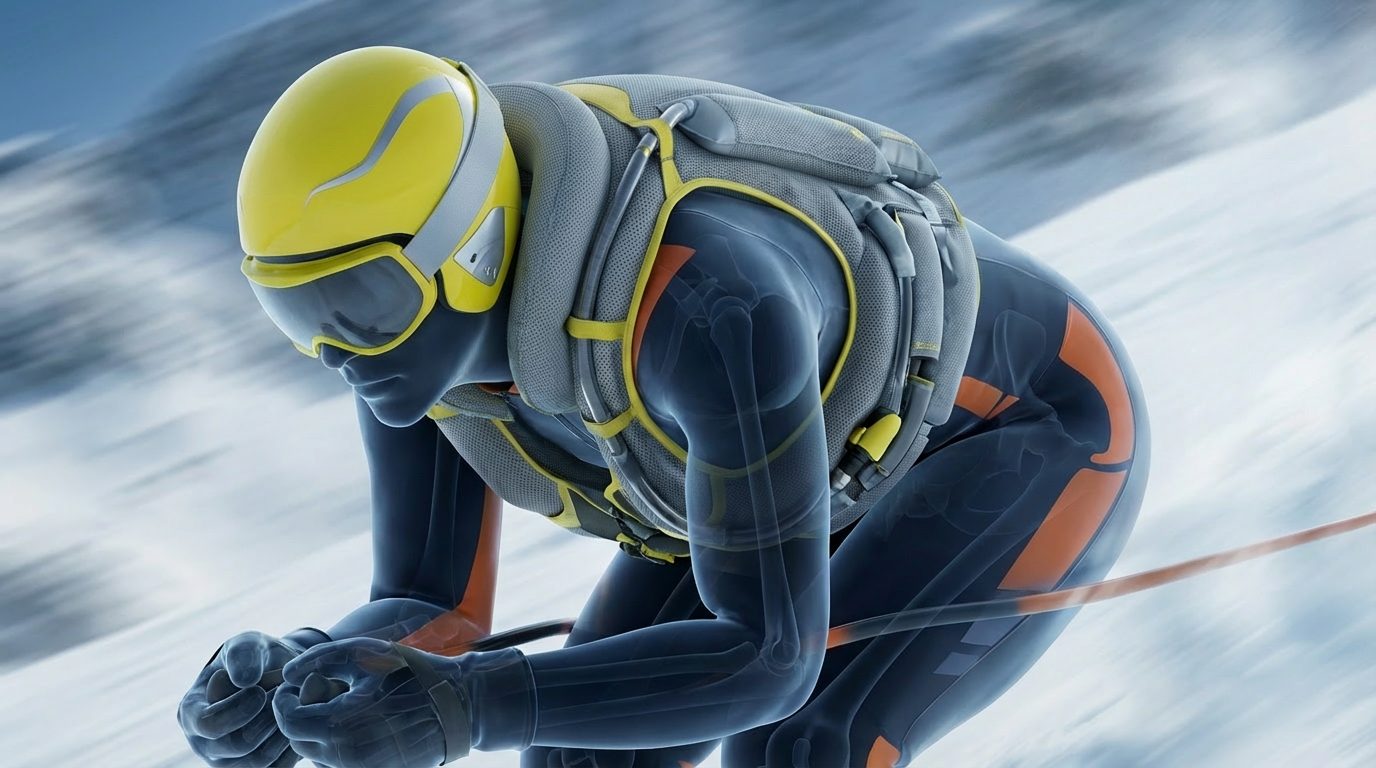
If you think of an alpine skiing race, the speed and noise of the edges on the snow immediately come to mind. Behind what you see on the track, however, lies an often overlooked element: protective device technology. In recent years, skiers’ equipment has transformed into an increasingly sophisticated system: airbags capable of inflating in a few milliseconds, helmets designed to counteract head rotations and back protector flexible that stiffen on impact. Solutions born, in many cases, from dramatic incidentswho have pushed technology towards a clear goal: allowing skiers to continue to push their limits, reducing the price they pay when something goes wrong.
The life-saving vest: the Airbag
Downhill and Super-G they are not only the fastest races in alpine skiing, in which they are also achieved 140 km/hbut they are also the most dangerous. For years, protection against high-energy trauma relied on passive solutions, until the revolutionary idea of the airbag came along. His adoption mandatory in speed competitions is a concrete demonstration of how tragedies and innovation can go hand in hand: the accident of the young promising Italian Matilde Lorenziwho lost his life during training in 2024, accelerated the introduction of this technology into racing.
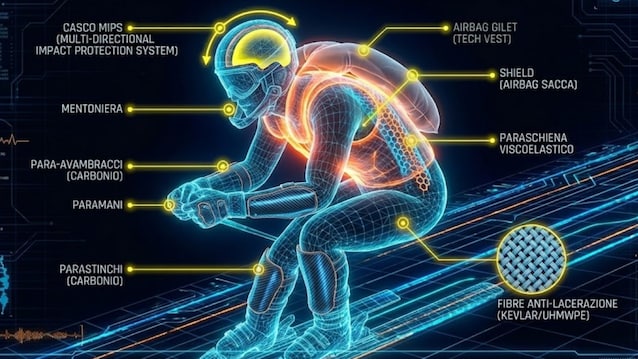
The airbag system for competitive skiing is a technical vest worn under the suit, designed to remain completely invisible until activated. Inside, sensors like accelerometers and gyroscopesmonitor the athlete’s movement and dynamics on the track in real time. This data is processed by a algorithm capable of recognizing typical situations of a fall. When the system identifies a potentially dangerous event, it activates the “Shield”, an airbag bag made of high-resistance technical fabric, designed to ensure rapid and uniform inflation.
The airbag inflates a few millisecondsmainly covering the chest and the areas most exposed to lateral and frontal impacts. Thanks to its internal structure, it distributes the impact force more evenly than rigid protectors, reducing the risk of trauma. In the case of Dainese D-Airthe bag is designed to be used up to three timesthanks to the system FRS (Fast Replacement System) which allows the skier to independently replace the gas generator and restore the functionality of the device between one race and another.
MIPS: rotational impact protection
For years, it was believed that the main problem was absorbing the force of a direct, or linear, impact. The helmets were tested by dropping them vertically. Yet, most high-speed crashes in racing don’t happen in a linear fashion; are angled impacts against snow, posts or protective nets, which cause a sudden and violent twisting of the head.
This is where the MIPS (Multi-directional Impact Protection System), recognizable by the small yellow dot on many racing helmets. It’s one very thin cap inserted between padding and hard shell. In the event of an oblique impact, it allows the head to move in a controlled manner 10 – 15 mmdiverting some of the rotational energy and reducing the risk of brain trauma. In FIS approved competition helmets, the integration of MIPS has redefined head protection, combining safety and lightness.
The development of the back protector and anti-tear fibres
The back protector it is now a fundamental component for ski safety, having evolved from the old rigid shells towards much larger devices flexible and adaptive. Most modern models use viscoelastic polymers (like D3O), which combine freedom of movement and advanced protection: in normal conditions the material remains soft and follows the athlete’s movements, while in the event of an impact it stiffens instantly to reduce the force transmitted to the spine and distribute the impact energy over a larger area.
In addition to impacts, one of the less visible but most dangerous risks in skiing is represented by lacerations caused by the edges of the skis. To protect themselves, athletes wear cut-resistant clothing under the racing suit, made with very high strength fibers such as Kevlar (used in body armor) or UHMWPE (high molecular weight polyethylene). These garments, which include tight-fitting trousers and shirts, are able to deflect the blades without hindering movement, protecting the legs, neck and arms.
Additional protection for slalomists
In disciplines like the Slalom and it Giant Slalomimpacts do not only arise from falls, but also from articulated poles that athletes repeatedly impact to shorten the trajectory.
To protect themselves from these frequent impacts, professional skiers wear:
- Shin guards, forearm guards and hand guards: in carbon fiber, light but resistant. They protect shins, forearms and hands from direct impacts without reducing the skier’s agility.
- Chin guard: a rigid metal or plastic reinforcement attached to the helmet, which protects the chin and jaw from impacts from poles.
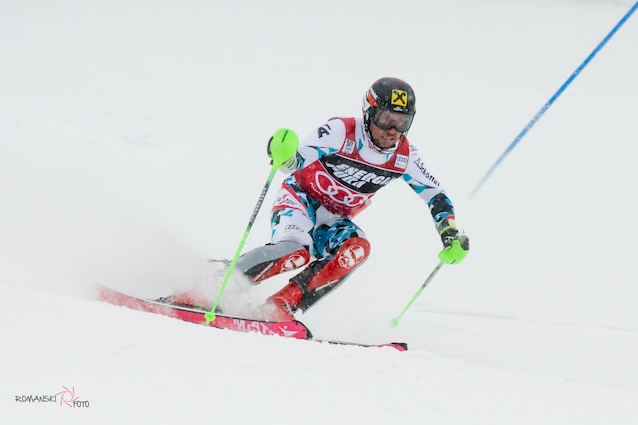
In alpine skiing the margin for error remains minimal, but the evolution of protection has profoundly changed the way athletes deal with risk.
