From Nicole Minetti to Beatrice Venezi: where has the Italy of merit gone?
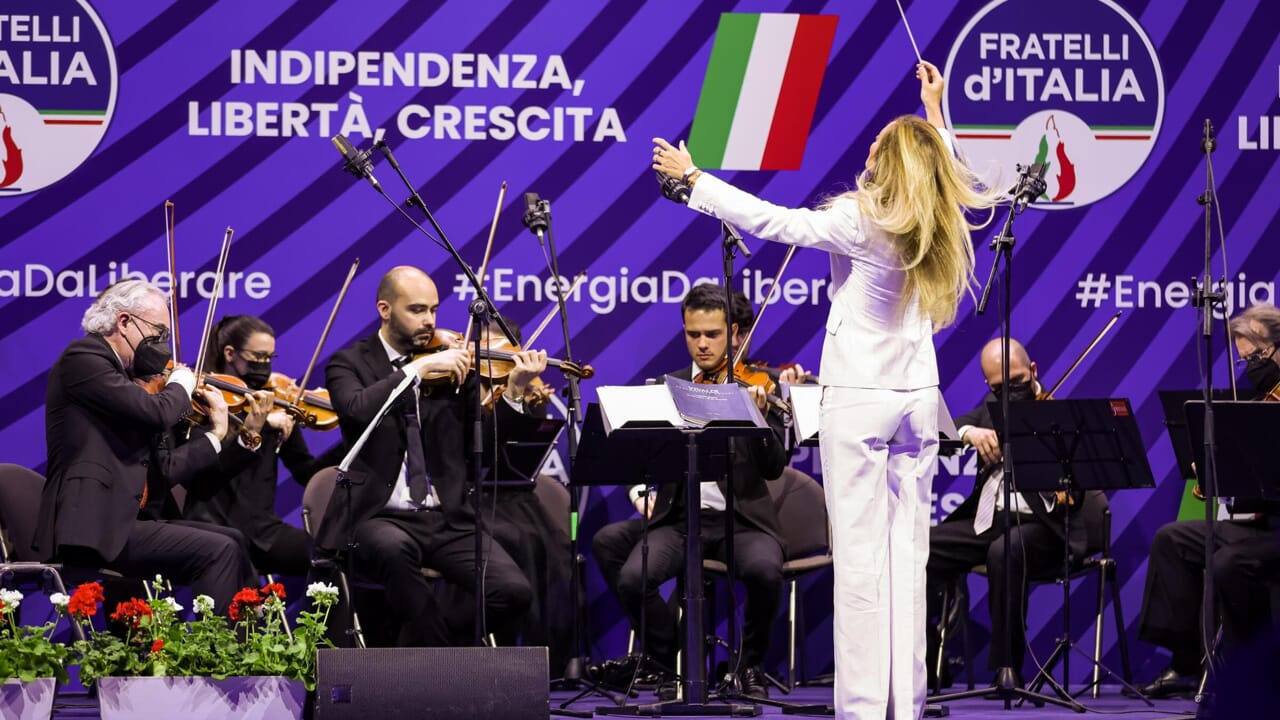
The latest case before everyone’s eyes is that of the (now former) musical director of the La Fenice theatre, Beatrice Venezi: relieved of her duties with a statement from the superintendent of the La Fenice Foundation itself, Nicola Colabianchi, from the prestigious position that the musician esteemed by the right should have assumed from October 2026 to October 2030. The penultimate case had been the catchphrase Giuseppina Di Foggiathe (now also) former CEO of Terna who is a friend of Arianna Meloni who the government torpedoed from the command deck of the important subsidiary, which deals with electricity transmission, just three years after his appointment to the same position.
One case a day: after Venezi comes Minetti
Before Venice and after Foggia, we witnessed the story of Giuseppe Del Deothe secret service manager promoted as deputy of the DIS in 2024 and then put into early retirement (at just 51 years old!) in 2025 by the same government. And before that, to the sudden dismissal of Roberto CingolaniCEO of Leonardo, appointed three years ago by Giorgia Meloni (although not attributable to his “round”: Cingolani had been made minister by Mario Draghi) and quite inexplicably not confirmed in the recent round of appointments. And again, over a month ago, in the aftermath of the referendum on justice, the public jubilation of three top brass of the executive: Daniela Santanché, Andrea Delmastro And Giusy Bartolozzi.
Without forgetting what happened in the last few hours at the Ministry of Justice, and the (probable) mess around the pardon granted by the President of the Republic to Nicole Minetti, the former protégé of Silvio Berlusconi, a provision on which the shadows of failed (or hasty) preliminary checks that should have been carried out in depth by both the general prosecutor’s office and the via Arenula department have begun to gather, and in the next few hours we will understand whether the flaw (assuming there was a flaw) is to be blamed on the magistrates of the prosecutor’s office or to the technicians of the ministry (in this case the person responsible would be the then head of cabinet Giusy Bartolozzi, former Forza Italia).
In short, a sequence of excellent torpedoes and embarrassments which, placed side by side, inevitably raise a question: doesn’t Giorgia Meloni, and the right in general, have some problems with its ruling class? How do they choose the men (or women) they then have to propose to the top institutions and top positions in the country?
To undertake a discussion of truth, it is necessary to remember that any political force has always tended to bring forward “its own”, that is, people who in some way, in addition to the professionalism required of them, also responded to a party or friendship affiliation very close to political environments. To deny otherwise would be to deny the evidence, and examples abound.
Rai as a (wrong) model of business and culture
From Rai, the direct expression of the parties to the point of reflecting their different currents, to its subsidiaries, not to mention the collateral bodies (culture, entertainment, sport, healthcare, judiciary), politics has always had its hands in as far as it could. In the first republic but also in the second, recently with some more prudence due to the increased attention of the judges, which however did not invalidate the substance.
So what is it that is striking about this right which is so clumsy in terms of appointments? Not that they divide up, that they want to place “their own”, but that they place people who they themselves then remove after a short time because they are evidently inadequate. A sign, as we said at the beginning, of an evidently modest ruling class but also of a way of selecting it that doesn’t work. Which they themselves admit doesn’t work. So what’s wrong? In a country generally rich in skills like Italy, in various fields, is it possible that a 30 percent party like the Brothers of Italy, which has governed important regions for years, which has been in the government orbit for thirty years, is unable to express a ruling class which then a year or two later does not have to be sent away due to (by themselves) ascertained inability?
Let’s take Berlusconi’s first executive (1994). The Cav, who had also entered politics only a few months earlier, brought to Palazzo Chigi people of the caliber of Giuliano Ferrara, Giuliano Urbani, Antonio Martino, Giulio Tremonti… The same Cav who then appointed people like Mario Monti or Emma Bonino as European commissioners. Why then is the right less attractive for skills that also exist in civil society?
Everyone does it: but it’s not a good reason
The answer is not simple, especially if it does not want to be simplistic, but we probably do not stray too far from the truth in reflecting how much the soup of minority culture in which this right has grown has weighed: that of “us against everyone”, “us hard and pure and all the others to besiege us”, the Tolkenian culture of the “companion of the ring”, the Hobbit Fields, Colle Oppio, the one that thinks about preserving its own purity and which in itself is exclusionary, when not sectarian. Which does not include, beyond the eternal race on the winner’s bandwagon that will have taken place this time too, as there has always been in the past but which is certainly not “ruling class selection”.
A culture of this type leads to rewarding only those who have always “been with me”, only those whose loyalty I have known for a long time, and since only seven-eight years ago FdI was at three percent, the number to draw from is not too large. A significant issue that Giorgia Meloni must resolve as soon as possible if she wants to make the leap in quality, and it won’t be easy. It means going out into the open sea of skills, from the reassuring pillars of Hercules of loyalty regardless. But not doing so would mean condemning yourself to a slow involution. The final mockery for what wanted to be the “government of merit”.
Read Pierfrancesco De Robertis’ editorials and investigations
