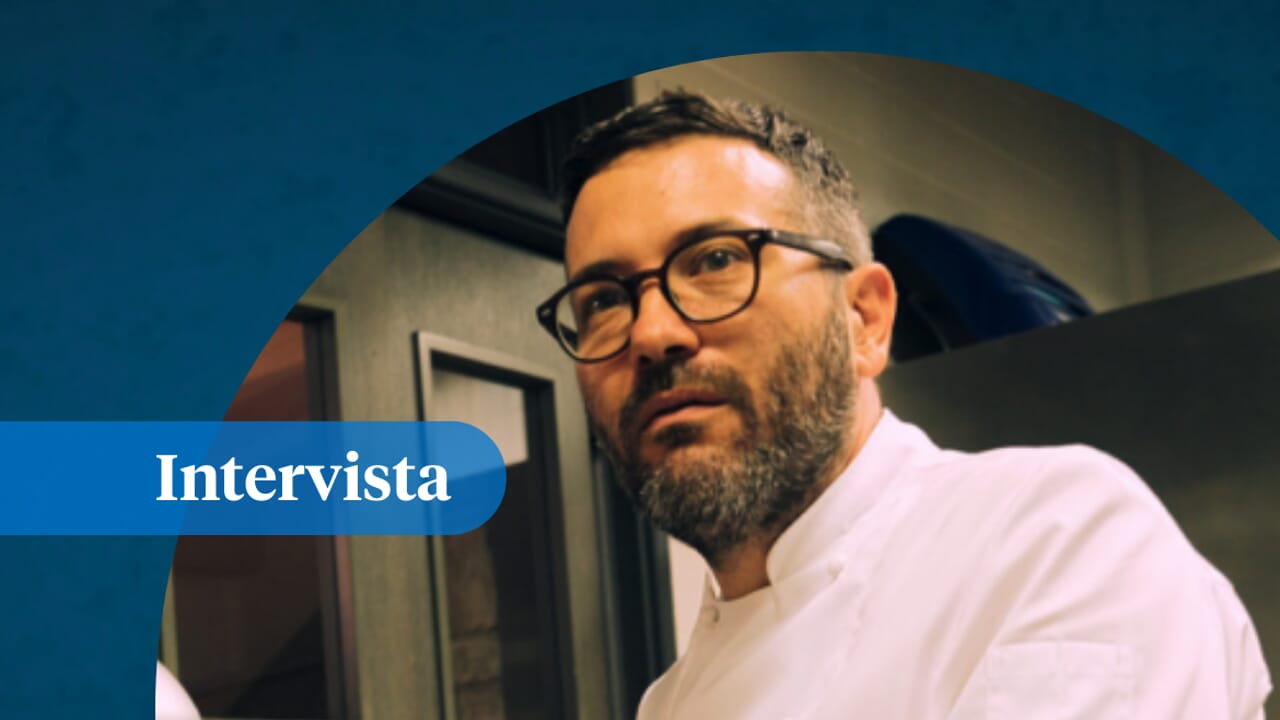
Cooking is not just his job, it’s science, it’s life, it’s his place in the world. Giuseppe Iannotti was supposed to be an engineer but he gave up his studies and was a few steps away from graduating to become one of the most important Italian chefs. To do this he risks everything, starts from scratch – he is not a son of art – and relies on the only weapons he has at his disposal: study, dedication and passion.
Born and raised in the province of Benevento, today, at 43 years old, Giuseppe manages the “Krèsios” restaurant in Talese Terme, in the province of Benevento, with two Michelin stars and only four tables and was recently the protagonist of the new TV series “Knife Edge: For a Michelin Star” produced by Gordon Ramsey and available on AppleTV.
In one of the episodes, Iannotti attempts to obtain the third Michelin star with a record-breaking dish: the smallest ravioli in the world. The size? 9 millimeters each, even checked under a microscope. And the dish? 20 mini ravioli in broth all served on a spoon.
How did the idea of wanting to make the smallest ravioli in the world come about?
“Apple asked me to think of a dish for the possible arrival of the third Michelin star and I thought of ravioli for the level of detail they require. I like the idea of making something that everyone does, like fresh pasta, “impossible”. Anyone can make a ravioli but who can make one 9 millimeters and put twenty in a single spoon? It’s something very complex.”
Is error allowed in a two Michelin star cuisine?
“No, for me cooking is science, it’s perfection, mistakes are not permissible for me. There is no such thing as overcooking or undercooking. For me everything must be perfect otherwise I wouldn’t make a restaurant with just four tables. And my collaborators must follow this thought”.
Are you strict with them?
“I’m not a bad guy but I’m very strict. I joke and play with the kids, but when you’re working you don’t joke.”
This mentality also comes from your scientific background, you studied engineering after all.
“I bring science to the dishes. I bring it to the method, to the management. I use the microscope in the kitchen, the same one that the soldering irons of the electrical circuits use. I also used it with the ravioli to check if there were imperfections”.
Why did you choose to study engineering if you liked cooking so much?
“I discovered a passion for good things since I was a child. I come from an agricultural land, I have always eaten the products of the land, drank freshly milked milk, eaten fresh bread cooked in a wood-fired oven. Then obviously, as happens in all families, they tell you to be concrete for the future, that you have to find a job. So I chose to study engineering”.
But then you dropped out of school.
“I studied computer engineering and four months before finishing I told my father that I would give up to open my own restaurant. I had an average of 29.5. My father’s response was: “I won’t even give you a lira”. Then there were liras”.
What was it like at the beginning?
“I started in 2007. In the small town of Castelvenere. I started with the numbers, always following my scientific approach. I did a market analysis, I started to bring a particular selection of meats, cured meats and other products but I saw that the territory wasn’t responding. So I said to myself: either I lower the bar or I raise it to the extreme. And I raised it.
I built a restaurant which from a commercial point of view is anti-marketing. I don’t have an approach that encourages the customer to come: the first thing we tell you is how much we cost, the second is that you can’t choose anything and the third that to eat with us you have to come to Talese, in the province of Benevento”.
But you did it.
“Saying at 43 that you’ve made it is a very presumptuous thing. I’ll be able to say it when I close my eyes. Let’s say that we fight every day with a helmet on our heads trying to give value to the territory and to the guys who collaborate with us, also because I can be everything but without them I’m nothing.”
In addition to your staff, two fundamental figures in your life are your parents who we also see in the series.
“My mother is fundamental but the real critic is my father. You should know that the most booked restaurant is not mine but my parents’ house. Even the other star chefs when they come to me want to eat at my mother’s house. It was like that for the Apple crew too.”
With your demanding job, are you able to have a private life?
“I have a family but I never talk about it. I protect that part of my life. I don’t want to expose them or exploit them to get likes. I care about my family in an obsequious way. For me, parents who overexpose their children for likes are inconceivable. Then obviously a job done like I do cannot fail to involve your life 100% but whoever is next to you must understand it. With my previous marriage it wasn’t like that.”
Is this dedication to work yours alone or does it arise from the education you received from your parents?
“In my house, since I was little, there has always been a veneration of work. We have always had this type of education where there is respect for work. I have been working since I was 14 and have never stopped. It doesn’t bother me to work, I am one of those lucky ones who chose work for themselves.”
Don’t you ever stop?
“For 15 years I haven’t gone on holiday to work, the holiday for me is two days attached to a work excuse. Even we don’t celebrate Christmas on December 25th because we work. So, with my parents and my family, at the beginning of December every year we choose when to celebrate Christmas and it can happen on any day, it doesn’t matter, the important thing is that on that day we are at home and we are together”.
How do you imagine the future?
“Always at work. And if I had to escape from everything you will still find me in a chiringuito abroad making tacos and cooking.”
