
There Crans-Montana tragedyin Switzerland, is particularly affecting public opinion in light of an apparently very simple question: how can a small localized fire become so large and so quickly as to cause dozens of victims in just a few minutes? In a film that is making the rounds a lot at the moment, and which we attach to this article, you can see a fire all in all contained in the ceiling of the local theater of the tragedy, which doesn’t seem to particularly worry the kids in the room. Within a matter of minutes, however, there would have been 47 confirmed deaths and over 100 injured. Actually, it development of a fire in a closed environment it is much more complex than it may seem at first glance, and knowing its dynamics can help us deal with an emergency situation and even save our lives in the worst cases.
From a purely scientific point of view, there are various models that describe the evolution of a fire in a delimited environment in the absence of any intervention. Conceptually, however, a contained fire predicts 5 phases:
- ignition;
- growth;
- flashovers;
- complete development;
- decay.
Quantitatively, the phases are delimited by the behavior of temperature as a function of time, as you can see in the graph below.
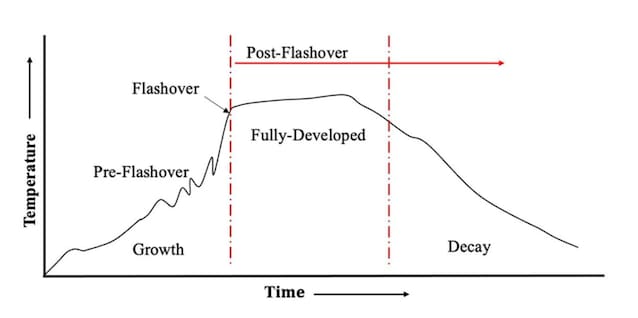
THE’ignition it can be caused by a spark, a flame, an ember, lightning or in general any element capable of providing a large, very concentrated quantity of heat. The surface where the ignition is located must contain materials capable of acting as fuelsgenerally in solid form. Initially, however, no combustion occurs: the heat decomposes part of this material without producing flames, in a process called pyrolysis which does not involve oxygen and produces volatile gases that dissolve in the air.
At this point there is the phase growthwhere the flames spread and the temperature rises. This happens because the heat produced by the flames reaches (also thanks to the hot gases developed during the ignition phase) surrounding surfaces which, once heated sufficiently, begin to catch fire. The growth rate of a fire depends on many variables, including the type of combustible material, the quantity of oxygen necessary for combustion to occur, and so on. The hot gases, and therefore not very dense, rise by buoyancy and accumulate in the upper part of the environment. It is also produced smoke due to incomplete combustion of various materials.
The phase of flashover it is the “turning point” of a fire of this type, and often also the point of no return. The hot gases, further increasing their temperature (up to approximately 600°C), emit increasingly larger quantities of thermal radiationwhich end up hitting all flammable surfaces in the room. At a certain point these materials can no longer accumulate heat: the growth phase ends and all the surfaces of combustible material are affected by the flames. The fire became generalized. This is perhaps the least intuitive part of the process: thermal radiation causes the entire combustible surface of the environment to be enveloped in flames simultaneouslyin times that can range from a few seconds to a few minutes depending on the specific situations. If this had happened in the bar in Crans-Montana, it would explain – at least in part – how the relatively contained fire we see in the footage led to the deaths of almost fifty people. In short, in a closed and isolated environment – like the basement room of the Swiss bar – too a small fire that appears not too threatening can become a deadly blaze at any moment.
In the phase of complete development everything that can burn is burning. The temperature reaches its maximum value (typically between 700 °C and 1200 °C) and the heat emission rate also reaches its maximum. Both values generally depend on the availability of oxygen present in the environment as well as the quantity and type of materials that undergo combustion. For example, a closed but well-ventilated room can always count on new oxygen entering from the external environment, thus allowing the complete development phase to extend considerably over time.
Finally we have the phase of decayin which the temperature and rate of heat emission decrease to completely zero. This phase begins when one or more of the three “ingredients” necessary to sustain a fire begin to run out: the oxidizer (i.e. oxygen), the fuel (what is burning) and the heat. In a well-insulated room, for example, the concentration of oxygen progressively decreases, as this element reacts with fuels. The percentage of oxygen in the air is 21% under normal conditions; when it drops below the 16%the flame tends to be no longer able to sustain itself. Ultimately, firefighting devices are tools that anticipate or accelerate the decline phase, removing heat and/or fuel and/or oxidizer from the fire site.
