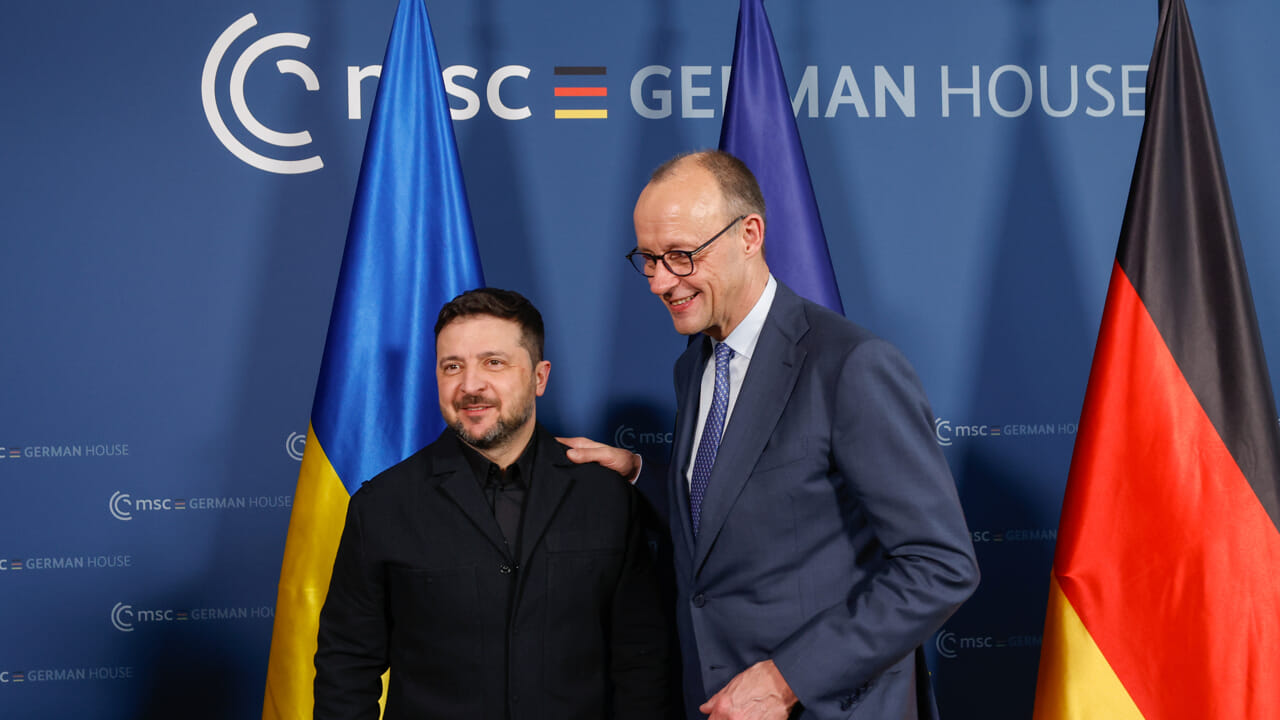
German Chancellor Friedrich Merz has proposed Ukraine’s candidacy as an “associate member” of the European Union, with a letter addressed to the major EU institutions. This is a status that does not currently exist and which would be created specifically for Ukraine. In short, it would allow the country to participate in meetings of the European Union, but without the right to vote, to elect some European parliamentarians (always non-voting) and to appoint a judge to the European Court of Justice.
Ukraine could also benefit from parts of the Union budget. Ukraine’s entry would imply the country’s participation in European subsidies, with reductions in quotas for others. The Ukrainian government had proposed to give up subsidies for a few years in exchange for a faster entry procedure.
In the letter addressed to the EU leaders, Merz recognizes that the accession process cannot be completed “in a short time”, given “the countless obstacles as well as the political complexities of the ratification processes in the various member states”. “However, in view of the peace process, we have no time for further delays. The time has come to boldly proceed with Ukraine’s European integration through innovative solutions as immediate steps forward,” says the Chancellor.
The meaning of the proposal
Friedrich Merz’s proposal was created to involve Ukraine in the European Union quickly, given that it is not possible to accelerate the process for complete membership of the Union, which began in June 2024 together with Moldova (a process which would however continue). According to Merz, the “associated membership” would not require any changes to the EU treaties nor the signing of an accession treaty by Kiev, but only “a strong political agreement”.
The proposal includes the extension to Kiev of Article 42.7 of the Treaty on European Union, i.e. the mutual defense clause, “in order to create a substantial security guarantee”. Kiev could also participate in meetings of the European Council and the Council of the European Union without voting rights, have an associate member of the Commission (without portfolio) and associate members of the European Parliament, also without voting rights.
So far the Kiev government has shown doubts about this solution, perceived as a sort of lower-level membership. Merz had discussed it with Ukrainian President Volodymyr Zelensky at the informal meeting of the heads of state and government of the Union held on 23 and 24 April in Cyprus. In any case, the plan will be discussed at the European Union-Western Balkans meeting scheduled in two weeks in Montenegro, where the main topics will be the accession of Montenegro and Albania.
Comparison with other candidate countries
Merz said the proposal “reflects the particular situation of Ukraine, a country at war.” For other candidate countries, such as Moldova or the Western Balkan countries, he instead imagines “substantial steps” on their path towards membership, such as “privileged access to the internal market and closer ties with European institutions in daily decision-making”. The goal would be to reach an agreement soon and set up a dedicated task force to work out the details. “I am convinced that we will find a common path for Ukraine and for the other candidates,” concluded the chancellor.
