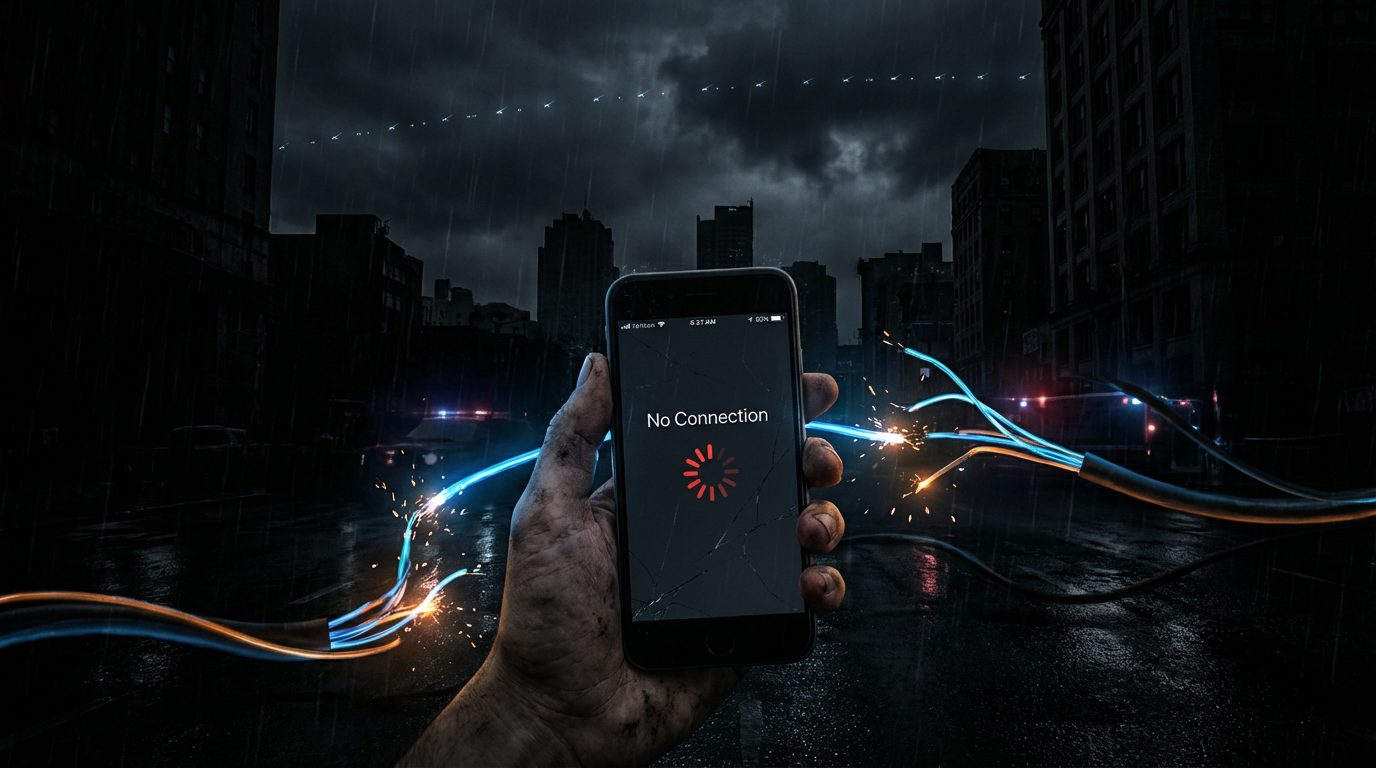
The Internet blockade in Iran during the latest repression it is not something new, given that it had already happened during the protests of 2009, 2019 (which lasted a week) and 2022: it is only proof that the regime feels threatened by the people who took to the streets against the devaluation of the Rial (Iranian currency) and the worsening of living conditions.
But have you ever wondered what it’s like, in practice, to experience such a lockdown? Within a few moments the messages no longer reach their destination, and nothing appears on social media anymore. Blank screen. What might seem like an extensive technical problem to any other democratic country is actually a political gesture aimed at making an entire country disappear, which can no longer let the world know what is happening.
Turn off the Internet for an entire nation to prevent it from transmitting information to the world or to make the organization and manner of the protests difficult might seem like something difficult (as well as dystopian) to implement, yet it has already happened several times: 2009, 2019 (lasted a week), 2022, and even in 2025, during the 12-day war. But in practice… how to do it?
Internet censorship in Iran: how is it possible
The fastest and most direct method for a nation to block its people’s Internet for a government – or, in this case, a regime – is to impose service providers to turn off the hardware devices in the control panels or the disconnection of international fiber optic cablesor block the electricity supply to the servers. But this appears unlikely, given that physically dismantling the country’s internal network infrastructures could create various kinds of difficulties and widespread disruptions.
A more likely method might be that of Deep Packet Inspectionwhich is a technique with which those who control the network (in this case the regime) “looks inside” the data packetsnot just the destination address, recognizing apps and protocols (social media, messaging and VPN) even if they try to “camouflage” themselves, blocking them or interrupting certain connections selectively. Basically, the internet is on, but it doesn’t work for everything. This system makes sure it is very difficult to use a VPN (Virtual private network), which is used to create an encrypted connection between the device in use and a remote server (by doing so, the traffic appears to originate from that server, and the original IP address is hidden, protecting the data in transit) to bypass the block.
However, the regime could also use the system Border Gateway Protocolwhich forces providers to erase digital routes connecting national IP addresses to the rest of the world, making it no longer possible to send or receive information to or from Iran.
Then there is a more selective method, which does not turn off the network but filters its contents, like the manipulation of the Domain name system (Dns): by doing so, citizens cannot reach a series of websites, social media or newspapers. In fact, if you try to land on these pages, either an error is given or a message appears (usually “controlled content”). However, DNS is a system that the most experts can easily circumvent, so the regime should use it with other more or less sophisticated methods.
The Starlink hypothesis
According to several tech industry magazines, SpaceXthe satellite company of Elon Muskwould have activated the Starlink network in Iranand precisely for this reason we received photos, videos and a series of information. The news has not yet been officially confirmed by the company, but was relaunched by the official Mossad (Israeli secret service) account.
