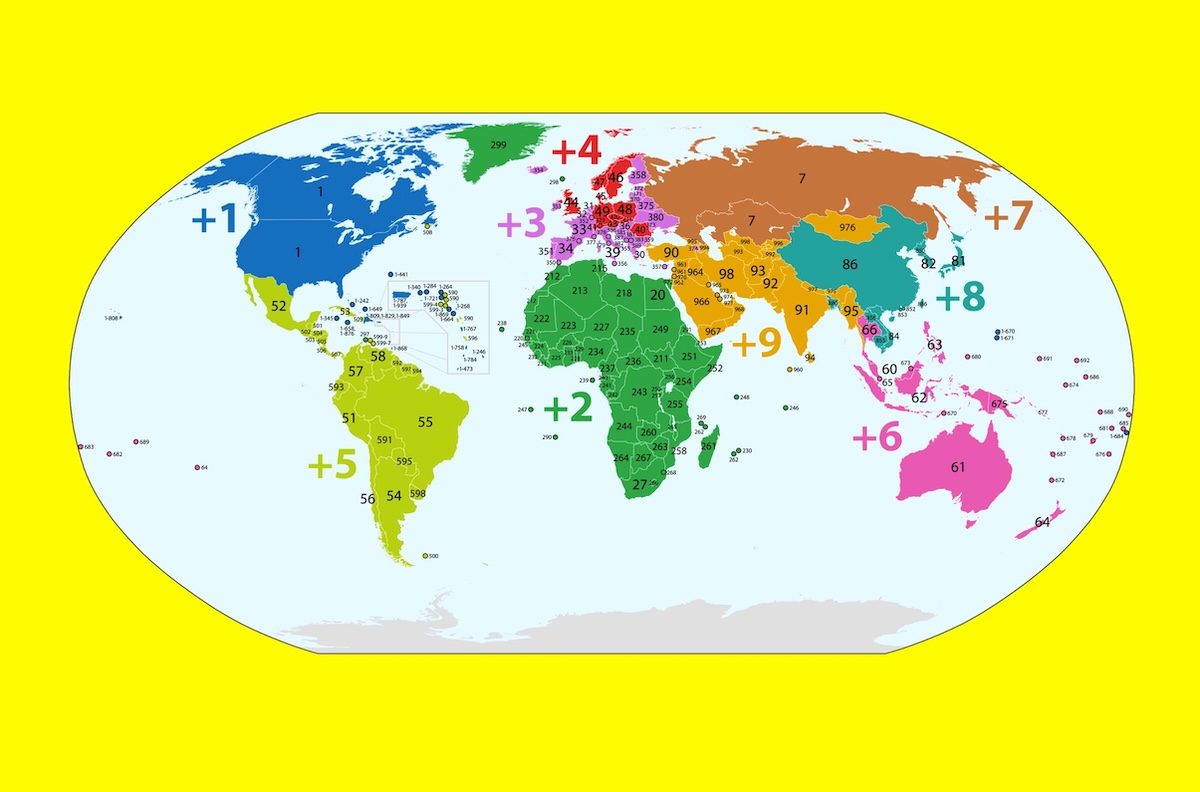
The international telephone prefix it is a code that must be added before a national telephone number to be able to make calls abroad: every country has one, for example Italian mobile numbers have the prefix +39 (or 0039), those of the USA (and Canada) have prefix +1 and so on. But how was it decided which prefix each country corresponds to? The assignment of prefixes in the various geographical areas of the planet is regulated byITU (International Telecommunication Union), an international organization founded on 1May 7, 1865 to Parisnow part of the UN and headquartered in Geneva, Switzerland. The ITU has defined country codes through specific standards, known as E.123 (which defines the notation of numbers, or how they should be written) ed E.164 (which defines the current “map” of prefixes, created in 1964).
What are the international dialing codes: from Zone 1 to Zone 9
To understand how the world is divided today, we must look at the zones established in 1964which, despite a now obsolete terminology, remain the basis of the system. There Zone 1 identifies the North American Numbering Plan or NANP and uses the single country code 1followed by a three-digit area code, to cover United Statesannexed territories, Canada and most of the Caribbean. Moving towards the Zone 2we find the use of two-digit codes (such as 20 and 27) and several three-digit series to mainly serve the African continentbut also distant territories such as Greenlandthe Faroe Islands and the British Indian Ocean Territory. THE’Europegiven its high density of nations and infrastructures, occupies entirely the Zones 3 and 4. Here, two-digit codes (including our 39, France’s 33, Germany’s 49 and the UK’s 44) and sets of three-digit codes are used to cover the rest of the continent.
Continuing our “virtual journey” among the international prefixes, we reach the Zone 5dedicated to Central and South America. The area of Southeast Asia and of theOceania falls within Zone 6. The situation is very particular Zone 7which uses the leading digit 7 to serve an immense area which today corresponds to Russia and Kazakhstan, a legacy of the Soviet bloc. THE’East and South Asiahowever, falls within the Zone 8which includes giants such as China and Japan. Finally, the Zone 9 covers a vast and heterogeneous area that includes the Middle East el’Western and Central Asia.
You can find the official list of international prefixes on the International Telecommunication Union website.
The birth of international prefixes
Looking back at the birth of international prefixeswe need to leap forward to 1960when the CCITT (Comité Consultatif International Téléphonique et Télégraphique), predecessor of the current ITU standardization sector, i.e ITU-Tintroduced the first “International Codes” during his second Plenary Assembly in New Delhi. Initially designed only for Europe and the Mediterranean basin, it would have been necessary to wait until 1964 to see the adoption of a real one world numbering zone systemwhose borders were loosely drawn based on geographic location.
The criterion for distributing numbers followed the continental mass, but the internal division depended on the capacity of each nation’s network at that precise historical moment. It is interesting to note how the hierarchy of world powers was reflected in the telephony sector: hegemonic nations received preferential treatment, while China managed to impose Not official listing of Taiwanto which the code was assigned anyway 886.
