Chatbots and virtual assistants, mathematical calculations resolved in a short time and images generated within a few seconds: theartificial intelligence (AI) has now become part of our daily lives. Precisely for this, it is spontaneous to ask: but What consumes really the AI?
Know with certainty The real consumption of artificial intelligence is rather difficult: The tech giants are not very transparent in this regard and the estimates published in recent months have never been confirmed. Easier to calculate, however, are the consumption of Data Centerthat is, the digital infrastructures underlying everything, essential for the correct functioning of the AI. According to a study published on Mit Technology Reviewby 2028 More than half of the electricity intended for the data centers will be used for artificial intelligence: this means that the AI, alone, could consume annually a quantity of electricity equal to 22 % of the energy needs of US families.
So let’s see the official estimates of the International Energy Agency and the growth forecasts for artificial intelligence until 2030.
Energy estimates consumed by artificial intelligence
As mentioned, There are no official data On artificial intelligence consumption: consequently, all the information we have on the energy impact is also estimates.
Last February, for example, the research company on artificial intelligence Epoch ai has published data (never confirmed by Openai) on the amount of energy used for one single chatgpt question: according to calculations, each message would consume about 0.3 Wattorathe equivalent of an LED bulb from 10 W lit for about 2 minutes. Generating a billion messages per day for a year would therefore mean a consumption of beyond 109 Gigawattora (GWH) of electricity, sufficient to feed 10,400 US houses for one year.
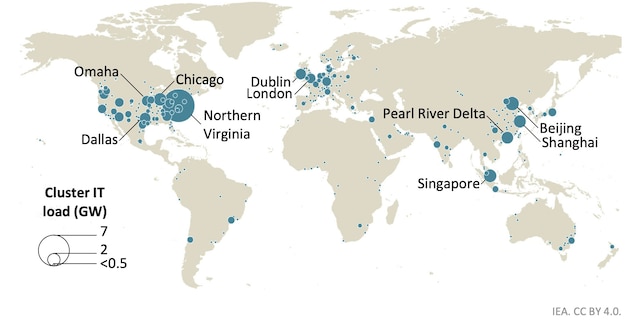
Simpler to measure, however, are the consumption of Data Center: according to the data processed byInternational Energy Agency (International Energy AgencyIEA), globally in 2024 the data centers consumed the1.5% of world electricity. These are the digital infrastructures underlying each online purchase, each item published on the Internet or of each lesson followed remotely. If between 2005 and 2017, the electricity consumed by the data centers has remained stable (despite greater technological development), in last 5 yearsthe consumption of data centers are raised by 12 % per yearbecoming essential infrastructures also for artificial intelligence models and doubling the total consumption of electricity in 2023.
In general, if a conventional data center consumes among the 10 and 25 megawatt (MW), a Hyperscale database (i.e. a large data center, built to support hundreds of thousands of interconnected servers) consumes approx 100 MW.
The problem is that these infrastructures are often grouped in big clusterswith consequent inconvenience for the local production of electricity and imbalances in the management of electricity. In Irelandfor example, the data centers consume about the 20% of the national energy needs, while in 6 states of USAthese infrastructures consume the 10% of the total electricity, with it State of Virginia in the lead with the 25%.
What the consumption of the AI depend on
In general, however, to better understand estimates on AI consumption it is possible to distinguish between two different phases:
Consumption to train the models of AI
In recent years, the quantity of data and calculations necessary to train cutting-edge artificial intelligence models has grown exponentially: according to estimates, training data for the GPT-4 model correspond to approximately 4.9 trillion of pure data.
These training calculations are performed on specialized computer chips such as GPU (Graphics Processing Unitfundamental for the development of AI): a single GPU can have a maximum consumption of nominal energy of 1,000 watts (in the case of the most recent and most powerful chip), which corresponds to the consumption of a toaster.
The large models, however, are trained using numerous GPUs: always taking GPT-4, this model has been trained on 25,000 GPUs with a combined nominal power of about 10 MW. If then all this is also the amount of energy required by cooling equipmentthe total nominal power of the equipment used to train GPT-4 is about 22 MW, which corresponds to the absorption of energy of approx 150 Coating stations for high power electric vehicles.
In short, the training of the larger artificial intelligence model requires an energy consumption of approx 154 MW; The cumulative consumption of training for large artificial intelligence models is estimated at approximately 1,700 GWh. To understand us, one family Italian type consumes on average 2,700 kWh per year (Arera data for a family unit of 4 components, which lies in a home in the climatic zone and): this means that the cumulative consumption of large AI models is equivalent to the annual consumption of approx 630,000 Italian families.
Consumption related to the use of the models of AI
The amount of energy used by AI models for each interaction depends on several factors, including:
- There length of the user demand (input) and of the response of the AI model (Output): Obviously, the longer the answers and require calculations, the higher the consumption of energy is high.
- The model size: the larger models require more calculations to process input and output and, consequently, consume more electricity.
- Input and output mode: The generation of videos and images is an activity that requires more calculations than the generation of text and therefore consumes more.
The differences in consumption to produce texts, images and videos
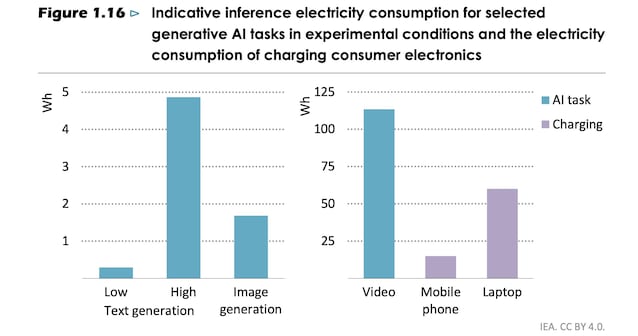
In general, therefore, the consumption of artificial intelligence models depend on the requests by users: always according to the AIA data, generate a video of a few seconds may require the same amount of energy necessary for Upload a computer twice.
According to estimates, a small linguistic model consumes approximately 0.3 WH To generate a textagainst the 5 WH medium -sized linguistic models. To recreate aimaginand, on the other hand, are consumed approximately 1.7 WHwhile to generate a short video (6 seconds) and low quality are consumed at least 115 WH.
To get an idea, Upload a smartphone requires an energy expenditure equal to 15 WHwhich pass to 60 WH If the device to be loaded is a computer.
The linguistic models of large size (Chatgpt, Gemini, Deepseek etc.), then, tend to have better performance in terms of precision and qualitybut at the same time they consume much more. According to the tests conducted by the IEA, a model of generation of images could generate approximately 55 trillion of images with about 100 TWH of input, about the Half of the annual energy needs of countries such as Iceland.
Last March, when Chatgpt began to generate images inspired by the graphics of the Studio Ghiblithe model generated 78 million of images in one day. If you then consider that, in 2025, Chatgpt has been confirmed as the fifth most visited site in the world (even exceeding WhatsApp), it is clear that the threshold of the 55 trillions of images generated is not so difficult to achieve.
The growth of AI consumption until 2030
As mentioned, in 2024 the data centers consumed about the1.5% of global electricity: according to the projections of the IEA, by 2030 The electricity consumed by the data centers will exceed i 945 TWHwhich correspond to more than triple of Italy’s energy needs (which stands around the 300 TWH).
However, it is necessary to specify. That not all the electricity required to feed the data centers depends on the AI: however, identifying precisely the demand for electricity that derives from the AI is increasingly difficult.
In a study conducted by Mit Technology Reviewby 2028 More than half of the electricity intended for the data centers will be used for artificial intelligence: at that point, the Ai alone could consume annually a quantity of electricity equal to 22% of all US families.
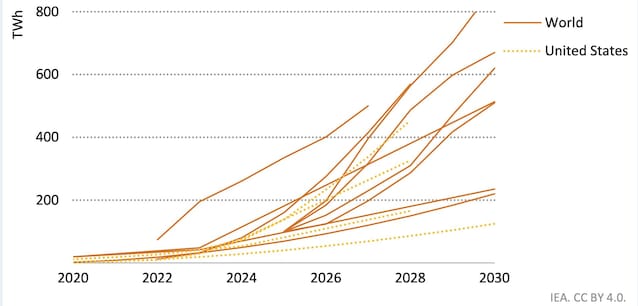
This surge will also depend on the fact that, in the future, we will not use artificial intelligence just to answer daily questions or to generate photos, but the models will become real Personalized agents based on user preferencescapable of carrying out tasks without human control and solving more and more complex problems.
The relationship between energy and artificial intelligence
There solutionhowever, is certainly not to interrupt the use of AI, also because energy and artificial intelligence depend strictly on each other: if it is true that It does not exist to the energy without energy (especially electric), it is also true that artificial intelligence has the potential for transform the future of the energy sector.
As IEA also points out, in fact, artificial intelligence can also be used for improve energy efficiency and reduce costs. For example, thanks to the use of the AI le Weather forecast They will become more and more accurate, thus allowing to foresee the energy produced by wind or photovoltaic systems with greater precision, monitoring in real time and optimizing the transmission lines.
The problem, therefore, is to find the right energy mix To feed the data centers uninterruptedly (which host the infrastructures necessary for the functioning of the AI), which must remain active 24 hours a day, 365 days a year. In other words, the data centers cannot depend on intermittent energy sources, such as renewables, which I am not able to produce energy at any time.
THE Tech giants As a destination, Amazon and Google are trying to remedy the problem by investing in nuclear energy, focusing above all on new modular technologies (the much discussed Small Modular Reactors, SMR), even if the construction of these new infrastructures will take several years.
