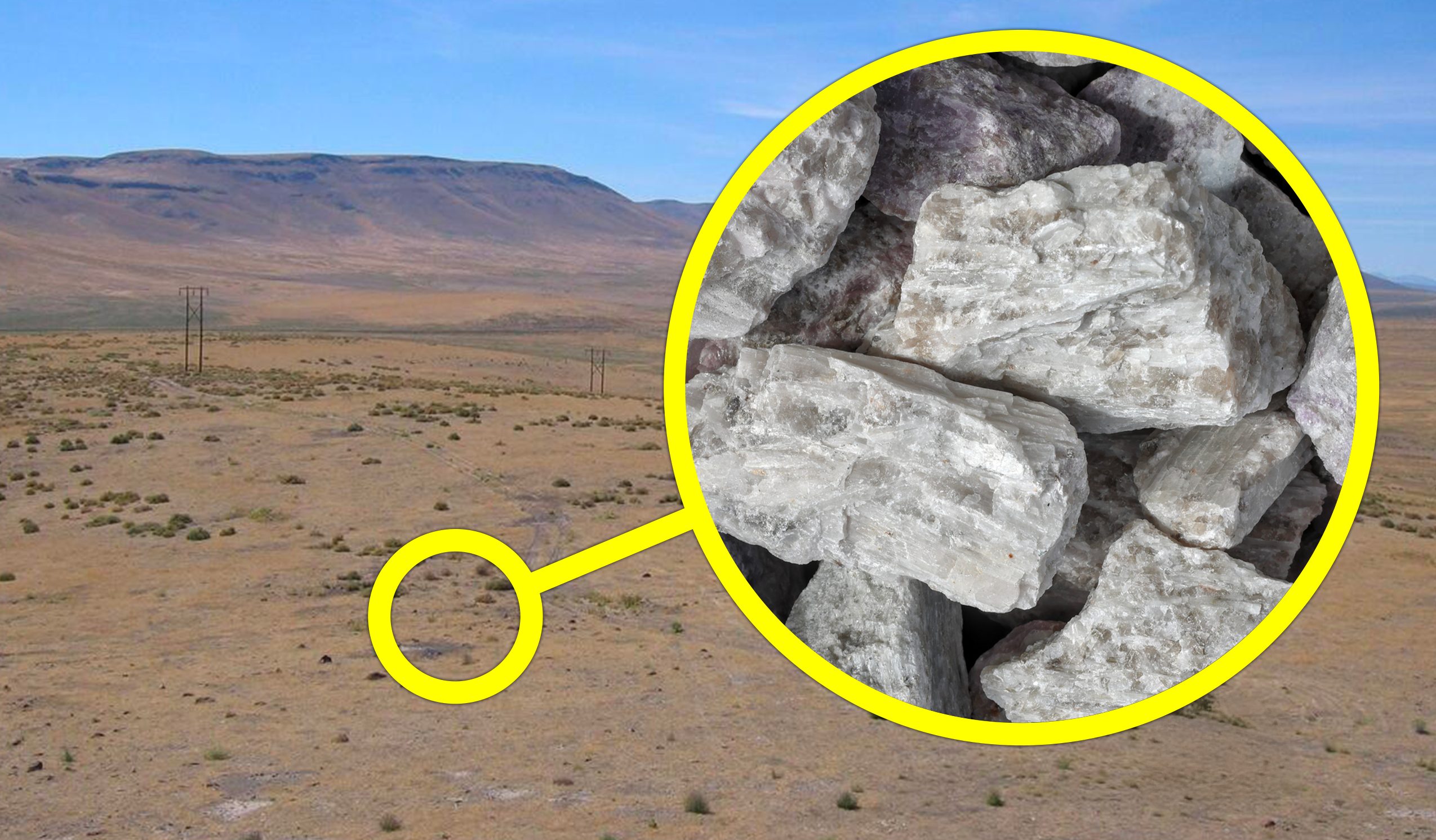
The United States may own one of the largest, if not the largest, lithium deposit to the world: this is the McDermitt caldera, whose estimated quantity of lithium ranges from 10 million tons (comparable to the largest deposit currently known, the Salar de Uyuni in Bolivia) up to more speculative estimates that even hypothesize 20-40 million tons. If these estimates are confirmed, the McDermitt caldera could represent a strategic turning point in the production of this resource in the USA. Today, almost all the world’s production of lithium is mainly concentrated in four countries, namely Australia, Chile, China and Argentina: things, however, could change.
The McDermitt Caldera and its fill
The lithium in question is found inside sediments lakeside – therefore deposited at the bottom of a lake – present inside the McDermitt caldera. These are the remains of an ancient one center eruptive volcanic which today extends for approximately 40km in length and up to 30 km wide in the northwestern portion of the United States of America, between the states ofOregon and of Nevada. The caldera and its fill were formed during the geological epoch known as Miocenein a period of time between 17 and 15 million years ago (Ma). About 16.3 Ma, over 1000 km³ of magma with rhyolitic composition – therefore rich in silica and, in this case, particularly rich in lithium – were erupted violently, causing the rapid emptying of the magma chamber and the consequent collapse structuralwith the formation of a caldera.
About the 50-85% of the material produced during the eruption accumulated inside the caldera, locally reaching thicknesses exceeding 1000 m. As evidence of the extreme violence of the eruptive event, the associated pyroclastic products were found up to distances of approximately 80km from the rim of the caldera. Following the eruption, the McDermitt caldera was occupied by a lake volcanicwithin which they accumulated further 200 m of storage lakeside until at least 15.7 million years ago. Among these deposits we recognize levels, sometimes lenticular, of clay-tuff consisting mainly of minerals such as smectites And illitiwhich host high concentrations of lithium within them.
How lithium got into the clays
According to experts, following the eruption and formation of the lake, fluids hydrothermal – that is, hot fluids present underground and rich in dissolved minerals – would have leachedi.e. progressively removed lithium from volcanic glass and pyroclastic deposits deposited in the caldera fill. These fluids would then transport the lithium upwards, traveling up through systems fractures And faultsuntil reaching the lake sediments saturated with water. Lithium was initially incorporated into minerals smectite during their training.
Subsequent interactions with hotter hydrothermal fluids they would then have triggered alteration processes of the smectite, transforming it into another clay, illite – a process known as illitization – capable of retaining significantly larger quantities of lithium within its crystalline structure. These are chemical processes and transformations that are well documented in the geological record. Furthermore, the presence of hot upwelling fluids in this region is not a surprise. Similar phenomena are in fact widely observed in neighboring areas, including the Yellowstone supervolcano itself.
The largest lithium deposit in the world: up to 40 million tons estimated
It is not yet entirely clear how much lithium is actually present in the sedimentary rocks present within the McDermitt caldera. Some regional extrapolations, discussed in a study published in 2020 in the journal Mineralsestimate an initial lithium content between 22.4 and 40 million tons (Mt). However, this is a very crude assessment. On the contrary, in a more limited and better investigated portion of the caldera, the companies Lithium Nevada And Jindalee Resources they estimated a content of approximately 7.8 Mt of lithium. In a more recent study, published in the prestigious international scientific journal Science Advancesgeochemical analyzes conducted on samples from the site Thacker Passin the southern portion of the caldera, indicate average lithium concentrations of approximately 5,100 parts per million (ppm) inside the smectites and concentrations up to 18,000 ppm in illites. Overall, the lithium content in the analyzed clay samples would be between 1.3% and 2.4% by weight.

Despite the uncertainties associated with these assessments, the authors suggest that the McDermitt caldera sediments may contain quantities of lithium comparable to, if not exceeding, the approximately 10.2 m estimated in the brines of Salar de Uyuniin Bolivialong considered the largest lithium deposit in the world. At the Thacker Pass site, in particular, a significant amount of high-lithium clay is close enough to the surface to allow open-pit mining.
Socioeconomic aspects for the United States
Lithium is today a fundamental primary resource for the technology, information technology and renewable energy sectors. If the quantitative hypotheses are confirmed, the resource contained in the McDermitt caldera could reach an economic value greater than 1,500 billion dollars Americans, as well as being able to be considered, in terms of overall dimensions, the largest lithium deposit in the world. In the global economic context, and in light of some estimates according to which global demand for lithium could reach one million tonnes per year by 2040, a deposit as large and concentrated within a single basin as that of McDermitt could allow United States to take a leading role in lithium production as well as strengthen the advancement and development of national industries based on its use.
Sources
Benson, TR, Coble, MA and Dilles, JH, 2023. Hydrothermal enrichment of lithium in intracaldera illite-bearing claystones. Science Advances, 9(35), p.eadh8183. Castor, SB and Henry, CD, 2020. Lithium-rich claystone in the McDermitt Caldera, Nevada, USA: Geologic, mineralogical, and geochemical characteristics and possible origin. Minerals, 10(1), p.68. Corrado, F., Putzolu, F., Armstrong, R.N., Mondillo, N., Chirico, R., Casarotto, B., Massironi, M., Fuller, D., Ball, R. and Herrington, R.J., 2025. Application of satellite and proximal hyperspectral sensing to target lithium mineralization in volcano-sedimentary deposits: A case study from the McDermitt caldera, USA. Remote Sensing of Environment, 323, p.114724. USGS
