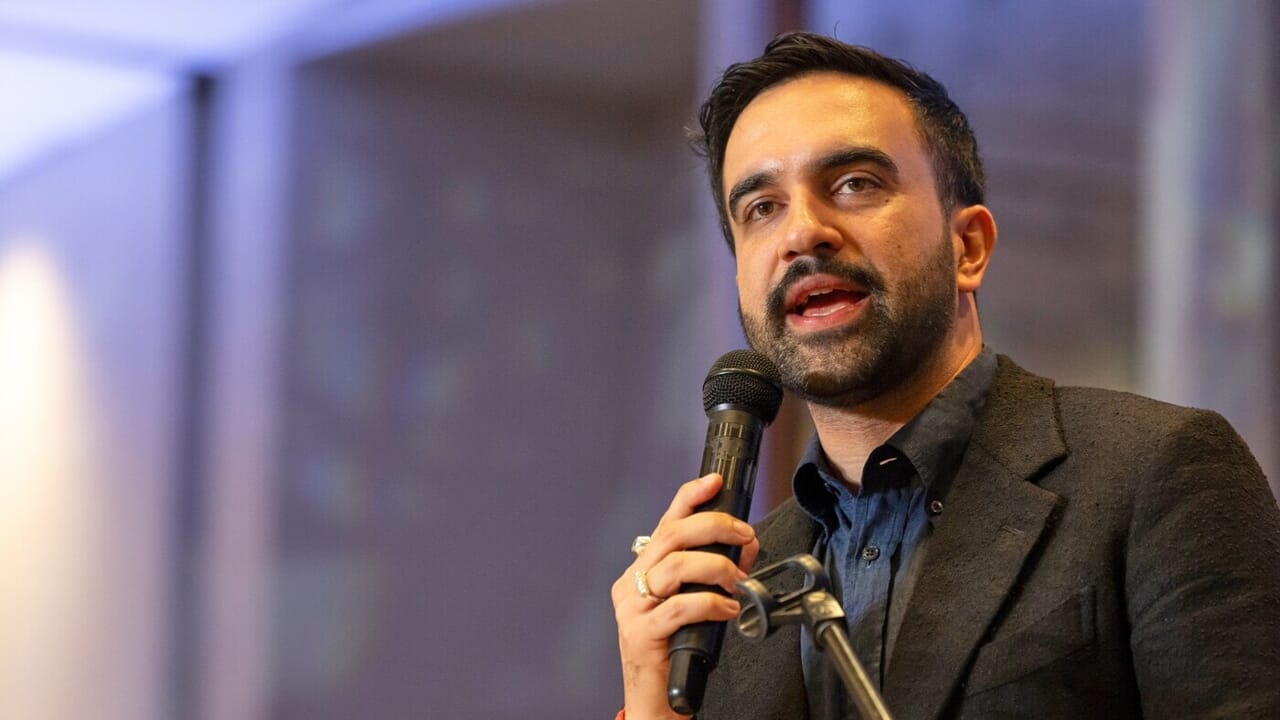
If rap was tennis, Mamdani would be a ball boy (but it helped him)
Not everyone becomes a rapper to be famous and make money. Sometimes they succeed because they seize an opportunity, perhaps the only one offered by a difficult area full of contrasts. Others don’t even know how they became successful artists: and they burn out, surrounded by a thousand transversal interests that they can’t cope with.
There are many narrative episodes also told by splendid films such as 8 Mile (Eminem) or Straigh Outta Compton (Dr. Dre, Eazy-E, Ice Cube) which tell the story of those who found money and fame between rap and hip-hop. And in some cases a brutal and quicker than expected transit to the morgue.
Also boasting an artistic career, even a membership in Ascap, the very powerful American association of music authors and publishers, is Zohran Mamdani – now mayor of New York – who had a past as a musician first under the pseudonym of Young Cardamom, then with that of Mr. Cardamom. A past that as enthusiasts we can kindly define as “modest”.
In that period Mamdani co-produced an EP entitled Sidda Mukyaalo, in six languages, with minimalist, very rough and artisanal bases, and rhymes that tried to talk about identity, migration, post-colonial culture and integration.
The mayor (almost) rapper
Despite Mamdani’s good will and effort, there is no trace of memorable hits in his musical past. But the authors’ society would reveal an income of a thousand dollars a year for royalties and copyrights. A lot of effort but little artistic reward and very little evidence. If rap were a tennis match – someone wrote – Mamdani would be a ball boy.
However, his artistic past was relevant if nothing else in the electoral story of Mamdani who used phrases borrowed from rhymes and figurative languages inspired by the world of rap and hip-hop in many speeches.
However, the mayor who presents himself as the face of progressive change in the Big Apple has a musical past that could also prove to be a double-edged sword. On the one hand, Mamdani may seem like the man who “comes from the streets”, who has direct experience of the base, employment offices and disadvantaged neighborhoods. On the other hand, it turned out that his album was almost entirely sponsored by ‘sponsors’. The same ones who financed much of his very expensive electoral campaign. A much more significant but enormously more profitable investment.
Mamdani’s rap career also weighed heavily on caricatures. Which somehow, perhaps unintentionally, Mamdani fueled. In particular when he decided to bring his grandmother – the actress and cooking author Madhur Jaffrey – on stage in a rap video which, upon closer inspection, appears more parody than serious art.
In this respect many American newspapers have been ruthless. The Washington Post, in an article entitled “How Zohran Mamdani went from C-series rapper to a political role” defined the mayor’s artistic past as undignified and grotesque: “Worse than an amateur”, says the editorialist.
In short: having a rap past is not enough to be credible. That past needs to be worth something. And there are many who consider it more of a divertissement than a trampoline.
The double game between stage and politics
However, it must be said that the story has its own charm. Mamdani didn’t just rap: he used the microworld of clubs and rapper competitions to build – or at least attempt to build – his own political identity. For example, in one song he improvises rhymes about the chapati, the omelette whose genesis is disputed by the Indian and East African coasts, with lines like “I have the same origin as the chapati, Indian origin but born in Uganda. I have the dark skin of an African but I can rap in English and Luganda” he says, citing the Bantu language of his country of origin.
Many criticized some of his raps played before his rallies: above all due to the cheesy, truly amateurish backing tracks: “It is precisely those backing tracks that represent a poor community that no longer wants to remain silent” replied the mayor. But what is surprising is that when he registered his document at New York City Hall under occupation, the employees reported that of free lance rapper as his profession.
And so yesterday’s not very successful rapper became today’s successful politician. A politician who now, however, risks finding himself pressed by increasingly pressing questions from the same community that elected him: “If you propose such weak rhymes, what will you do with the subway or the police? If the rapper was second-class, what guarantee do you have as mayor?” ask the first skeptics.
The past that becomes narration…
The point is that that chapter still remains part of his public identity. In a city like New York, where authenticity matters, the fact that Mamdani has experienced the rap scene firsthand can be presented as a sign of experience. His supporters see him as “someone who is not afraid to show himself, to make people laugh, to take on the culture of the Indian-Ugandan-American diaspora.”
But for critics it remains a story that highlights practical shortcomings: according to the New York Post, Mr. Mamdani has only three years of effective work under his belt before politics also counting his artistic participation. But above all, verbatim, “no experience in managing a budget or a municipal agency.”
Here then is the dilemma: can an improvised politician with a carefree past become a political leader? Perhaps, until we get to the concreteness of public housing, public transport, waste collection.
Bottom line: if it’s not good, at least it remains the legend
While Mamdani’s musical journey hasn’t earned him Grammys or millions of plays, his story remains curious – and perhaps useful. So much so that his songs have been listened to much more now, after his election, than before. Upon their publication. And Mr. Cardamom’s royalties could certainly grow next year. And by a lot.
In a New York that seeks “authentic”, “diverse” and “cultural” faces, a former rapper from the streets of Kampala-Queens can have charm. At the moment, if nothing else, the story of the rapper who wanted to govern the city remains one of the most curious chapters in American history in recent years. And one of his slogans, “drop the beat, run the city,” is really cool. Even if he didn’t write it. But his press office.
