
Miss a single night’s sleepwe know, can have catastrophic effects on ours Attention. A new study from the Massachusetts Institute of Technology (MIT), released on Nature Neurosciencehighlights the neurological mechanisms underlying the disaster of cognitive abilities in sleep deprivation, revealing that the brain activates processes that resemble the non-REM sleep even while awake, making us have those collapses of attention which we don’t even notice, typical of sleepless nights. In practice, if we don’t sleep, the brain “turns us off” even if we are attentive and vigilant, trying to claim what it deserves: sleep. Never before has the physiological behavior of the brain in sleep deprivation been described in such detail, and never before has it been clear how “well, if I don’t sleep, nothing will happen to me” is an erroneous belief, and above all out of our control.
The cost of a sleepless night: the brain begins to clean itself while awake
There lack of sleepas well as sleeping badly or little, has devastating effects on the functions of our brain, and in general on many of our biological functions. One of the main effects on the brain is called “attentional failure” and, as the name suggests, manifests itself with sudden blackouts, attentional disconnections in a few moments over which we have no control. This time frame, the Average reaction time increasesthat is, it takes us longer to react when, for example, they ask us a question or (even worse) when we drive, until the complete absence of response to a stimulus, during what is apparently a state of wakefulness and vigilance.
A team of MIT scientists led by Zinong Yang discovered that when we deprive the brain of sleep, it does imposes suddenly and without warning us, phenomena that normally occur during non-REM sleep. Among these is the ignition of slow waves: known indicators of “sleep pressure” (measurable physiological signals that reflect the increasing biological need for sleep), are oscillations of the electrical activity of neurons, which during the night synchronize and “pulse” together at a frequency between 0.5 and 0.4 Hz.
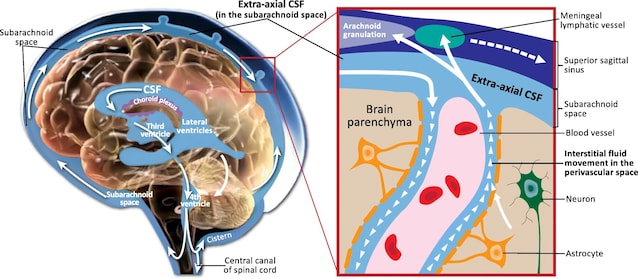
Then there is another singular phenomenon that occurs when we are awake for too long: the pulsations of the blood flow increase cerebrospinal fluida fluid that surrounds the brain and spinal cord. This is a physiological behavior, which usually occurs in stage N2 (the second stage of non-REM sleep, after the N1 stage of falling asleep), and which is believed to help “wash away” the metabolic waste products that accumulate during wakefulness. The cerebrospinal fluid is in continuous movement, even during wakefulness, but generally when we are well rested its flow is characterized by small amplitude rhythms, synchronized mainly with breathing. However, in sleep deprivation, the flow begins to show large pulsating waves similar to those characteristic of the “night wash“, which nevertheless erupt while we are awake. These are exactly these pulsations of the cerebrospinal fluid to be closely related to the exact moments in which theattention fails.
What exactly happens during “attentional failure”
By analyzing the precise timing, the researchers identified a coordinated sequence of changes involving the brain and body. Before sudden drops in attention, the pupil in the eye constricts and the waves alpha-beta in the electroencephalogram they lose power (between 10 and 25 Hz). All signs of a sharp decline in arousala technical term indicating the level of alertness, vigilance and reactivity of the body and mind. Attention finally collapses two seconds before the flow of cerebrospinal fluid begins to flow out of the brain. When attention recovers, the pupil dilates, and there is an increase in power alpha-betaall this a second before the flow of liquid reverses and is drawn inwards.
