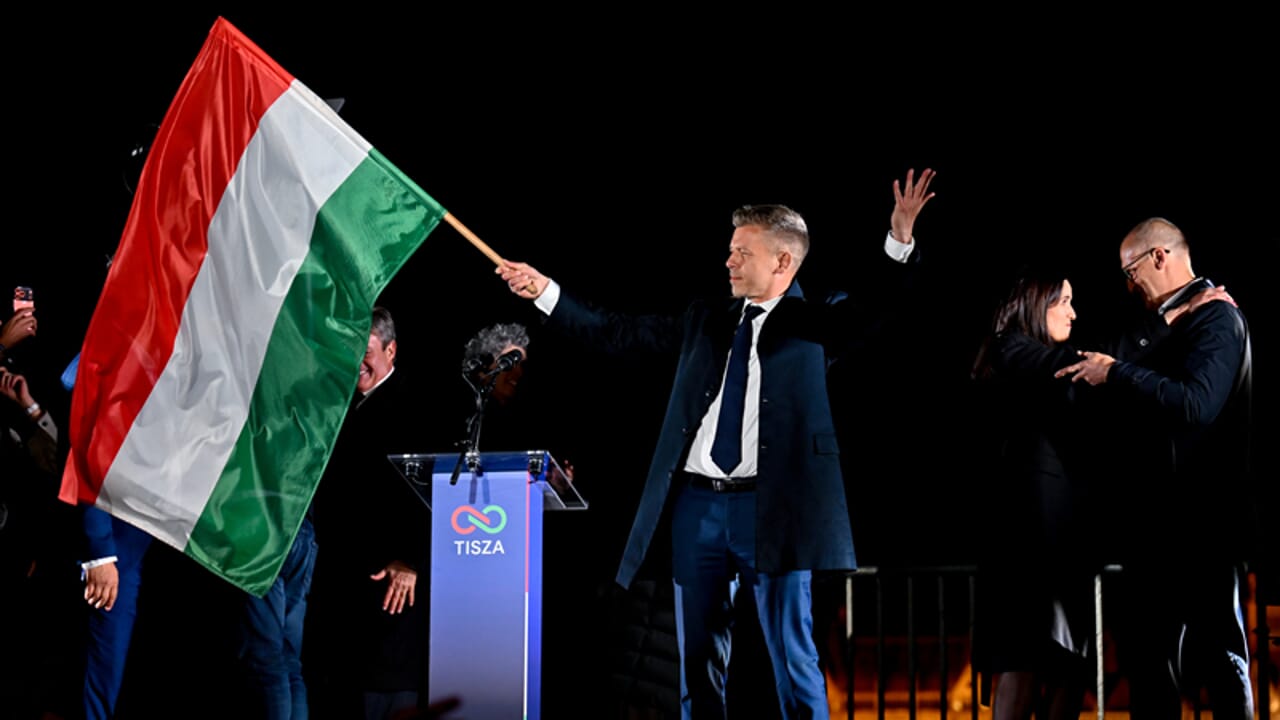
After sixteen years, the Orban era in Hungary ends with a very clear thud. The pro-European conservative Peter Magyar won a “super majority” of two thirds of the seats. The Tisza party wins 138 seats out of 199 up for grabs. The turnout was the highest ever: almost 80%.
Orban speaks of a “clear and painful” result. Magyar rejoices and immediately clarifies: Hungary “will once again be a strong ally in the EU and in NATO”. We understand what changes in Europe and in international balances, what repercussions there could be in concrete terms.
https://t.co/A4gWkr3oRG
— Magyar Péter (Ne féljetek) (@magyarpeterMP) April 12, 2026
The first speech
Magyar’s pro-European line is clear from the first words. “Hungarians have said yes to Europe,” he said from the stage of the Tisza rally in Batthyany Square, Budapest. “Together – said the 45-year-old leader speaking in front of the crowd that cheered him – we brought down the Orban regime. We liberated Hungary, we reconquered our homeland”.
Then the announcement: the first trip abroad will be to Warsaw, then he will go to Brussels to ask to “unblock EU funds”. “Hungary will be a strong ally of the EU and NATO”, he reiterated.
What’s changing in Europe
The implications of Orban’s defeat are multiple and touch on different aspects. The EU leaders, in the next few hours, will once again press on the accelerator to implement the first tranche of the loan to Kiev. The political green light could at this point already arrive at the formal European Council in Cyprus on 23 and 24 April. In reality, the veto so far has not only belonged to Hungary but also to Slovakia. But in Brussels they have long been convinced that with Orban’s departure the bargaining power of the Slovakian Robert Fico – as well as that of the Czech Andrej Babis – is destined to be reduced.
Remaining silent in recent days, the President of the Commission Ursula von der Leyen, enemy number one of the outgoing Hungarian Prime Minister, entrusted her silent joy to one line, on X: “Tonight the heart of Europe beats stronger in Hungary”.
But this Europe was erősebben dobog Magyarországon.
Europe’s heart is beating stronger in Hungary tonight.
— Ursula von der Leyen (@vonderleyen) April 12, 2026
Because Putin and Trump also lost
Orban’s defeat is also the defeat of Vladimir Putin, who in recent years has made Budapest a proxy for Moscow, also exploiting his faithful Hungarian ally to enter the halls of European power. Orban’s defeat also removes from the table the clearest internal obstacle within the EU for enlargement to include Ukraine, as well as the possibility for the 27 to continue along the path of sanctions.
Congratulations to @magyarpeterMP and the TISZA party on their resounding victory. It is important when constructive approach prevails.
Ukraine has always sought good-neighborly relations with everyone in Europe and we are ready to advance our cooperation with Hungary.…
— Volodymyr Zelenskyy / Володимир Зеленський (@ZelenskyyUa) April 12, 2026
There is another loser: Donald Trump. The American president did his utmost for his loyalist. JD Vance even flew to Budapest to support the outgoing prime minister. It wasn’t enough.
Meloni thanks Orban
And the Italian reaction also arrives shortly. Prime Minister Giorgia Meloni recognizes the “clear victory” of Peter Magyar with whom she says she is ready to “collaborate”, but at the same time thanks Victor Orban, “my friend” as she defines him without hesitation, who, she is sure, “will continue to serve his nation from the opposition”.
Unlike League leader Salvini, Meloni consciously stayed away, except for a short video message in January, from Orban’s electoral campaign, openly supported by Donald Trump’s America.
Congratulations for the clear electoral victory to Peter Magyar, to whom the Italian government wishes good luck in his work. I thank my friend Viktor Orban for his intense collaboration over these years, and I know that even from the opposition he will continue to serve his nation. Italy and…
— Giorgia Meloni (@GiorgiaMeloni) April 12, 2026
“We need to talk to everyone” has always been the mantra of the prime minister, who has often mediated with Orban to overcome deadlocks in the Council. To remind her of the close relations with Orban, when the results were not yet consolidated, Matteo Renzi thought of it: you can see the “Trump effect” but also that of the “magic touch of Meloni, King Midas in reverse”, quips the IV leader on social media, also lining up the prime minister’s support “for the anti-Europeanists in Poland” and in Spain” and underlining that they too “have lost”.
This is “extraordinary news” for +Europa (a party delegation is in Budapest), the “electoral defeat of the tyrant Orban, enemy of the EU and the rule of law”, as Benedetto Della Vedova says, and a “great day for Europe” which must be “liberated from Putin’s servants (#Salvini)” for Action leader Carlo Calenda. While for the dem secretary Elly Schlein, the Hungarian vote says that “Orban lost, Trump lost and Giorgia Meloni and Matteo Salvini lost, with their embarrassing videos in support of an autocracy”. Every step “of great democratic participation”, adds M5S leader Giuseppe Conte, is proving to be “a nightmare for the patriotic purposes of our home”.

Who is Peter Magyar
Peter Magyar was born in 1981 to a family of lawyers, studied law and worked for the Foreign Ministry. He then went to the prime minister’s office in Brussels, later moving to a state bank and running a student loan agency. In 2006 he married Judit Varga, who would become Orban’s Justice Minister. The two, later divorced in 2023, have three children.
Peter Magyar is a former member of Fidesz, the party of the now former prime minister Viktor Orban. His political explosion came in 2024, after a noisy break with the system: he said he felt disillusioned by the corruption and propaganda seen from the inside. From then on the relationship turned into open hostility. Orban has treated Magyar as the political face of the external front that wants to overthrow him, associating him with Brussels and Kiev and presenting the vote as a choice between “war and peace”, insisting that “for peace, Fidesz is the safe choice”.
