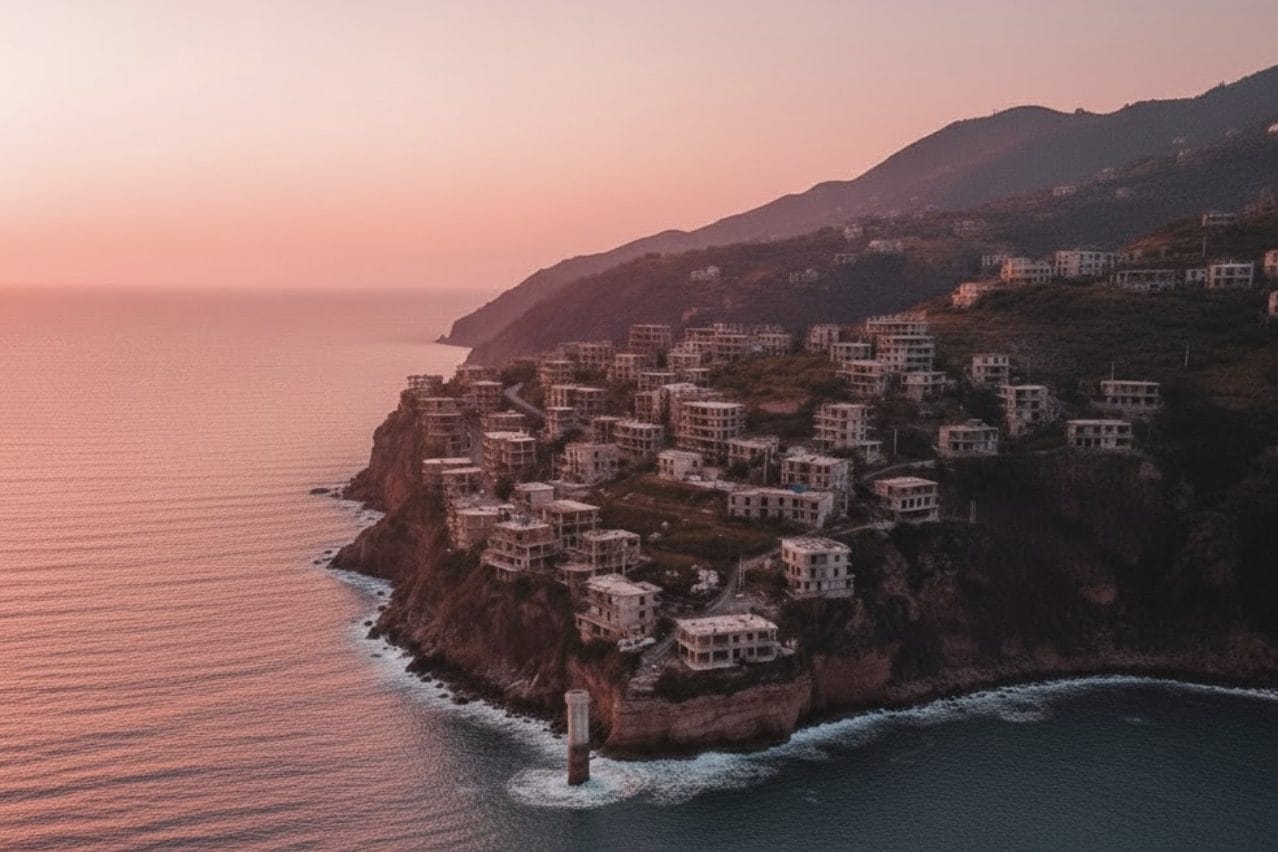
In Southern Italy one building in two is illegal: this is what Cresme (Centre for economic, sociological and market research in construction) and the Istat 2024 Bes (fair and sustainable well-being) report say. If in the North illegal dwellings are 4.3% of the total and in the Center they rise to 14.7%, the figure skyrockets in the South, reaching 40.2%. In particular, I am the Calabria and the Basilicata to hold the record of regions with more illegal construction: for every 100 authorized buildings, 50.2 are illegal.
Recently, the issue has returned to the fore given the upcoming elections in Campania: the Fratelli d’Italia party – which would like deputy minister Edmondo Cirielli to be president of the region – would in fact like to modify the budget law to reopen the building amnestythat is, the possibility of bringing houses built without permission into compliance. But the opposition and the associations believe that this is not the right method to stop the rampant illegal construction in Southern Italy, given that the amnesties can pass for an incentive for those who build (or have built) without any respect for the public good, while the solution must pass through a solid and well-structured reform of urban planning policies.
What is illegal construction and why is it dangerous
When we talk about illegal construction, we mean a house – or more generally a building – which, either entirely or in part, has been built without the permits required by lawor that was built differently than permitted really authorized. In essence, therefore, illegal buildings are built with works not permitted by law because violate urban planning, environmental and safety regulations.
A very common example of this type are the extensions to a property without permission (and therefore the construction of a room, a floor or a terrace when by law it would not be permitted) and often without any type of qualification (the building permit), or the construction of buildings in coastal, protected or landslide-prone areas, or on unbuildable agricultural land. Building in this type of area in fact means erosion, soil consumption and instability which in the event of earthquakes, floods and landslides can lead to the death of the inhabitants of these properties. In particular, in the 1990s and early 2000s, there was a period in which in Campania there were at least 5,000 cases of building abuse per year, and the homes in question were almost all built in “highly attractive” areas (Ischia, the Amalfi coast and Campi Flegrei) with the excuse of the need for new homes.
But illegal construction is also dangerous citybecause neighborhoods become chaotic and busy, and public spaces disappear. Both in the case of illegal buildings built in risk areas and in the city, the costs for the State are very high: demolitions, in fact, are very slow, and endless disputes arise, given the timing of Italian law.
What the data say and why illegal construction is so widespread in Southern Italy
The Cresme findings and Istat data speak clearly: the phenomenon is almost nil in the North, but gradually as we move towards the South, the data increases.
In the North, in fact, the illegal activity index is very low, and there are approx 4.3 illegal homes for every 100 authorized homes. In Central Italy the figure rises, with 14.7 illegal homes for every 100 authorized. But let’s move on to the South, where the figure rises to 40.2.
In particular, Calabria and Basilicata hold this sad record (54.1 out of 100), followed by Campania (50.4 out of 100) and Sicily (48.2). The region governed by Vincenzo de Luca stands out for its own record, that of orders issued in relation to the population: according to the Legambiente study, in fact, from 2004 to 2022 one case was opened for illegal construction for every 236.6 inhabitants.
But why is illegal construction so widespread in the South? The phenomenon is fueled by a series of structural factors:
- Weak controls (or understaffed technical offices)
- Few demolitions: often less than 20% of those ordered
- Expectation of amnesties: every time it comes up, many hope to be “regularized”, and the recurring expectation of amnesties fuels new abuses
- Housing needs: many people feel the need to expand their home quickly, thus avoiding prolonging the bureaucracy. Furthermore, expanding illegally allows you to avoid many costs (design by architects, building practices costing hundreds or thousands of euros, urbanization charges, construction contributions, very expensive mandatory adjustments that many cannot afford)
- Social issue: in many municipalities, almost all houses have at least one illegal part, and it is convenient for almost anyone to turn a blind eye to the issue
What can happen when a building violation is discovered
In this field we must pay attention to the terminology: when we talk about building abuse we mean the illegal act, i.e. the single illicit intervention; thebuilding abusiveon the other hand, is the result of building abuse, the house built or modified illegally.
If the building abuse is discovered, technically the Municipality should order thedemolition of the building in question. If the Municipality does not intervene, the Prefecture should do so. But if for some reason the property could not be demolished, the building would pass “free of charge” to the municipal heritage.
In practice, however, are performed very few demolitionsespecially in the South. According to the Legambiente study regarding failed demolitions in Lazio and Southern Italy, from 2004 to 2022 the 485 Municipalities taken into consideration issued a total of 70,751 demolition orders, but 10,808 demolitions were carried out, i.e. a paltry 15.3%.
How building violations can be remedied
Building violations can only be remedied through ordinary amnesty or building amnesty.
There ordinary amnesty it is a procedure provided for by law that allows you to regularize some building abusesbut only in very specific cases. To explain better: if a part of the house was built without permission (partition moved, mezzanine built without having been declared, attic that becomes an attic, garage that becomes a tavern), but complies with urban planning and environmental rules, you can ask the Municipality to “bring it into compliance”, as if the permit had been requested late. Simply put, the building is “regular”, but contains abuse buildings also known as “partial discrepancies”. After a verification by the Municipality, if there is compliance, the amnesty can be granted.
The amnesty can only be granted if the abuse was “authorized at the time“: this means that the part built without permission must be compatible with the law that existed at the time it was built. For example: in 2015 a person closed a balcony of their house with a veranda, and did so without asking for permission. In that year, the building regulations allowed it to be done, so they can ask for an amnesty and obtain it. In practice a delay is forgiven, not the wrongdoing.
However, if the law had prohibited such a modification at the time, the abuse cannot be remedied with an ordinary procedure. And this is where the building amnestythat is, an extraordinary law that “forgives” works that they would never have been authorizednot even in the years in which they were made. In this case, it is the wrongdoing that is forgiven.
Because in politics there is a battleground over building amnesties: the associated risks
On a political level, not everyone is in favor of granting amnesties, for various reasons: first of all because this type of law in some way “forgive” who built illegally, while those who respected the rules paid designers, taxes and charges, and it would be an affront to the latter who behaved honestly and paid and respected the rules.
Furthermore, on a political level, promising amnesties is risky because, while waiting for new rules in the Municipalities, the demolitions are suspended for years, and doing so generates an administrative stalemate in which practices remain stagnant and neighborhoods remain in situations of more or less dangerous irregularities (think of illegal houses built in highly bradyseismic areas).
Furthermore, the message that is conveyed is potentially dangerous, namely that if it is built illegally, sooner or later it will be forgiven. Following this reasoning, therefore, we will continue to build without permission while waiting for the next amnestiesdisrespecting the environment, human lives and those who build legally.
Furthermore, many politicians believe that those who propose amnesties in areas where the phenomenon is widespread do so exclusively to obtain the votes of those who live there, who do not want to see their homes demolished. The amnesty therefore becomes a means of political propaganda.
The solution to building abuse is not easy to find, but an excellent starting point would be the increase in the technical staff who have to deal with the checks (still understaffed) and the checks themselves, with uniform procedures throughout Italy. The sanctions, then, must be truly applicable, with certain times for demolition or restoration. Furthermore, vigilance should be constant, because without it it is also the best reform of urban planning policies can fail.
Currently, a reform of this type would be more than necessary, especially to improve the coordination between the State, Regions and Municipalities and avoid conflicts of jurisdiction that slow down action against abuse. And then, make the procedures simpler and clearer (the text should be as specific as possible, to avoid “grey areas” that lend themselves to arbitrary interpretations) and make it more difficult to circumvent the construction rules.
Even before this reform, however, it is essential get to the roots of the problem of illegal construction, and understand why many Italians choose this path and what can be done in practice, such as significantly reduce construction costs or offer concessions for restructuring and the recovery of existing houses, instead of new illegal constructions. At the same time, they are necessary forward-looking housing policiescapable of reducing the pressure to build illegally, especially in the most sensitive areas or where the demand for housing is particularly high.
