
To the Phlegraean Fields seismicity remains contained despite the earthquake of magnitude 3.3 recorded today, 7 April, with an epicenter 5 km from Pozzuoli: according to what was reported in the latest weekly INGV bulletin, from 30 March to 5 April just 26 earthquakes were located in the Phlegraean area, with a maximum magnitude of 2.1. This is a slight increase compared to the 13 tremors the previous week. Throughout the month of March 2026the Vesuvian Observatory recorded 178 earthquakes with a maximum magnitude of 2.4a clear decrease compared to the 254 earthquakes located in the 28 days of February.
Meanwhile, INGV has confirmed the end of the earthquake swarm started today, April 7, at 04:32, during which 16 tremors were recorded, of which the strongest was that of magnitude 3.3.
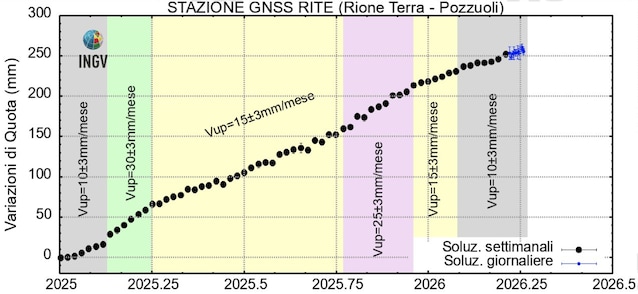
From the point of view of soil lifting due to bradyseismin the reference week the situation remains unchanged, with the average monthly speed standing at 10±3 mm per month. The geochemical parameters are also stable, with the temperature of the fumarole in the Solfatara crater confirming an average value of 173 °C.
Seismicity remains low: in one week 26 tremors with a maximum magnitude of 2.1
In the week from March 30 to April 5, 2026, a26 earthquakes were recorded in the Campi Flegrei, with a maximum magnitude of 2.1. Only two tremors, however, had a magnitude greater than 2.0, therefore at the limit of perceptibility for the local population. Compared to the previous week, the total number of seismic events doubled (going from 13 to 26) while remaining at low values, with the maximum intensity of the tremors rising from 1.0 to 2.1.
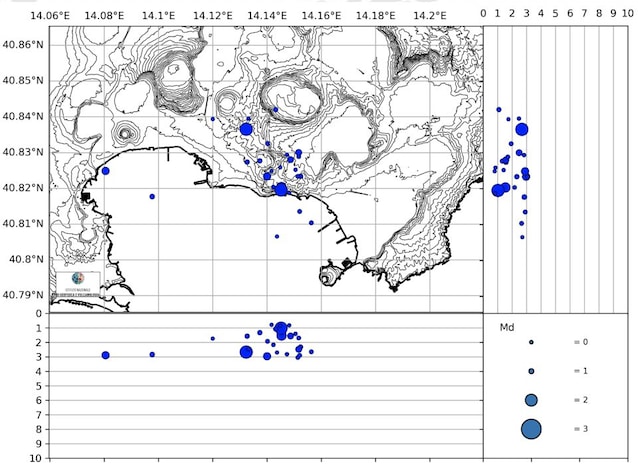
At the same time, no seismic swarms were detected and the depth of earthquakes it was maintained superficialvarying between 1.03 km and 2.97 km. This happens because in the Phlegraean area the seismicity is due to bradyseism: earthquakes are not generated by classical tectonic movements, but by the deformation of the earth’s crust caused by the thrust of fluids and uplift.
Stable bradyseism, with the ground lifting speed at 10 mm/month
As of February 2026, the average speed of ground lifting (due to bradyseism) has settled back up values equal to 10 ± 3 mm per monthbucking the trend after the acceleration recorded between October and December 2025, when the speed reached 25 mm/month. Since January 2025, the total lift recorded at the GNSS station (Rione Terra) is approximately 26cm.
The geochemical parameters are also confirmed in line with the already known increasing trends, both in terms of gas flows emitted and in terms of temperature of the fumaroles. In the reference week, the temperature in the Pisciarelli fumarole showed an average value of ~95 °C, while at the main fumarole (BG) in the Solfatara crater an average value of approximately 173°C.
The INGV weekly bulletin in summary
In summary, the latest weekly bulletin of the Vesuvian Observatory on the activity of the Campi Flegrei reported:
- Seismicity: it remains at low levels, despite today’s seismic swarm. In the reference week, 26 earthquakes were located with a maximum magnitude of 2.1.
- Bradyseism: confirmed stable from February 2026, with a ground lifting speed of approximately 10±3 mm/month.
- Temperatures: values substantially unchanged (around 173 °C in the Solfatara crater), in line with the long-term trend which indicates a progressive warming of the hydrothermal system.
