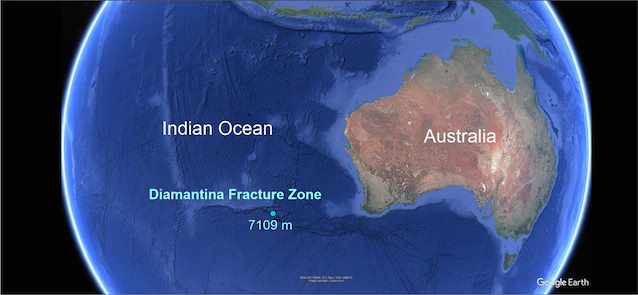
On the backdrop of Diamond PitWhale graveyard has been discovered in the southeastern Indian Ocean deepest and most extensive ever found in the world: 476 fossil cetaceans distributed along 1,200 kilometers of seabed, at depths between 4,616 and 7,001 meterssome dating back to 5.3 million years agoothers still decomposing. A stratified and continuous archive that no other known oceanic area can match. This is documented by a study published in Natureconducted as part of the Global Hadal Trench Exploration Program (GHEP) and created with the contribution of paleontologists Giovanni Bianucci And Alberto Collareta of the University of Pisa. The discovery is the result of dives conducted by Fendouzhethe Chinese Academy of Sciences’ manned bathyscaphe capable of operating above 10,000 meters of depth. This discovery sheds new light on the so-called whale fallthe “fall” phenomena in which the death of a single giant of the sea gives rise to a true oasis of life in the depths.
What happens when a whale dies: whale fall
The Fossa Diamantina belongs to the so-called hadal zonethe deepest and most remote part of the abyss located between 6,000 and 11,000 meters deep. In this “liquid desert” the pressure exceeds 600 atmospheres, the temperature is close to zero and sunlight is a memory miles away.
But why did this abyss turn out to be an immense whale cemetery? To understand this, we need to look at what happens when a cetacean dies. Its body begins a long descent and, once it hits the bottom, the carcass transforms into one source of nourishment for deep-sea organisms.
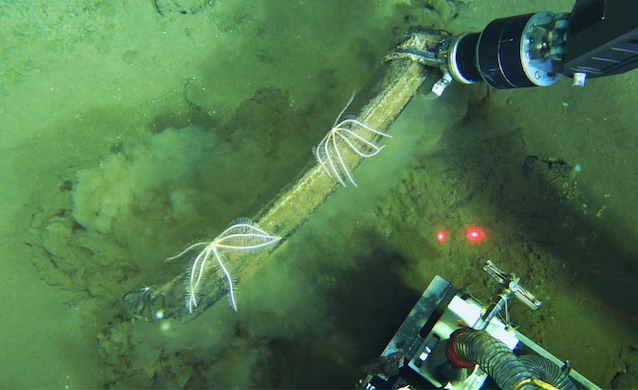
In the early stages, which last only a few months, deep-sea predators and scavengers intervene en masse to consume the soft tissues. Subsequently, the organic debris settles to the bottom enriching the surrounding sediments, while special marine worms (genus genus Osedax) begin to perforate the bones. Eventually, the remaining skeleton becomes the mainstay of the ecosystem for years or decades. The bones both provide a solid surface on which they settle sponges, starfish And pedunculated anemonesis a precious source of sulfides deriving from the decomposition of internal organic compounds. This is where anaerobic bacteria initiate the chemosynthesis deriving energy from sulfur compounds in decaying bone.
Right along the explored seabed of the Diamantina Trench, the research team has identified well five active communities of whale fallor carcasses still decomposing. Communities of unique organisms and species that have largely never been described by science thrive around them, finding the vital energy to survive in these remote oceanic cemeteries.
The 476 fossils of the Diamantina Trench: from beaked whales to the new species
The discovery in the Diamantina Trench is the result of dives conducted by Fendouzhethe Chinese Academy of Sciences’ manned bathyscaphe capable of operating above 10,000 meters, as part of the Global Hadal Trench Exploration Program (GHEP). The project’s steering committee includes researchers from 11 countries including Italy with Giovanni Bianucci And Alberto Collareta of the Department of Earth Sciences of the University of Pisa. The vast majority of 476 fossil remains belongs to beaked whales (Ziphiidae), odontocete cetaceans (with teeth, like sperm whales) of variable length between 4 and 13 m, specialized in diving to very great depths, regularly between 1,000 and 2,000 meters.
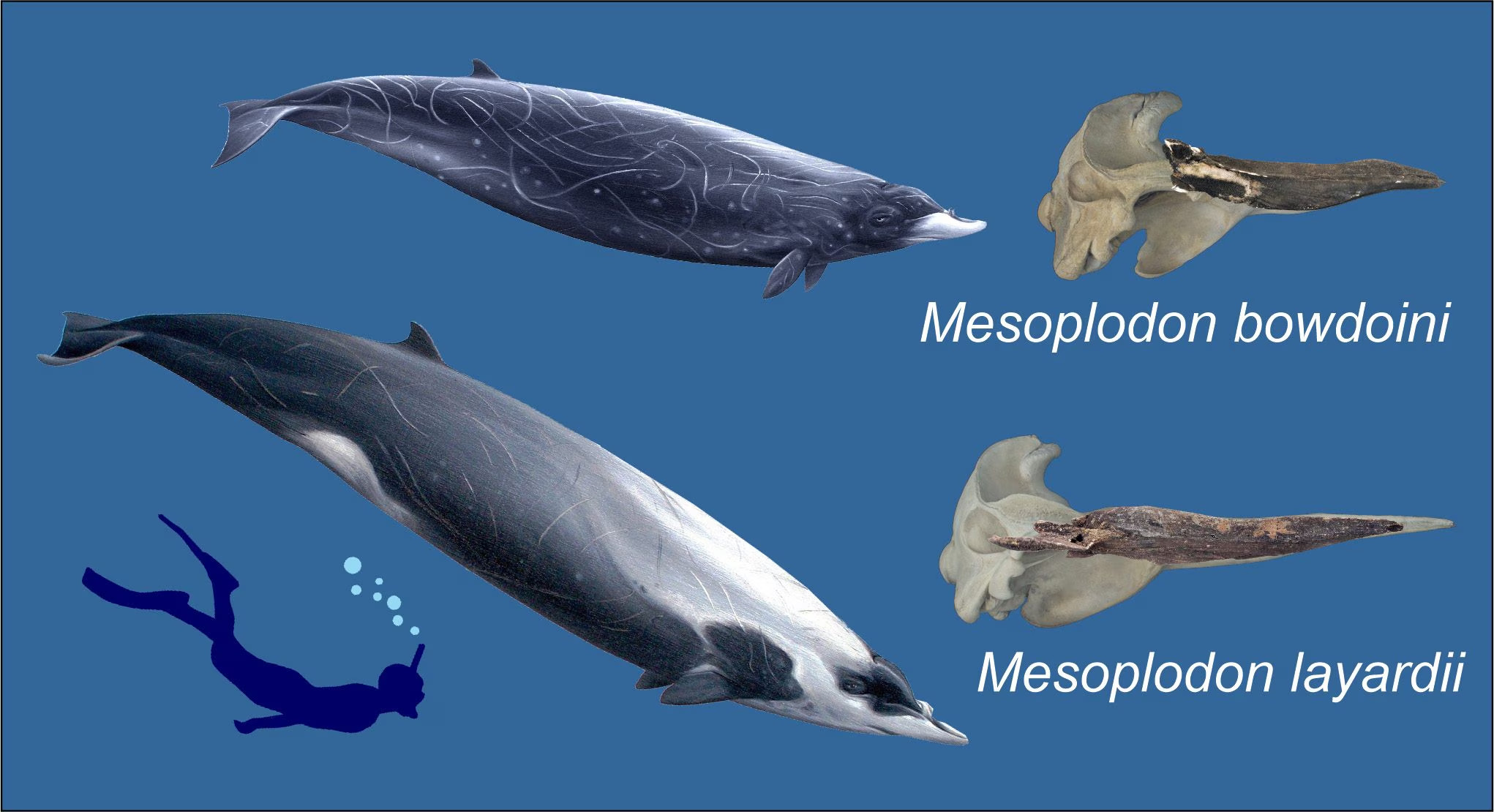
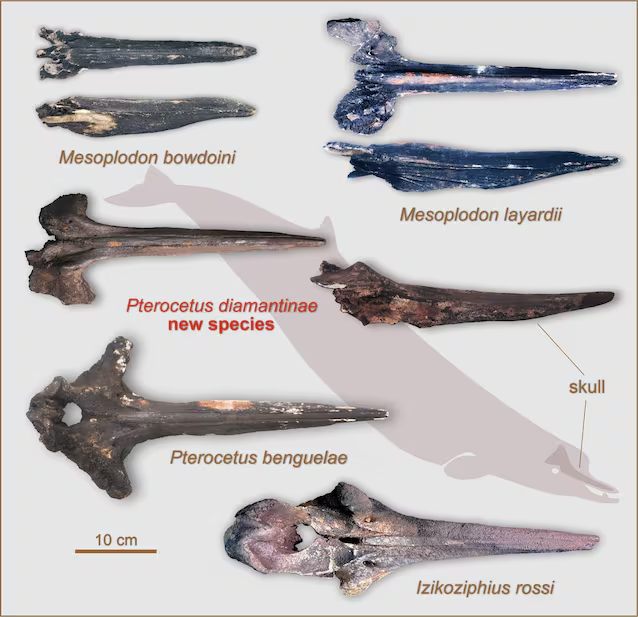
The finds consist mainly of beaksi.e. the front part of the skull, made up of compact bone that is very resistant to degradation, many covered by a ferromanganese encrustation (a layer of iron and manganese oxides that precipitates on submerged objects over millions of years) which has guaranteed exceptional conservation. Among the identified species there are two still living mesoplodons: the Bowdoin mesoplodon (Mesoplodon bowdoini) and the Layard’s mesoplodon (Mesoplodon layardii). Then there are the extinct fossil species, including one new to science: Pterocetus diamondinaenamed in honor of the pit that preserved it.
A 5 million year old fossil archive: dating the finds
To establish the age of the finds, the researchers used the strontium isotope dating: The ratio of two isotopes of this element (⁸⁷Sr and ⁸⁶Sr) in seawater changes predictably over time, and marine bones absorb it during mineralization. The results suggested that the remains of the still living species are deposited by 1.2 million years ago to today. Those of fossil species date back to PlioceneBetween 2.4 and 5.3 million years ago. Prior to this study, the identification of whale fall deep was extremely fragmentary: only isolated carcasses were discovered, without any temporal continuity. The Diamantine Trench instead offers, for the first time in the history of paleontology, an uninterrupted record spanning 5.3 million years in the exact same place.
“These findings redefine our understanding of the deep ecosystems associated with cetacean carcasses,” explains the paleontologist Bianucci«and highlight the enormous potential of ocean trenches as a fossil archive to reconstruct the evolution of cetaceans over geological time.»
