
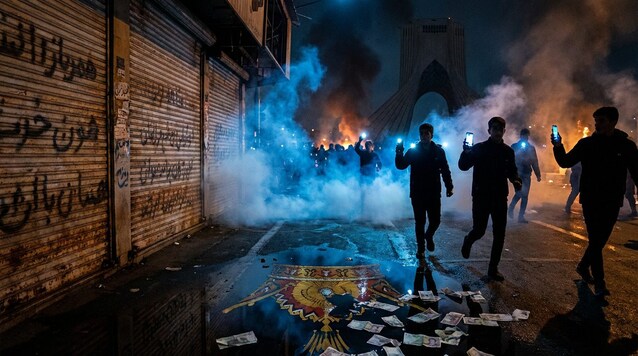
Started last December 28, 2025, they show no signs of stopping anti-government protests in Iranbetween the Internet blackout in Tehran (and not only that, also in Tabriz and the holy city of Mashhad) and the songs of rebellion. Despite the interrupted telephone lines throughout the country – as also reported by the independent organization Netblocks which monitors Internet freedom and digital communications interruptions worldwide in real time – the images of the crowds descending on the streets of more than 100 Iranian cities they reached everywhere on social media and on Persian-language television channels based outside the country.
Furthermore, according to local sources, two members of the Iranian Revolutionary Guards (armed force responsible for repressing or managing protests), better known as “Pasdaran“, were killed in Kermanshah (western Iran) in a clash with “separatist elements”. There are already dozens of deaths among the demonstrators, but due to censorship it is difficult to have precise data in this regard. According to the NGO for the defense of human rights Iran Human Rights (IHR), so far the Iranian security forces have killed at least 45 protestersincluding eight minors, while there would be at least 2 thousand arrests. Meanwhile, the president of the Islamic Republic of Iran Massud Pezeshkian called for restraint from protesters and called on security forces to Don’t hit the protesters and to distinguish between protest and violence.
To better understand what triggered this situation and what could happen next, we interviewed the geopolitical analyst Andrea Gaspardo.
What is at the origin of these protests?
The protests began on December 28, 2025, but to understand their origins we need to go back six years.
The Gordian knot of this story is the economic crisis into which Iran is going through following the Covid-19 pandemic: the Iranian economy, in fact, has never managed to recover from the inflationary phenomenon that hit it. Continuous economic and currency crises were then intertwined with the water crisis and, above all, the energy crisis (the country has been experiencing continuous electricity blackouts for two years), bringing the population to the limit of endurance.
As if that were not enough, the 12-day war last June between Israel and Iran and the US bombing of the sites where the Iranian nuclear program was taking place, Iran severed all relations with the IAEA and other monitoring organizations. As a result, the international community he immediately reinstated the regime sanctions which completely strangled the country’s economy, entered a devastating inflationary spiral (in December it was 42.2%): the Rial, the Iranian currency, has dramatically lost value against the dollar and all other international currencies. We can therefore say that the Rial is waste paperright now. Clearly all this has hit the country hard purchasing ability of a large part of the Iranian population, and the spark was sparked by the bazaaria category that has great social and political weight in Iran (it has always been a pillar of the Iranian theocratic regime), given that it has trade in its hands.
The protests started right from the “Stronghold of the bazaars” of Tehran, and then quickly spread to other cities as well. In the meantime they have affected all the other states of society. At the moment, however, it is difficult to quantify the extent of the phenomenon, even if many observers have stated that these are the largest protests in Iran since those of 2022-2023, which broke out under the slogan “Women, life and freedom” after the killing of Mahsa Amini by the Islamic moral police.
The fact that the Iranian regime is taking the issue seriously can be seen from the fact that alongside the normal tools of repression there is an attempt by the authorities to deal with trade associations and with i representatives (especially bazaars). The regime knows that these associations occupy an important position in the economic and social sphere, and without their own support the clerics, the pasdaraan and those who hold the levers of power of the Islamic Republic would struggle to keep the people under control.
What does “Pahlavi is coming back” mean and what does it have to do with the USA
During the demonstrations some people raised the slogan stating that “Pahlavi is coming back”. However, it must be said that Reza Pahlavison of the last Shah of Iran, is not a noteworthy political figure: he has demonstrated this in the past very little political acumenand he is a give person limited strategic horizons: His past statements have essentially expressed the idea that Iranians “owe” him a throne. But if he were to get it, there would hardly be a regime changea democratic and cutting-edge Iran embarked on a process of convergence with the most developed and Westernized countries. He and the supporters of “the Pahlavi monarchy” – which was expelled in 1979 by the Iranians after being guilty of horrendous crimes – seem to me to be anti-historical reasoning and not worthy of consideration.
Protests in Iran today they lack leadershipand Pahlavi emerged as the most prominent figure, paradoxically, without having a “leader” role. History teaches, however, that a revolution has a greater chance of success the more visible its leaders are, capable of channeling anger into political action. If there are no military interventions by external powers, there is a risk that the protests will ultimately be suffocated by the regime with a mixture of repression towards the most intransigent demonstrators and instrumental dialogue towards those more malleable segments of the protest.
Meanwhile, the American far-right influencer Laura Loomer announced on X that Reza Pahlavi would be expected to Mar-a-Lago next Tuesday, although the meeting with Donald Trump has not yet been confirmed. If the news were to prove true, it would confirm Reza’s plan to propose himself as a leader of the protests, seeking the “blessing” from the tycoon, who has stated several times in recent days that the United States is ready to intervene in case lethal violence is used against peaceful protesters. Speaking to conservative radio host Hugh Hewitt, Trump said:
I let them know that if they start killing people, which they have a tendency to do during protests, they have a lot of them, if they do that, we will hit them very hard.
The great enemies USA and Israel: what they would gain if they intervened to overthrow the Iranian regime
Americans and Israelis, even more so after the short war last July, if they were to intervene jointly it would be for a very specific purpose: that of overthrow the regime of the ayatollahs. Israel is eager to eliminate a regime it considers enemyand hopes that his overthrow will lead to a reduction in military pressure on the borders.
The Americans, on the other hand, would like to get rid of the Iranian regime because in the grand scheme of the global conflict that pits the United States against China, the overthrow of the regime would seriously affect Beijing’s energy supplies. Furthermore, Russia would also be affected, because together with North Korea in recent years it has stood out among the Kremlin’s military suppliers in the war with Ukraine, in particular for the sale of Shahed drones. A regime change could interrupt supplies and industrial agreementsputting Moscow in difficulty.
