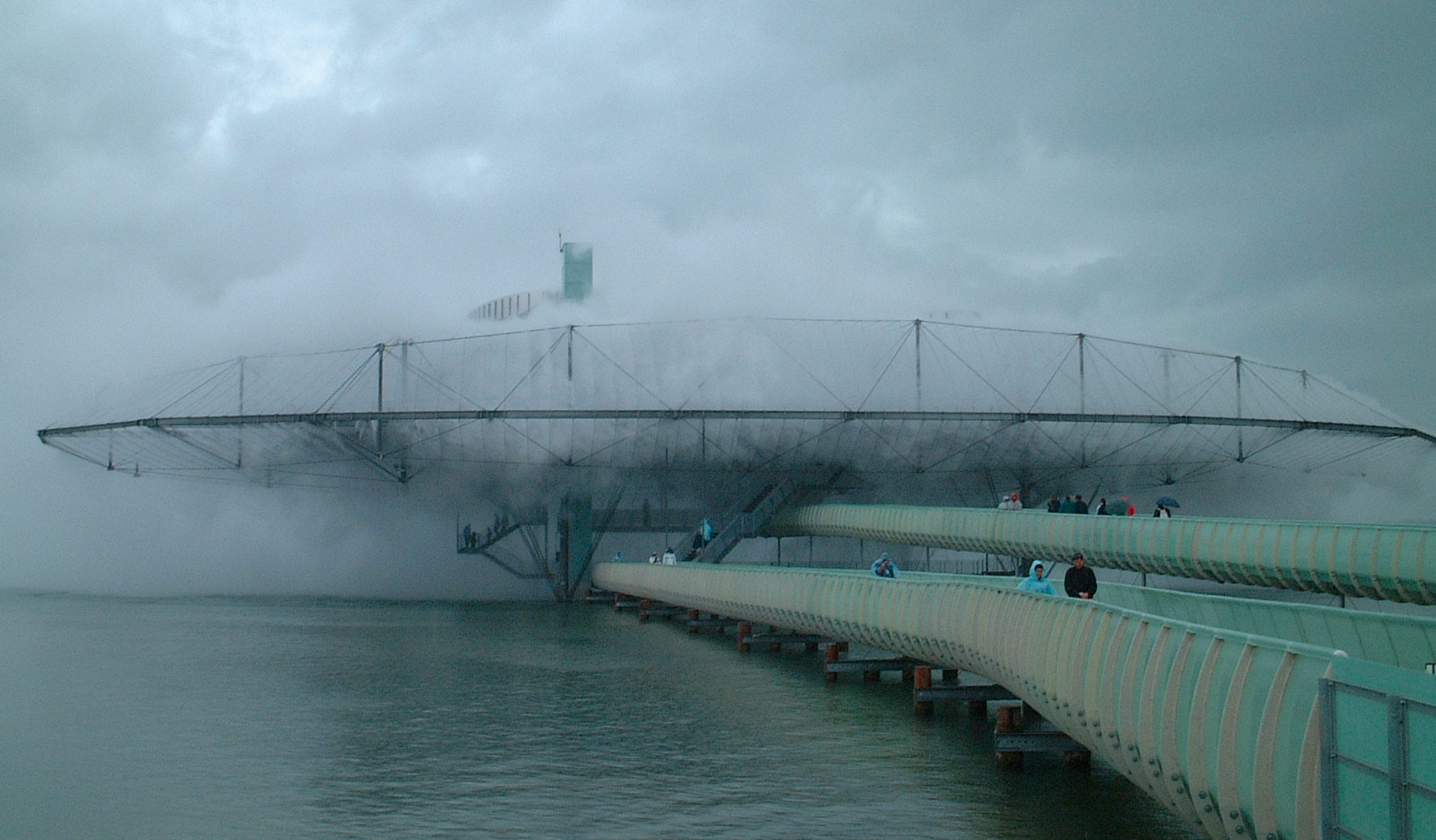
In 2002, on the waters of Lake Neuchâtel, in Switzerland, a apparently massless building appeared in Switzerland. It was the Blur Buildingone of the temporary pavilions of theExpo.02the sixth Swiss National Exhibition held in Yverdon-Les-Bains, made using an impalpable material, not to say “intangible”. The appearance, in fact, was that of a platform suspended above the lake, Wrapped in a dense and changing cloud. Designed by New York architects Elizabteh Diller And Ricardo Scofidio (Diller Scofidio + Renfro), the temporary building entered Guinness World Records as the first architecture built mainly with artificial fog. In an era dominated by the high definition and overdue of visual media in the exhibitions, the Blur Building was proposed as an immersive installation in “low definition “an experiment of de-enfasi on an environmental scale that questioned the centrality of the vision (and dependence on it), inviting visitors to perceive space with the other senses, without consequently relying on digital simulations.
Blur Building, a building made of air and water
Fresh water, pumped directly from the lake, was filtered and sprayed at a pressure of about 80 bar through 35,000 steel nozzles from 120 microns in diameter. The very fine drops (between 4 and 10 microns) and light enough to remain suspended in the air, generated a Banco di fog in continuous transformationwhich enveloped the large walkable platform of the pavilion. 90 meters wide, 60 deep and 23 high, the structure of the Blur Building had been designed according to the principle of tendernessthat is, the balance between compressed metal profiles and a network of thesis cables: a conception that, in addition to embracing the skeleton aesthetic typical of the light structures, allowed the platform to self -consciously resting on only four pylons, fixed on the lake background.
https://www.youtube.com/watch?v=g6cyc-xhhu
The behavior of the fog, That could literally cross and permeate the pavilion, varied according to the atmospheric conditions: with strong wind, the front edge of the structure was revealed and long trails were formed; high humidity and high temperatures favored their expansion to the outside; In the presence of high humidity and lower temperatures, the fog lowered on the lake and expanded horizontally. In conditions of low humidity and high temperatures, the evaporating effect prevailed, while when the air was colder than the water, a convective current was created that raised the fog upwards. A sensor system However, it was able to monitor in real time temperature, humidity and wind, adapting the pressure of the water disbursed by the nozzles in different areas of the structure, maintaining the stable cloud. It was a primitive form of artificial intelligencecapable of learning and responding dynamically based on the data acquired on the field.
The experience of crossing between the fog
The pavilion was reached by along two prefabricated metal catwalks that connected the bank of Lake Neuchâtel to the platform. Once the threshold of Blur Building has been crossed, every visual reference vanished: the visitor immersed himself in a sort of optical white-out, wrapped in the white noise produced by the nozzles. The effect was at the same time disorienting and fascinating, amplified by the sound carpet edited by the Swiss artist Christian Marclaywhich accompanied the movement of the fog with subtle acoustic interventions. Inside, no pre -established path, no barrier: visitors could freely wander about the cloud, following their own rhythm and perceptions. A staircase led to the upper level, theAngel deckwhich emerged above the fog opening a gap in the sky; while below the platform there was the Water Barwhich offered a selection of bottled water from all over the world: springs, artesian, minerals, sparkling, distilled. Since the water was the main material with which the Blur Building had been built, it was as if the audience was invited to “drink the building”. Immediately after the opening, it was celebrated with a souvenir chocolate tablet, an all -Swiss homage that added an ironic note to the narrative: the public could symbolically also “eating the building”.
An ephemeral architecture, a memory that remains
The Expo.02 took place on the border between French and German Switzerland, in the region of the three lakes, involving the cities of Biel/Bienne, Murten/Morat, Neuchâtel and Yverdon-les-Bains. The four permanent exhibition centers, located on the banks of the lakes, took the name of ArtePlages. In addition to Blur Building Designed by Diller Scofidio + Renfro, the same study that the famous linear park will sign years later High line of New York, among the pavilions symbol of the “art beaches” stood out the Monolith by Jean Nouvel in Murten/Morat, the metal towers of Forum by Coop Himmelb (l) Au a Biel/Bienne and Galets (the three pebbles) of multipack in Neuchâtel.
Despite the interest of the city of Yverdon-les-Bains in transforming Blur Building into a permanent museum dedicated to science fiction, the pavilion was disassembled six months after the exposure closure. The steel was recycled to give shape to new structural profiles, the fog dissolved in the air, but its legacy is definitely still alive. And it is that of a project that has passed i Conventional boundaries of architecture Already at the beginning of the new millennium, showing that even what is shapeless, ephemeral and impalpable can transform into something tangible, between space, meaning and imaginary.
