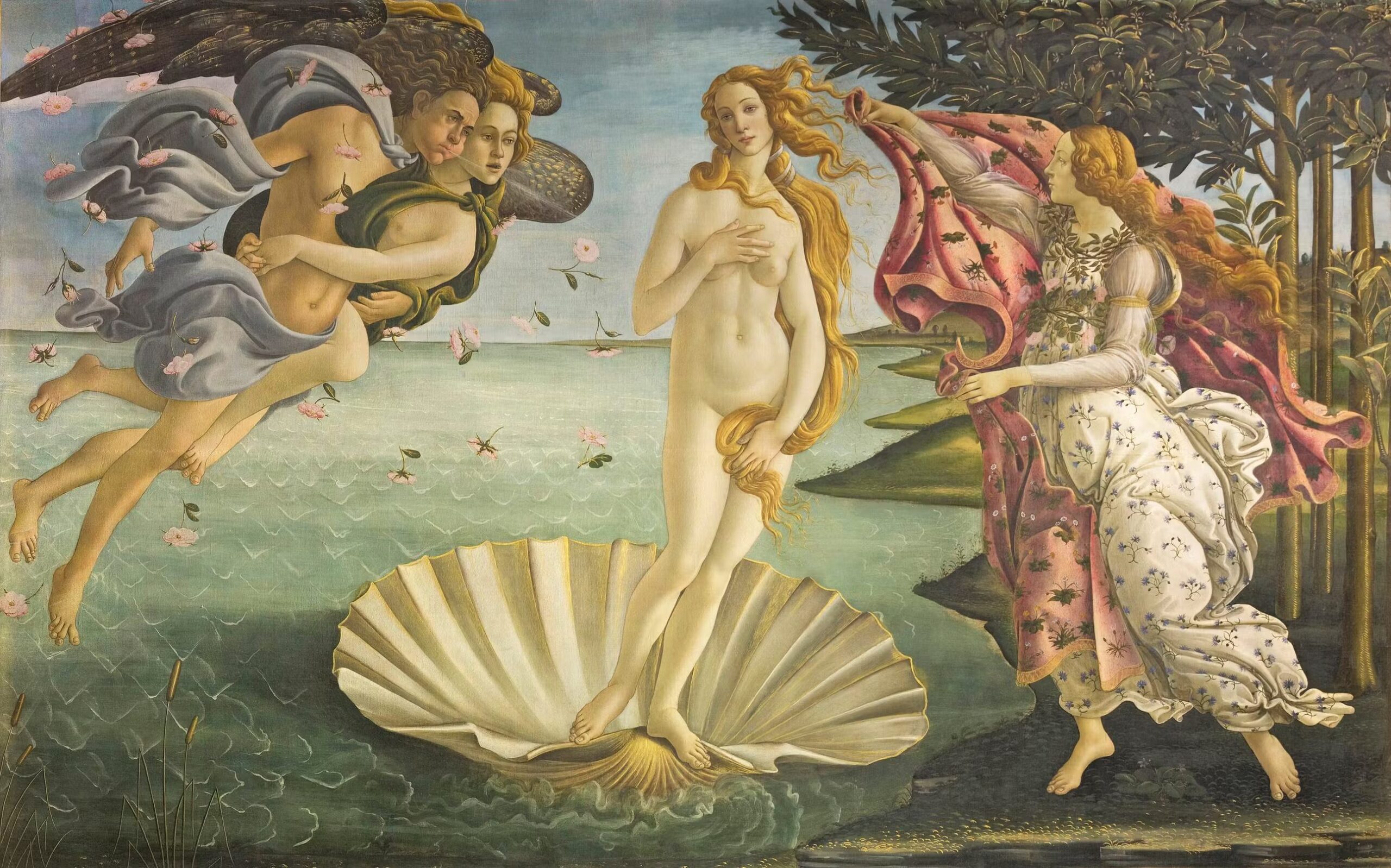
There “Birth of Venus” by Botticelli, preserved in the Uffizi Galleries in Florence, it portrays Venus, the goddess of love and beauty, as she lands on Cyprus, with her long red hair and the grace that made her famous. Commissioned by Doctors and inspired by classical art, the work has fueled legends about his muse: Simonetta Cattaneo Vespuccia young Genoese admired for her beauty and who died prematurely, became symbol of the feminine ideal of Renaissance art. Even without evidence that he posed for Botticelli, his image influenced the artistic imagination, intertwining history, myth and romantic fascination.
Commissioned by the House of Medici – in 1550 Giorgio Vasari describes it in the Medici villa of Castello – this large painting on canvas is one of the most recognizable of the entire Florentine Renaissance: to create it, the artist took inspiration from statues of the classical era but also, legends suggest, from a real woman. In the history of art of the nineteenth and twentieth centuries, many find this inspiration in a young Genoese woman who aroused great admiration upon her arrival at the Medici court: Simonetta Cattaneo Vespucci. Known as the “beautiful Simonetta”, this member of one of the oldest Genoese noble families married the banker Marco Vespucci (relative of Amerigo, the explorer who gave his name to America) at the age of sixteen, and died at just twenty-three, perhaps of tuberculosis. She was well known for her beauty, which corresponded to the aesthetic ideal of the time: graceful and harmonious, it soon became popular among the Florentine beau monde of the fifteenth century. Her premature death also greatly impressed her fellow citizens, who remembered her in poems and chronicles as an almost spiritual presence.
Because of this suggestion she was compared, as a muse, to the name of many artists of the time, including Botticelli himself. However, there is no documentary evidence that she ever posed for himalthough some studies have tried to identify her with some female characters in her paintings, such as Venus or Spring. Some have also noted that Botticelli asked for to be buried in the same church as Simonettaon All Saints Day, but this choice reflects more than anything else family and neighborhood ties.
The similarity between the young Genoese and the female figures in her paintings is probably explained by the fact that Simonetta embodied the ideal of Renaissance beauty. Botticelli, in fact, did not paint specific modelsbut it followed an iconographic and humanistic prototype inspired by Neoplatonism. Thus, the identification between her face and Venus or Spring arises naturally, even if it is a cultural construction that emerged especially in the 19th century, perhaps also fueled by the young woman’s early death, which fascinated the Romantics.
