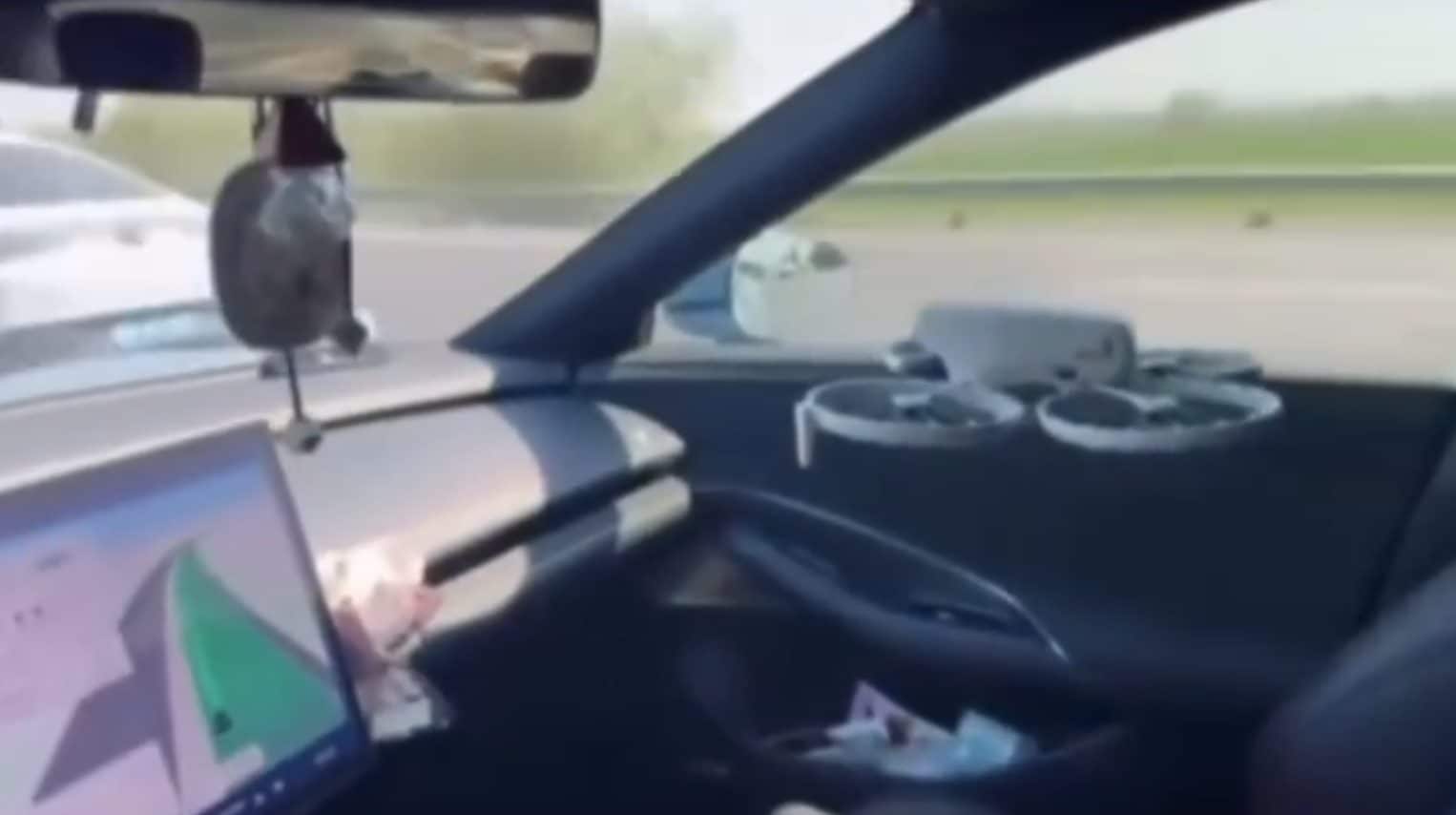
In these hours, a short video posted on Instagram is raising the curiosity of many people. Shows a car going to 100 km/h on a road, with a small drone on board that remains suspended in the air above the passenger seat. On the one hand, the drone taken from the driver’s seat appears perfectly stillon the other side it is moving along with the car at 100 km/h. The question is therefore: is the drone stationary or is it proceeding at high speed? The correct answer is: depends on the reference system from which the drone is observed.
From a physical point of view, it is correct to state both that the drone is stationary and that it is moving at 100 km/h. But both of these answers are incompletebecause the fundamental question here is “Still with respect to what? In motion with respect to what?”. Speed, in fact, is one of those quantities that are called in physics relational: the velocity of a body only makes sense if it is specified in relation to another body with respect to which it is measured. So we can say, with certainty that we are right, that the drone is both stationary relative to the car and moving at 100 km/h relative to the road.
The aspect of this scenario that challenges our intuition is probably that our intuition tells us that if the drone were “still” relative to the car, it would crash into the rear window. As the drone ascends, should not “fall behind” compared to the moving car? The answer is: Absolutely not. The reason is all in all simple: while the drone is “stationary” compared to the car, it is still proceeding at 100 km/h, because it has the same speed as the car. This means that when the drone rises it has already been brought to the speed necessary to remain “stationary” with respect to the cockpit. It doesn’t have to “reach” that speed because it has already “inherited” it from the car.
It is exactly the same reason why, if we throw a ball upwards while we are on a moving train, it is not thrown backwards (try it!) but falls back on our hand without problems. The ball has the same speed as the train, and the fact that it is stationary with respect to the carriage does not mean that it is also stationary with respect to the track.
However, all this is only valid because the speed of the car is almost constant while the drone flies. If this were not the case – that is, if the car accelerated or braked – the drone would still continue to have the horizontal speed it had when it left the seat, but the car would not, and this difference in speed would mean that the drone would no longer be stationary with respect to the passenger compartment: there would be a horizontal motion of the drone with respect to the car. But as long as the car maintains constant speed on a straight road, the drone appears stationary relative to the cockpit.
All this has a very specific name in physics: Galilean relativity. It is a principle discovered by Galileo Galilei in the seventeenth century and essentially says that there is no way to distinguish a stationary reference system from the same system moving at a constant speed: every physical experiment will always give the same result, everything will behave in the exact same way in both cases. Galileo discovered that a “stationary” or uniformly moving system is completely equivalent from a physical point of view. The drone flying in the car is the perfect demonstration of this principle: in the eyes of the driver who films the drone, the latter’s behavior it is exactly the same as it would be if the car were stationary.
It is precisely for this reason that both answers to the initial question are correct: speed is always relative. The drone, like everything else in the universe, does not have an absolute speed: it will have as many speeds as there are reference systems against which we choose to measure its speed.
