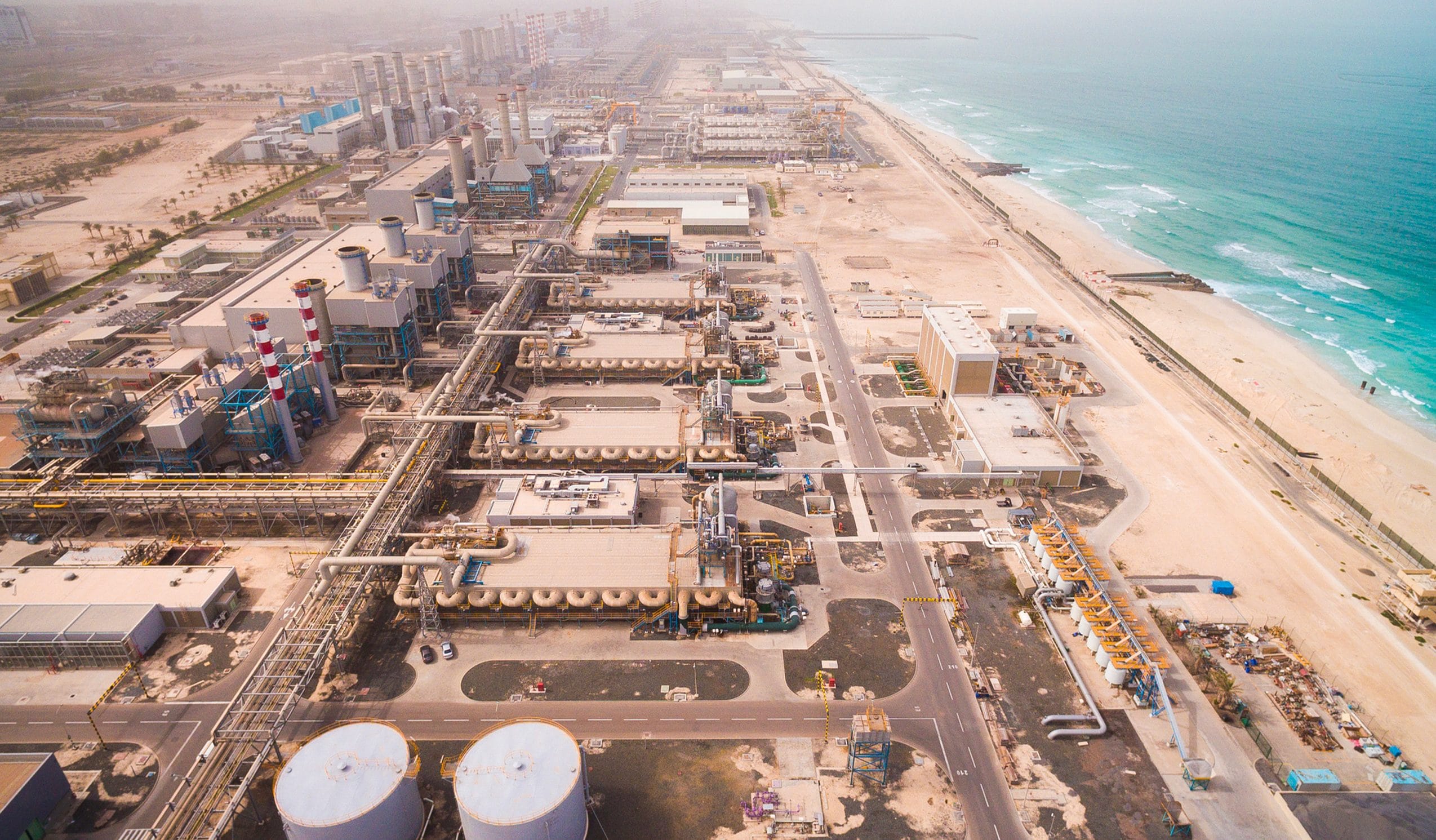
The desalination plant of Jebel Alilocated along the coast of the Persian Gulf about 40 km south-west of the center of Dubai, is among the largest complexes in the world dedicated to desalination and electricity production. Part of the vast industrial and port area of Jebel Ali, a location known for the palm-shaped artificial island of the same name, is capable of supplying up to 2.2 million cubic meters of drinking water per day and reaches an installed capacity of 9,547 megawatts. An infrastructure of exceptional scale which, together with the new Hatta hydroelectric power stationcontributes to the strategy outlined by the operator – the Dubai Electricity and Water Authority (DEWA) – which aims to bring clean sources to cover a large part of Dubai’s energy needs by 2050.
The main characteristics of Jebel Ali
The Jebel Ali complex is divided into several sites and uses some of the most advanced technologies available today for water desalination. On the one hand, technology Multi-Stage Flash (MSF), which allows the waste heat produced by the site’s power plant to be recovered and reused; on the other, thesea water reverse osmosis (SWRO), based on high efficiency membrane filtration processes. This is a strategic infrastructure, essential to guarantee the water supply of the areas surrounding Dubai. The desalinated water, once produced, is in fact accumulated in huge quantities containment basins.
How water is desalination
The entire system is an example of water co-management, which means that the water desalination and the energy production electrical operations take place at the same time, in order to maximize the efficiency of the entire system. In fact, the residual heat of the gas turbines used to produce electricity is used to heat sea water in thermal desalination processes, thus reducing energy waste, with a large gain in terms of efficiency. The desalination process – based on the system Multi Stage Flash – begins with the collection of sea water which is heated and passed through a series of pressure chambers decreasing which cause evaporation. The vapor is then condensed and becomes fresh water. The desalination system also employs thereverse osmosisa technology that uses semi-permeable membranes and high-pressure pumps to separate salt from water, without using heat. Another process adopted is that of Multiple Effect Distillation (MED)similar in operating principle to Multi Stage Flash (MSF)but operating at lower temperatures.
Numbers and challenges for the future
To understand the efficiency of the Jabel Ali desalination plants, it is necessary to take a look at the numbers. In particular, the desalination system is capable of producing 490 million gallons of fresh water per daymanaging to cover the water needs of the city of Dubai and all its industrial and production areas. Fresh water clearly needs to be conserved, once obtained. That is why the plant also has a complex system of artificial aquifers, which allow water to be stored for several months. The Jebel Ali water desalination system, although efficient, however presents some critical issues. One of the main ones concerns the production of very high salinity waterresidue of the desalination process, which is reintroduced into the waters of the Gulf. The solution to this problem, together with the reduction of waste products, represents a significant engineering and technical challenge. The objective is therefore to progressively shift production towardsreverse osmosis powered by solar energy (coming from Mohammed bin Rashid Al Maktoum Solar Park) reducing dependence on natural gas.
