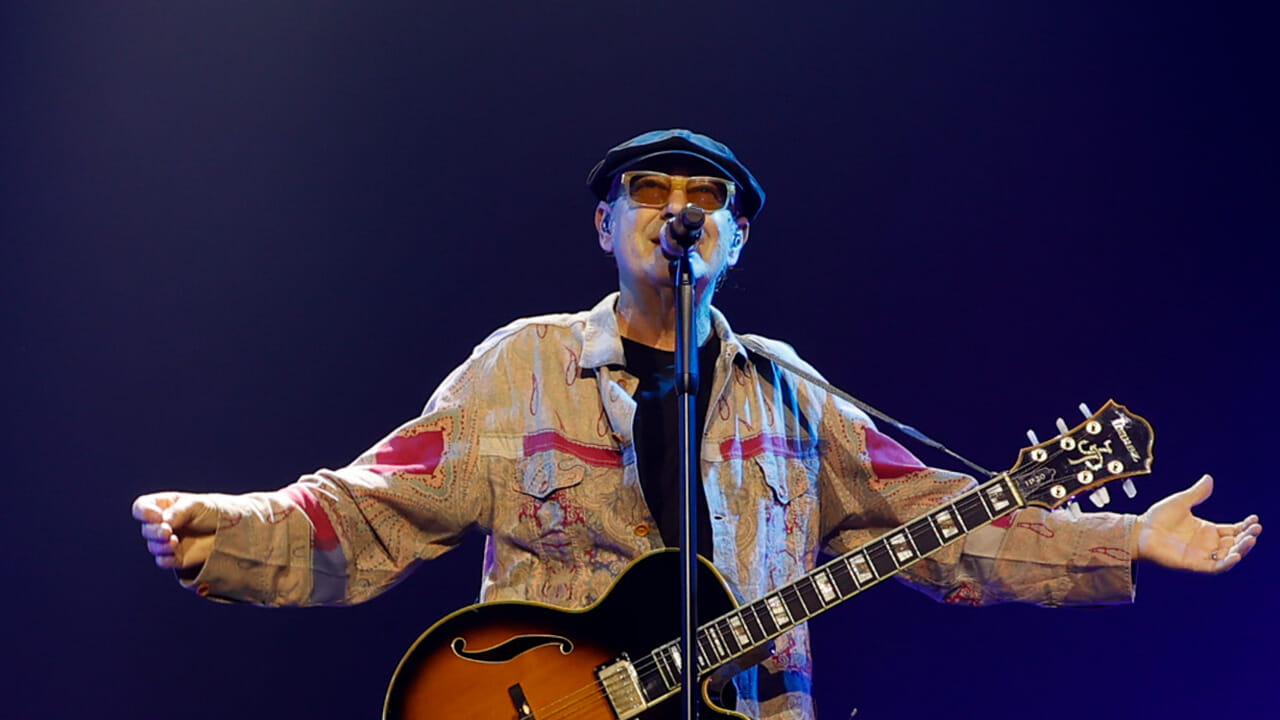
Let’s not get fooled by nostalgia, Luca Carboni is more current than ever
He hadn’t given concerts since 2019, thanks first to the pandemic, and then to the illness, a lung tumor that struck him in March 2022, “so they gave me very little hope”. He recovered and on the evening of November 11th Luca Carboni returned to the stage, where time really seemed to have stopped. Not so much for his physical stature – it must be said, excellent, for almost three straight hours of live performance – but for the air that envelops his songs, clearly now out of any sort of contemporary reference, but which does not for this reason sound like antiques, on the contrary. At first very excited and – he says – “terrified” and then gradually more relaxed, at the Forum in Assago he closed a resumption of performances which began this summer, as a regular guest on Cesare Cremonini’s tour, with whom he sang Saint Luke (2024). At the moment, there isn’t much else to add: he spoke of a rebirth (and in fact he opened with Spring) and after the show he admitted that he is thinking about an album and that he is working on an autobiographical book but, in short, we will have to wait a little longer for new music, he wants more than anything to live from day to day (in 2026 he will repeat in Rome and Bologna, who knows he might not go as a special guest in Sanremo, even if he has never had particular sympathy for the Festival).
Let the songs speak
Among the guests of the evening, tender, minimal and at times ironic, as per the house recipe, there were Cremonini himself, Elisa and Jovanotti, with the first two who owe him part of their background and the third who directly owes him a part of his career, as he himself recalled, when Carboni took him on tour in sports halls for the first time in 1992, first giving him a “singer-songwriter” credibility and a large audience that Jovanotti had never seen. Because yes, there was a moment, between the Eighties and Nineties, in which Carboni was one of the greatest around, in which with songs like Silvia you know, Butterfly, Sea sea And It takes a beastly physique dominated the charts with hundreds of thousands of copies sold. And let’s understand: all this was strange even at the time. The new generations rediscovered it without taking it into account around 2015, with the successes of Luca the same And Bologna is a rulewhen he acted as a bridge with the indie-pop scene of Calcutta and TheGiornalisti, which was about to explode at that time and he never made a secret of considering him one of his spiritual fathers. At brand newhowever, perhaps it will have been completely overlooked, but in general it is precisely the lesson that Carboni’s career teaches us – and which also applies to those who lived it at the time and, perhaps, have forgotten it, at least judging by today’s market – that is precious.
The strangeness, we were saying. Perhaps, today, the only true heir of his spirit is Lucio Corsi. Not in terms of sounds and aesthetics, given that Corsi does a sort of glam rock and focuses on the visual aspect, while Carboni was an anti-star par excellence, with a very low profile. The fact is that Corsi, even with the necessary proportions first and foremost durationwhich will have to be measured, has given voice to a certain type of malaise, in some way he is a generational singer because he has shown that the road can actually be traveled against traffic, that the public is willing to do so and that above all that intolerance (in his case, towards a music that is necessarily successful and plastic) is truebut that doesn’t mean you have to give up. Here, Carboni had been the same, a true short circuit of his time: while the others sang the ritual hedonism, he harked back to the singer-songwriters (considered outdated) of the previous decade, he said – first song ever – that We’re wrong (1984), sang of melancholy, tenderness, disillusionment, however intimacy; he sang softly, above all, in an era that shouted and danced. Yet millions, perhaps in difficulty with the world, as is also normal, loved him. If you think that with Sea seathe anti-catchphrase par excellence, even won the Festivalbar, the turnaround is total. Because when it comes to pop, Carboni has always and only had the choruses right, and sometimes not even those. And about the pop star, above all, nothing at all.
Parenthesis: seeing him with his eyes shining for three hours, even clumsy in enjoying the applause of a walled-in forum, the impression is of having before him a pure man, one who had been more scoundrelas is asked at certain levels, perhaps the sincere affection that so much criticism has for him today would actually replace a sanctification, as a venerated master, but whatever.
An artist to love
Of course, he was and remains a white fly and perhaps once upon a time the market was more generous, but the nostalgic key with which many of his pieces are experienced today – or at least, this was the dominant atmosphere of the beautiful concert at the Forum, average age of the audience over forty, desire for memories – must not mislead us. Five seasons off the stage, nowadays, are an eternity even for a classic like him, just look at the desire for revivals that is around, including very big names (Venditti and De Gregori, among many). Yet his old-fashioned songs have not lost their charm, neither on a musical level – precisely, for the heirs he has today – nor on a lyrical level. They are precious: with Carboni you are moved and undressed, because like few others he sings about intimacy, sweetness, tenderness, sadness, without ever being saccharine or tragic, if anything always with a human touch, close to the listener. This is the key: in spite of music that depersonalises – and which, of course, was also there in his era – his pieces put the human being at the centre, be it the one who sings them or the one who hears them. The fragilities, the happiness, the pain. Without special effects, but also without intellectualism. For this reason, more than an artist to admire or see oneself in, Carboni has always been someone to love. Translated: one who never really passes away and, indeed, is even ready to return.
