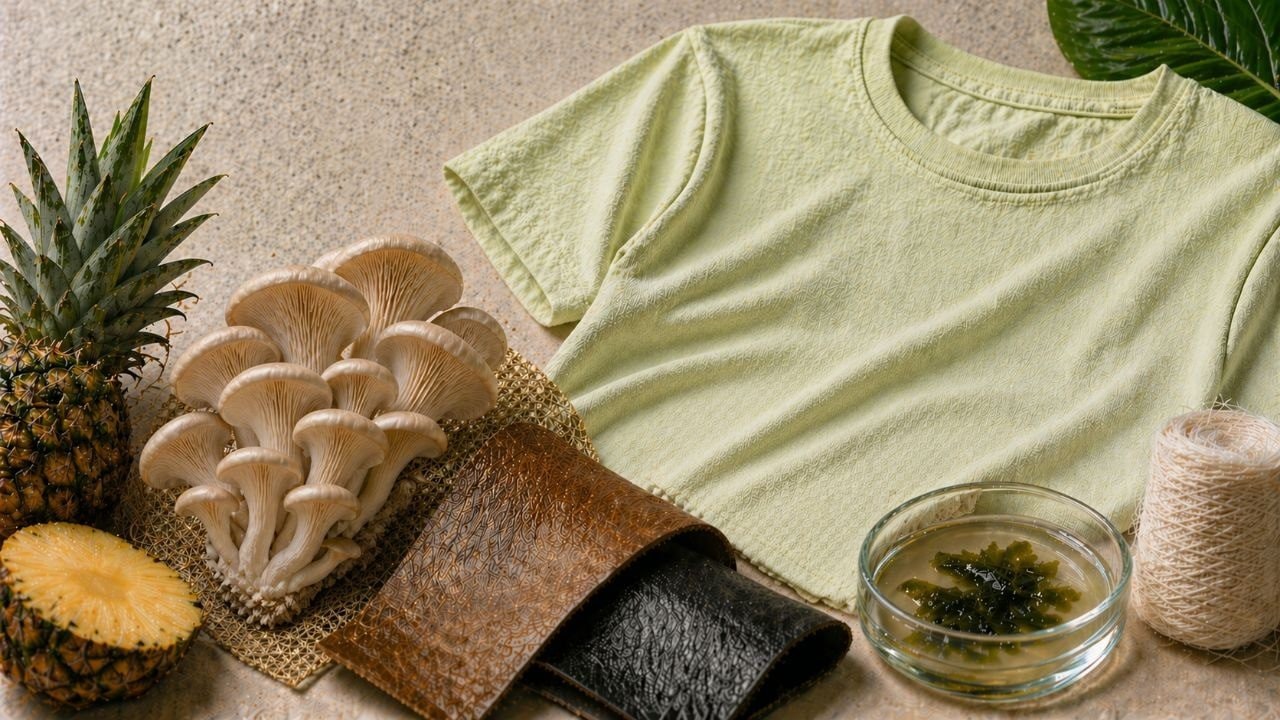
Give it to him pineapple scraps an alternative skin is born, from mushroom mycelium flexible and resistant materials are obtained, and even i bacteria they are used to produce silk-like protein fibers. These are the so-called Next-Gen materialsnew generation fabrics that promise to revolutionize the textile industry. But why do we need this revolution so urgently? The answer lies in a simple question: how much does a t-shirt really pollute? Much more than we imagine. The fashion industry is in fact responsible for approximately the 2-8% of global greenhouse gas emissionsa share well above that of civil aviation. Behind this statistic are decades of dependence on natural fibers such as cotton And wool (which consume enormous quantities of water and land) and from synthetic materials derived from petroleum, such as polyester. Today, fortunately, things are changing. But how do these new ecological alternatives really work? And how close are we to finding them in our stores?
Why change the fibers we have been using for centuries
The problem of traditional materials is not only environmental, but systemic. Climate change is already disrupting the production of raw materials like cotton, wool and leather, and the clothing sector is nowhere near reducing its emissions with current approaches. Animal skin brings with it a double impact: on the one hand the tanning requires large quantities of water and chemicals, on the other intensive farming contributes to emissions and land consumption.
THE next-gen materials they are designed to replicate the properties of leather, silk, nylon and polyester, but obtained from renewable biological sources or from low impact processes. More than simple green alternatives, they are solutions designed to intervene on a production system that today shows obvious limits.
According to a 2021 report from theApparel Impact Institute And Fashion for Goodnew materials, combined with innovative processing technologies, could offer up to 39% of emissions reductions necessary to achieve carbon neutrality.
From the mushroom mycelium to the Hermès bag: leather that grows in the laboratory
Among all the new generation materials, the one that has received the most media attention – and the most investments – is the mycelium skin. The mycelium is the underground structure of the mushrooma network of intertwined microfilaments that extends beneath the soil. Growing it requires little space and energy: it grows in weeks rather than years like animals, it feeds on agricultural byproducts such as corn stalks or sawdust, and it is biodegradable.
To produce mycelium materials, companies create controlled growing conditions: temperature, humidity and substrate are precisely regulated to make the fungus grow upwards, forming a three-dimensional carpet of interconnected cells. Once the mycelium has reached the desired thickness, it comes compressed into a two-dimensional sheet and subjected to a stabilization and finishing process, after which it can be dyed. The result is a material that is surprisingly pleasant to the touch similar to calfskin of high quality. Below is an example of a bag created with this material.
From pineapple to algae: the panorama of Next Gen materials is expanding
If mycelium leather is the star of the moment, the world of next-gen materials is much broader. One of the most concrete examples is the Pinatexa material obtained from waste from the pineapple industry. About 40,000 tons of leaves are produced every year, normally destined to rot or be burned. Fibers are extracted from these leaves which, after being washed and dried, are transformed into a compact material similar to fabric, through a mechanical process and the addition of a corn-based biopolymer. The result is a flexible and resistant materialalready used on a large scale. However, it should be noted that the final material also contains a plastic component, in polyurethane resin: complete biodegradability therefore remains an open objective.
Innovation reaches marine ecosystems, where new fibers are developed from algae grown in sea water. This approach is advantageous as it does not take land away from agriculture and reduces the consumption of fresh water. Another promising direction is that of fermentation, which allows the production of protein fibers from plant ingredients, capable of imitating materials such as silk and wool with a lower environmental impact.
A promising future, but still with many obstacles
The picture described so far is fascinating, but it would be naive to ignore it concrete difficulties that these materials have yet to overcome. One of the main problems is the slowness with which these materials can be introduced on a large scale: obtaining constant quality takes time and also the production chain must adapt. However the fashion industry is built around speed. To this we add a cost problem: Sustainable alternatives can cost up to twice as much as traditional options, making them still unaffordable for most low- and mid-range brands.
The European regulatory push towards greater transparency also fits into this context, with the “digital product passports” which will force brands to declare the environmental footprint of each garment.
However, the issue remains another. These materials are not only replacing traditional ones, but are calling into question the entire production system. As long as they remain more expensive, difficult to scale and partly dependent on processes that are not yet fully sustainable, their impact will be confined to a niche. The real challenge is transform these innovations into accessible and widespread solutionsand only then will it be understood whether it is truly a turning point or a transition phase.
