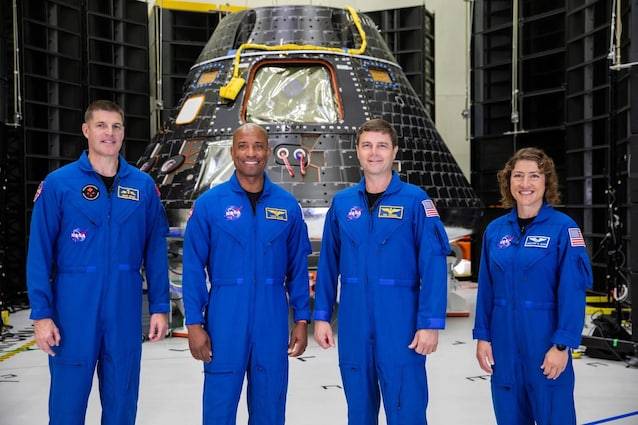
The mission Artemis II of NASA that will bring humans back around the Moon after more than 50 years for the first time since 1972 it is almost ready to begin: the launch could take place in three windows between 6 and 11 February, between 6 and 11 March and between 1 and 6 April. The four crew members (Reid Wiseman, Victor Glover, Jeremy Hansen and Christina Koch, first woman on a lunar mission) will venture into deep space aboard the Orion capsule which will be launched into space from SLS rocket (Space Launch System). The mission will last 10 days and does not include a moon landing but a close flyby of our natural satellite with the aim of testing all systems and procedures before the actual moon landing which will take place with the Artemis III mission scheduled for 2027.
When will NASA’s Artemis II launch?
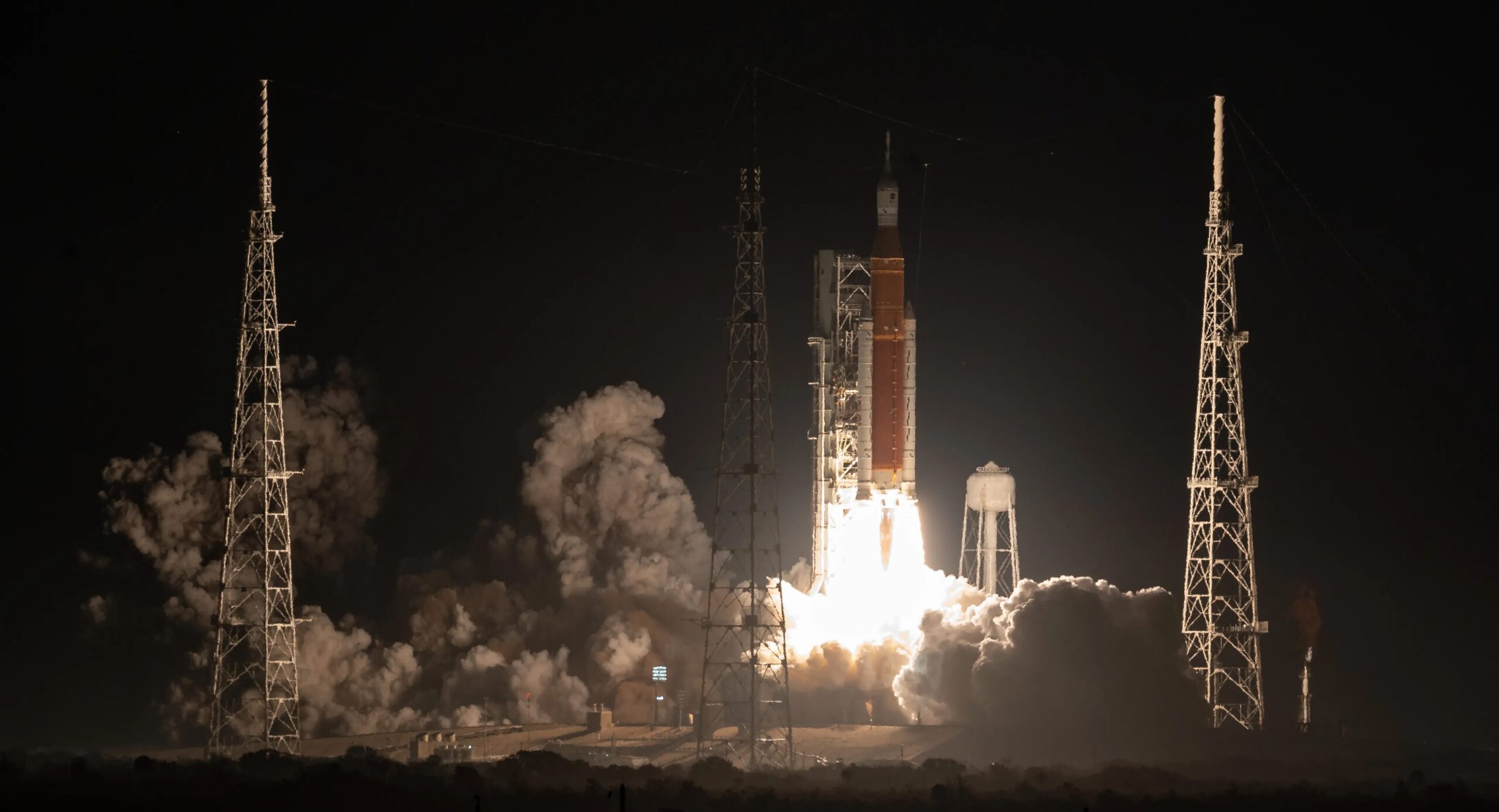
Preparation for the Artemis II mission has already begun. The astronauts will travel aboard the Orion capsule which will be pushed into space by the rocket SLS (Space Launch System), the only rocket in the world powerful enough to send the Orion capsule, astronauts and mission cargo directly to the Moon in a single launch. These days NASA is finalizing preparations to move Orion and SLS from Vehicle Assembly Building at the launch pad 39Bwhich will happen no earlier than Saturday 17 January. The rocket will be transported to the launch pad from crawler-transportera tracked mechanical monster that it will take approximately 12 hours to complete the 6.4 km journey which separates the Vehicle Assembly Building from launch pad 39B.
NASA also released three possible launch windows for Artemis II. The first covers the period January 31st to February 14th and includes the days February 6, 7, 8, 10, and 11. The second launch window runs from February 28th to March 13th, with the possibility of 6, 7, 8, 9, 11 March. The third and final launch window is from March 27th to April 10th, when the possible dates will be 1, 3, 4, 5, 6 April.
The flight plan, the Moon flyby and the mission objectives
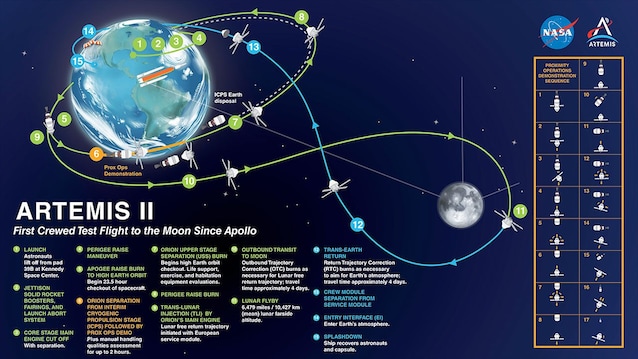
Artemis II will be the first test of NASA’s crewed deep space exploration system. After launch, the Orion capsule will first enter orbits the Earthonly to then execute one series of engine starts which will take it on a trajectory that will complete a trip around the Moonthen returning to Earth using its gravity. This ensures a return to our planet even in the event of serious system failures.
The spacecraft will take approx 4 days to reach our natural satellite. As it circles the Moon, the spacecraft will reach a maximum height above the lunar surface of approximately 8900 km. At the farthest point, the crew will be at a distance from Earth that will make the four astronauts humans who have ventured further into space than anyone else in the history of humanity. The mission is expected to last approximately 10 daysalthough the possibility of extending the flight was envisaged if further test objectives were approved.
Artemis II is not destined to land on the moon, but only to make a landing fly-by of our satellite. The mission is designed to evaluate theeffectiveness of four main areas: mission planning and operations, spacecraft and onboard system performance, crew interfaces and habitability, and guidance, navigation and communications systems. The goal is to confirm that Orion, SLS and mission operations can safely support astronauts in deep space before attempting a lunar landing on a future mission. There will be no shortage of scientific experiments, such as biomedical and behavioral investigations to analyze the physiological and cognitive effects of deep space flight, and test the system Orion Artemis II Optical Communications System which will allow long-distance optical communicationsto and from Earth.
The crew members
THE’crew of the Artemis II mission will consist of four membersthree Americans from NASA and one Canadian from the CSA (Canadian Space Agency). The mission commander will be the astronaut Reid Wisemanin service with NASA since 2009, and already the protagonist of a space adventure in 2014, when he spent 165 days as a flight engineer in the International Space Station (ISS). Victor J. Glover he will instead be the pilot of Artemis II. In service since 2013, Glover was pilot in 2021 of the NASA-Space Christina Hammock Koch of NASA, the only woman on the crew, and Jeremy Hansen of the CSA. Christina Koch she also joined NASA in 2013 and of the crew she is the one who has spent the most time in space. In fact, it was on board the ISS for almost all of 2019, 328 days, becoming the protagonist of the first all-female spacewalk in history. Jeremy Hansen will instead make the history of his country, becoming the first Canadian to venture to the Moon. It will be a mission of firsts for him, as Artemis II will represent his first real adventure in space.