
The intervention in Venezuela last January 3 to oust Nicolás Maduro, strongly supported by President Trump, is the last act of a long series of interferences of the United States in the affairs of Latin American countriesthat is, South America, Central America, Mexico and the Caribbean, countries that speak Spanish, Portuguese and French, distinguishing themselves from Anglo-Saxon America (USA and Canada).
Since the beginning of the 1900s the Monroe Doctrineissued in the previous century for defensive purposes, was transformed into a tool to assert theUS hegemony on the continent. Interference has developed in various ways and forms: destabilization policies, sanctions and other economic measures, financing of subversive movements, organization of coups d’état, direct military interventions. However, the United States has not always succeeded in imposing its will on Latin American countries.
The Monroe Doctrine invoked by Trump
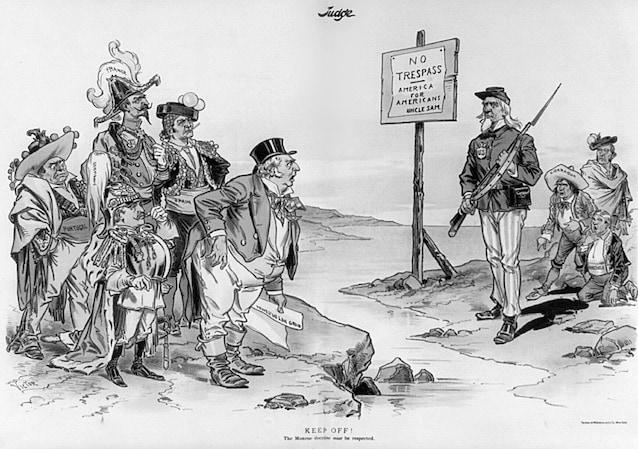
United States interest in Latin America dates back to at least the early nineteenth century. One of the first significant acts to determine relations with the countries of the continent was the enactment of the Monroe Doctrine in 1823. The president, James Monroestated that the independence of the American countries freed from Spanish and Portuguese domination should no longer be questioned by the Europeans. It is therefore a foreign policy position that he placed himself in opposition to European colonialism. THE’Americain essence, it had to be governed by the Americansfor this reason any interference by foreign powers in the political affairs of the American continent would have been considered as a hostile act towards the United States itself.
The Monroe Doctrine had purely defensive character and the United States, which was still a state in the making, did not have the means to demand its application. During the nineteenth century, not surprisingly, the Europeans intervened in Latin America on several occasions – the best-known intervention was the French attempt to place a European prince on the throne of Mexico in 1864 – without the United States being able to oppose.
Roosevelt’s corollary: the United States as the continent’s hegemonic power
The balance of power changed at the end of the nineteenth century, when the United States, having completed the conquest of the national territory, became a economic and military power. In 1898 they intervened in the war of independence broke out in Cuba – which was still under Spanish sovereignty – and inflicted a clear defeat on Spain.
Since then, their direct and indirect interventions in the affairs of Latin American countries they were continuous.
At the beginning of the twentieth century, moreover, they explicitly claimed the right to interfere in Latin American affairs. First, in 1901 a resolution passed by Congress, known as ePlatt amendmentexplicitly recognized the ability to intervene in Cuba’s affairs if US interests on the island were in danger. Three years later, Pres Theodore Roosevelt issued the corollary to the Monroe Doctrinewhich claimed the right to intervene throughout the continent. The president, in fact, declared that “a civilized nation” (i.e. the United States) had the right to intervene in the internal affairs of Latin American countries to prevent possible European interventions. It had happened, in fact, that three states of the Old Continent (United Kingdom, Germany and Italy) had imposed a naval blockade of the ports of Venezuela due to the failure of the Caracas government to pay some debts. Roosevelt did not intervene against European countries, but, to prevent similar situations from happening again, issued the corollary. The Monroe Doctrine, from a defensive instrument, became a means to assert US hegemony.
Interference and “good neighborliness” in the first half of the twentieth century
In the first half of the twentieth century the United States intervened in Latin America numerous times. One of the territories in which they had the greatest interest was Panama. In 1903 they favored the independence of the country, which until then had belonged to Colombia, because they were interested in the construction of the canal which, as is known, would be inaugurated in 1915.
Among other interferences, they intervened several times in Cuba under the Platt Amendment and in 1916 they organized a shipping to Mexico against the troops of the revolutionary leader Pancho Villa.

In 1933, however, President Franklin Delano Roosevelt decided to set up relations with Latin American countries differently, initiating the “good neighbor policy”, which planned to limit interference.
Post-World War II: Latin America becomes the “backyard”
Since the end of World War II, US interference in Latin America has become much more frequent. At the end of the war, in fact, the geopolitical context changed radically: the Cold War began and the United States, abandoning isolationism, committed itself to exercising its influence on the continent and limit that of the Soviet Union.
In the last decadesDespite the end of the Cold War, US policy has not changed and interference in Latin America has continued.
The interventions have been conducted in various ways and with different tools: in some cases the United States has sent their armed forces directly in Latin American countries; on other occasions they favored coups d’état or funded specific factions in civil wars; in still others they used economic measureslike the embargo, and policies to destabilize non-aligned governments.
The main interventions
Here are some of the main interventions carried out by the United States after the end of the Second World War.
Guatemala 1954: a coup for banana plantations
In 1954 the CIA organized a coup in Guatemala against the president Jacobo Arbenz, guilty of having promoted a agrarian reform to give the land to the farmers and to have thereby harmed the interests of United Fruit Companythe US company that held huge tracts of land in the country.

Some important members of the US ruling class had direct interests in United Fruit, such as John Foster DullesSecretary of State, and his brother Allen Dulleshead of the CIA, who pushed President Eisenhower to authorize the operation against Arbenz. In place of the ousted president, the United States put General Castillo Armas in power, who canceled the reforms of his predecessor.
Cuba 1961: the defeat at the Bay of Pigs
The United States retained great influence over Cuba until 1959, when Fidel Castro came to power after revolution and promoted radical economic and political reforms, rejecting US control. In 1961 the President Kennedy he authorized a military operation, exploiting the Cubans who had fled to the United States after the revolution. About 1,500 CIA armed men landed in Playa Girónin the Bay of Pigs, with the intention of overthrowing Castro’s government, but they were repelled by Cuban troopsalso because Kennedy refused to have the American Air Force intervene. Castro retained power and, to protect himself from further invasions, tied himself closely to the Soviet Union.

The Chilean coup and Operation Condor
In 1970 in Chile, following regular elections, the socialist Salvador Allende became president. The president continued the economic reforms initiated by his predecessors, completing the nationalization of copper mines and rejecting US interference. In 1973 the United States facilitated a coup d’état, which brought one to power military junta led by Augusto Pinochet. The Pinochet regime, which remained in power until 1990, was one of the bloodiest of the twentieth century. The role of the United States in the Chilean coup has never been fully clarified, but it is certain that they supported the military.
Since 1975, moreover, the United States supported theOperation Condori.e. a plan for the exchange of information and repression of left-wing movements between right-wing Latin American dictatorships, which lasted until 1983.
Grenada 1983: Marines in the Caribbean
In 1983 the marines invaded the Caribbean island of Grenada and overthrew the socialist government led by Hudson Austingeneral of the People’s Army of Grenada who had just carried out a coup d’état. In the military operations, 19 marines and around 70 Grenadian soldiers lost their lives (including some Cubans fighting for Austin).

The civil wars in Nicaragua and El Salvador
The United States has frequently interfered in civil wars that have broken out in Latin American countries, offering weapons and financing to one of the warring parties. During the 1980s in Nicaragua they financed the Contra movement (abbreviation for Counterrevolutionaries), who fought with terrorist acts the Sandinista governmentwhich came to power in 1979 and was considered too close to the Soviet Union given its socialist, nationalist and anti-imperialist positions. In El Salvador, on the contrary, they supported the military dictatorship in government in the civil war, frightened by the major opposition group: the Farabundo Martì Front for National Liberationmade up of socialist and communist guerrillas. The conflict lasted from 1980 to 1992 and cost the lives of over 70,000 people.
Panama 1989: the intervention against Noriega
Around December 1989 27,000 US troops they invaded Panama to overthrow the president Manuel Noriega. The president was came to power in 1983with the support of the CIA, but had subsequently escaped US control and had been involved in illegal activities, such as drug trafficking and money laundering. At the end of the 1980s the US administration, led by George HW Bushdecided to overthrow him and in 1989 supported the rival candidate, Guillermo David Endara Galimany, in the presidential elections. Noriega won the consultation, but the Bush administration did not recognized the result and accused Noriega of fraud. On December 20, US soldiers invaded the country with Operation Just Cause. The clashes with Noriega’s forces lasted five days, during which 23 American soldiers and several hundred Panamanians died. Noriega, who took refuge in the Apostolic Nunciature, was captured on January 3 and transferred to the United States, where he stood trial and was sentenced to 40 years in prison. In Panama, Guillermo David Endara Galimany was proclaimed president.
