
At what point is nuclear fusion in the world? To understand it we can consult two tools: the first is the Fusion Device Information System (Fusdis) developed byInternational Atomic Energy Agency (Iaea)which collects data relating to active, under construction or planned, public and private melting systems. The other is the Global Fusion Map developed by Clean Air Task Force (Catf) Which traces an overview of companies, programs, research collaborations in nuclear fusion. This map, however, includes only operational devices and therefore excludes historical or planned ones.
The comparison between the two maps
The map financed by Ies, based on data Fusdisfocuses on Tokamak, Stellarator, Heliotron reactors, laser systems, inertial confinement and other alternative types. Currently the database presents 172 world systemsof which almost half of Tokamak. In total, it reports 146 experimental systems and 26 plants. Among the countries with the largest number of merger systems, we find the US with 52 plants, to follow Japan with 27, Russia with 14 and China with 13. The map financed by Catf instead identifies the Active or operational projects with the extent of theeconomic investment correspondent: those lower than $ 20 million, the intermediate of 100 million and large ones that exceed 500 million dollars. In addition, it divides the plants into three macro categories: merger devices, commercial initiatives and research & development.
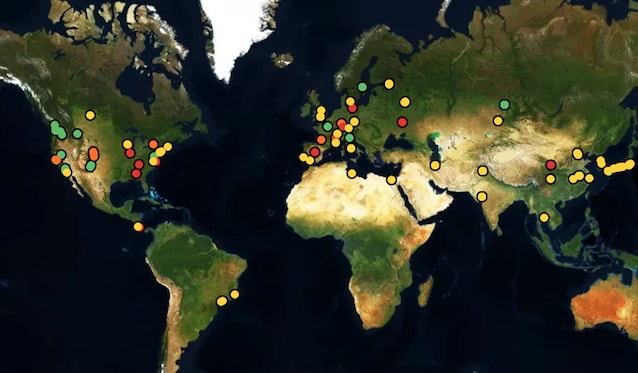
These two interactive maps are different and contain some Compatible data and others complementary. For example, the goal of the map developed by the IIEa is that of catalog experimental devicespresent, past and future. The map financed by Catf, on the other hand, presents the current world scene of economic investments. While Fusdis divides the plants by type, for example in Tokamak and Stellarator, the Global Fusion Map focuses on investments and distinction between commercial and research systems.
The Fusdis map presents All merger devices never existed, while the Catf map is ideal for those who want to follow the investments.
The Italian situation
The Fusdis system identifies 4 plants relating to the merger in Italy, three of which in Rome.
The Divertor Tokamak Test (DTT), under construction at the Enea Center in Frascati, which aims to identify materials and geometric configuration of an essential component for future merger reactors, the diverter, necessary to dispose of reaction products.
Previously on the same site there was the Frascati Tokamak Upgrade (FTU)used from 1989 to 2019 to study plasma behavior in very high magnetic field conditions, up to 8 Tesla. It was dismantled to leave space right at DTT. The appeal is also the Proto-sphera, A magnetic confinement experiment that uses spherical symmetry. This system has also been installed at the Aeneas of Frascati and has been operational since 2017.
Finally, the project Reverse Field Pitch (RFX)approved in 1984, was built inside the Padua CNR. Since 2001 the RFX machine has achieved an update, called RFX-MOD, which worked until 2016. Currently a second upgrade is underway for the construction of the machine RFX-MOD2. This machine will allow you to study plasma in different energy configurations.
The Global Fusion Map map, on the other hand, presents two only two active centers in Italy: that of Frascati, already described above, and a second center in Milan. Within the latter there is the Gyma Linear Plasma Device (LPD) which has had different objectives over time, from the study of basic plasma physics to the interaction between plasma and material.
