Next, the newsletter of Europa Today which every Monday morning tells you what will happen in the European week
Top of the agenda
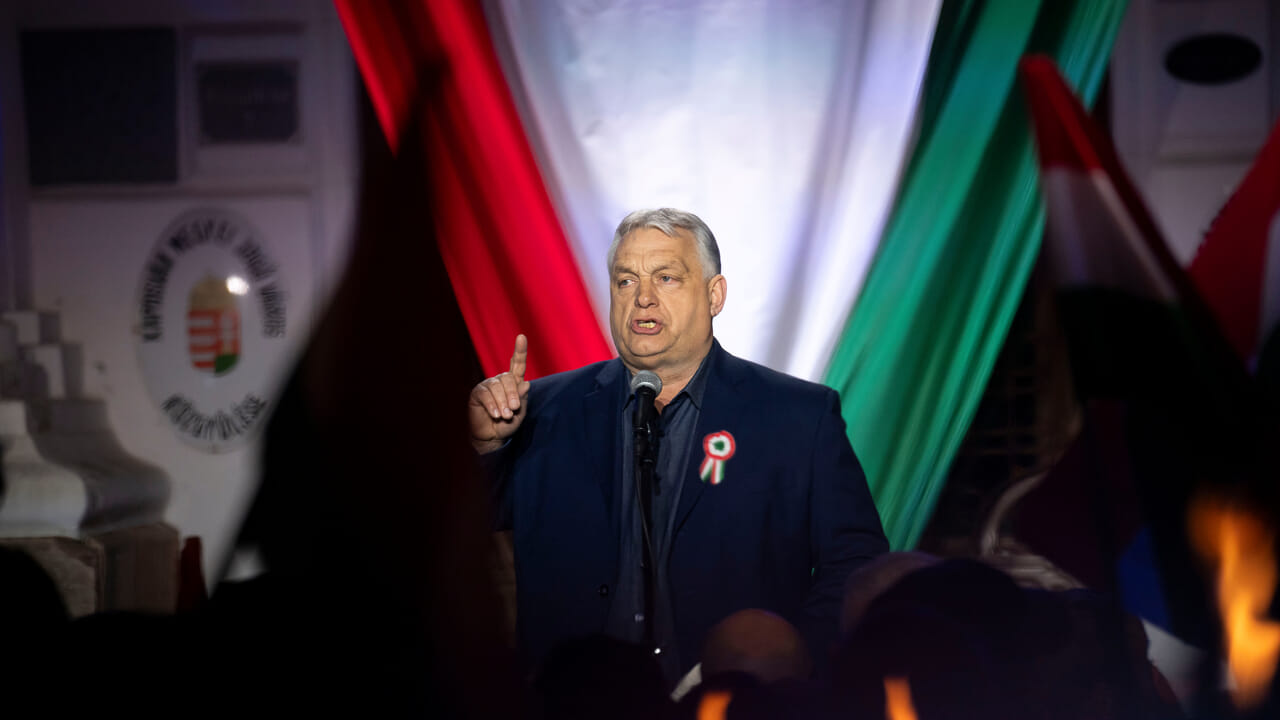
The spotlight on Hungary – The countdown to the elections in Hungary has now come to an end, with the election scheduled for Sunday 12 April, which will determine whether the Hungarian Prime Minister and leader of the right-wing Fidesz party, Viktor Orbán, will continue his 16-year uninterrupted “reign” or whether he will be ousted by popular will in favor of his direct competitor, Péter Magyar, leader of the center-right Tisza party.
What will Hungarians vote for? – Voters will be asked to renew the members of the National Assembly, on which the parliamentary consensus necessary for the formation of a new government will be built. There are four main political forces that will compete for the 199 seats of the Assembly: in addition to the coalition between Fidesz and the Christian Democratic People’s Party (founding members of the European Patriots) and Tisza (which joined the ranks of the European People’s Party in 2024), there are also the ultra-right of the Our Homeland Movement (Europe of sovereign nations), the centre-left of the Democratic Coalition (no European affiliation) and the Hungarian Two-Tailed Dog (satirical and anti-establishment party).
10 points waste – At the moment i polls they give Magyar’s party a stable lead of 10 percentage points over Orbán’s – 49 to 39 – strengthening the scenario of a radical change at the top of the Hungarian institutions. The last week before the elections will be the decisive one and it cannot be taken for granted that the results of the polls will confirm the electoral polls. The incumbent prime minister will play his last cards to try to bridge the gap and attempt a turnaround, as desperate as it is sensational, to remain in the government for another four years.
Meloni and Salvini together with Netanyahu and far-right leaders in the video in support of Orban
The consequences in Brussels – Whatever happens, the elections in Hungary will have a heavy impact on Brussels. Orbán has long been the most problematic leader among the 27 – in particular due to his relationship with Vladimir Putin and respect for the rule of law – but above all in recent months he has adopted an obstructionist attitude towards the EU institutions for their support for Ukraine. If Magyar were to become the new prime minister, in Brussels we could count on a politician who is more willing to compromise and who promises to resolve the institutional conflict on the rule of law in Hungary, on financial support for Ukraine and on the veto of Kiev’s path to EU membership. However, if Orbán were to be re-elected, an unpredictable scenario opens up: the Hungarian prime minister could bring the internal attrition of the European Union to the end and the compromise of European unity in support of Kiev, or, thanks to the new popular consensus, he could reduce the level of conflict to obtain new concessions from Brussels.
Electoral leverage – Orbán tried to exploit the tension with Brussels and Kiev as much as possible to use the weapon of nationalism in view of the elections at home. After blocking the adoption of the 20th package of sanctions against Russia and European financing in Kiev of 90 billion euros until the end of 2027 (already agreed by the 27 leaders at the December 2025 European Council with the guarantee to Hungary of being exempted from sharing the responsibility of the common debt), made the blockade of the Druzhba oil pipeline – which guarantees the transit of Russian oil to Hungary – a personal issue with the Ukrainian president, Volodymyr Zelensky. The situation got out of hand when Hungarian authorities seized two State Bank of Ukraine vehicles loaded with money from Austria, while the Hungarian Parliament passed a law opposing Ukraine’s EU membership and financial support. In response, Ukraine rejected a Hungarian delegation to monitor the pipeline.
Problematic observation – Not only the elections, but also another element worries international observers: the monitoring of the vote itself. In addition to the mission of the Organization for Security and Cooperation in Europe (OSCE), there will also be other parallel missions linked to the governing party, which could contest a possible negative result for Orbán. Not only that, the OSCE mission itself ended up at the center of controversy due to the presence of Daria Boyarskaya, an official linked in the past to the Russian Foreign Ministry and interpreter in high-level meetings with Vladimir Putin.
“Russia was planning a fake attack on Orban to favor him”: Putin’s plan for his sidekick in Europe
Other hot topics
No good news – Weeks pass, and the war in the Middle East shows no sign of coming to an end, due to the continuous US and Israeli bombings in Iran and the almost total closure of the Strait of Hormuz by Tehran in retaliation. Europe is also paying the indirect consequences, paying for its dependence on fossil fuels from the Gulf region – oil and natural gas – which must necessarily pass through the Strait off the coast of Iran to be exported.
Dark projections – The fears of the last month were confirmed by the macroeconomic projections of the European Central Bank (ECB), which updated its inflation estimates on 2 April. The second economic bulletin of the year warned that headline inflation in 2026 will average 2.6 percent, peaking at 3.1 percent in the second quarter before easing. Compared to the December 2025 projections, the estimates have been revised upwards, precisely due to the increase in energy prices caused by the war in the Middle East.
The effects of war – The ECB also forecasts economic growth averaging 0.9 percent in 2026, 1.3 in 2027 and 1.4 in 2028. This is a downward revision, which “reflects the global effects of the war on raw material markets, real incomes and the climate of confidence”. The impact of the conflict in the Middle East, however, could be even more pronounced in alternative scenarios that involve a “more severe and prolonged” energy shock.
Economic dialogue – It is precisely in this context that the Committee on Economic and Monetary Affairs (Econ) of the European Parliament will hold an economic dialogue with the European Commissioner for Economy, Valdis Dombrovskis, on Thursday 9 April. On the agenda is the discussion on the implementation of the revised economic governance framework, which came into force two years ago, but above all the implications of the war in the Middle East on the European economy will take center stage, amidst the risks of an exponential increase in inflation, technical recession and fuel rationing.
Lasting shock – In an interview al Financial Times Energy Commissioner Dan Jørgensen urged the 27 member states and European citizens to prepare for a “long-lasting” energy crisis, with the situation “could worsen in the coming weeks” for some “critical” products, such as jet fuel or diesel. That’s why the Commission is considering “all possibilities” to tackle it, including fuel rationing and the release of further oil reserves. Although there is currently no problem of “security of supply” for Europe, in Brussels we are preparing “for worst-case scenarios”, without even excluding the possibility of modifying EU legislation to allow greater fuel imports from the United States.
Grounded planes and canceled flights? What’s true about the kerosene crisis (on the eve of summer holidays)
Speaking of war – A meeting of the United Nations Security Council will be held in New York on Wednesday, April 8, which will focus on the protection of civilians in conflicts. An increasingly urgent topic, from Iran to Lebanon to Gaza, while over 100 US experts on international law they warned that the behavior of the US military and statements made by senior US officials “raise serious concerns regarding violations of international human rights law and international humanitarian law, including potential war crimes”.
New legislatures at the start – The inaugural sessions of two European national parliaments, the Slovenian and the Danish, will be held simultaneously on Friday 10 April. The start of the new legislature comes following the parliamentary elections in the two EU member countries, on 22 and 24 March respectively, and will mark the first step in the formation of new governments. The two outgoing prime ministers – the Slovenian progressive Robert Golob and the Danish socialist Mette Frederiksen – are in pole position to put together a coalition to continue leading their respective countries.
Against the far right – Demonstrations are scheduled for Saturday 11 April in Magdeburg (Germany) against the regional congress of Alternative für Deutschland (AfD) in Saxony-Anhalt, the German federal state where the far-right party is second with 20 percent of the vote. The voters of Saxony-Anhalt will return to the polls to elect the 105 members of the Landtag (the unicameral legislative assembly) on September 6th.
AfD MP accused of giving the Nazi salute at the entrance to the German Parliament
From the European Parliament
Support for workers – On Wednesday 8 April the Committee on Budgets (Budg) will vote on the decision relating to the mobilization of over 2 million euros from the European Globalization Adjustment Fund requested by Belgium, to support 507 workers made redundant from the Belgian branch of Liberty Galaţi, a base metals manufacturing company that went bankrupt in April 2025.
Pension funds and insurance companies – Also on Wednesday 8 April, members of the Committee on Economic and Monetary Affairs (Econ) will discuss with experts from the insurance and pension sectors on best practices relating to the role of pension funds and insurance companies in the mobilization of long-term capital.
Coordination on transport networks – An exchange of views on current developments relating to the corridors of the Trans-European Transport Network (TEN-T) will take place on Wednesday 8 April between the members of the Committee on Transport and Tourism (Tran) and the European coordinators Catherine Trautmann (North Sea – Baltic Sea), Pawel Wojciechowski (North Sea – Rhine – Mediterranean) and Matthias Ruete (European Rail Traffic Management System).
Registration documents – During the same session of the Tran Committee, the vote will be held on the Commission’s proposal to update the rules on vehicle registration documents and data storage and exchange between Member States, which is part of the ‘Road Safety Package’. The compromise text includes some adjustments to ensure that the move to digital certificates does not penalize people with limited digital access and skills. Further changes concern the provisions on vehicle register data, strengthening the rights of vehicle owners and aligning with related pieces of legislation.
Agricultural promotion policy – The Italian MP Salvatore De Meo (Forza Italia) will present on Wednesday 8 April to the Committee on Agriculture and Rural Development (Agri) the implementation report on the policy for the promotion of EU agri-food products in Europe and in the world – with an investment of 205 million euros in 2026 – and his recommendations to improve its effectiveness.
Post-2027 agriculture – The following day, Thursday 9 April, a seminar will take place in the Agri Committee on the key elements of the proposals relating to the EU budget for the period 2028-2034 and the sectoral legislative initiatives concerning the post-2027 Common Agricultural Policy (CAP). In particular, budgetary implications will be discussed, including allocation mechanisms, financial architecture and the proposed governance model.
