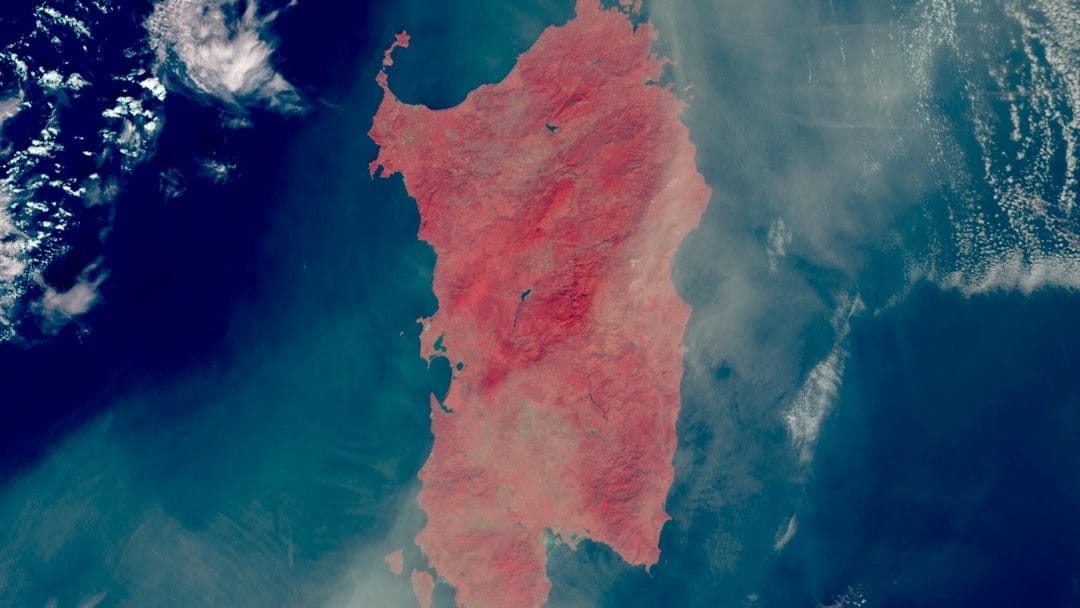
A large cloud of sand from the Sahara it overlooks Sardinia and Corsica in this image taken by the European earth monitoring satellite Sentinel-3 of the network Copernicus a few days ago, November 14th. This satellite image is in false colors because it was made in the infrared band: this is why the emerged lands appear red instead of their usual color.

These incursions of dust from the North African desert into Italian territory are not rare: they occur several times a year, caused by currents that occasionally become intense enough to transport millions of tons of dust from the Sahara to continental Europe across the Mediterranean Sea. But climate change is making them increasingly frequent.
The work of monitoring satellites like this are important for following the evolution of these dynamics, estimating how much sand reaches the atmosphere and, above all, predicting its effects. In fact, data from the European Copernicus program feeds the systems early warningessential for informing the populations, given that these episodes can affect the air quality and on health.
These Saharan sand particles are in fact analogous to fine dust: only the particles below 20 thousandths of a millimetre in fact they manage to remain at altitude carried by the wind above the Mediterranean Sea (le PM10for comparison, are under 10 thousandths of a millimetre). All this can temporarily have negative effects on the health, especially of those suffering from respiratory system diseases, because in extreme cases it can lead to breathing difficulties.
These dusts may contain iron-containing minerals, such as hematite And magnetitewhich make the dust magnetic (it is attracted by magnets) and are responsible for their reddish color. It’s not much different from what happens above Mars: the “red planet” has this color precisely because its surface is covered in iron oxides. Not only that: the Martian sky shows a yellowish color very similar to what we see here on Earth when the Saharan dust waves occur because the planet’s atmosphere is extremely rich in dust.
