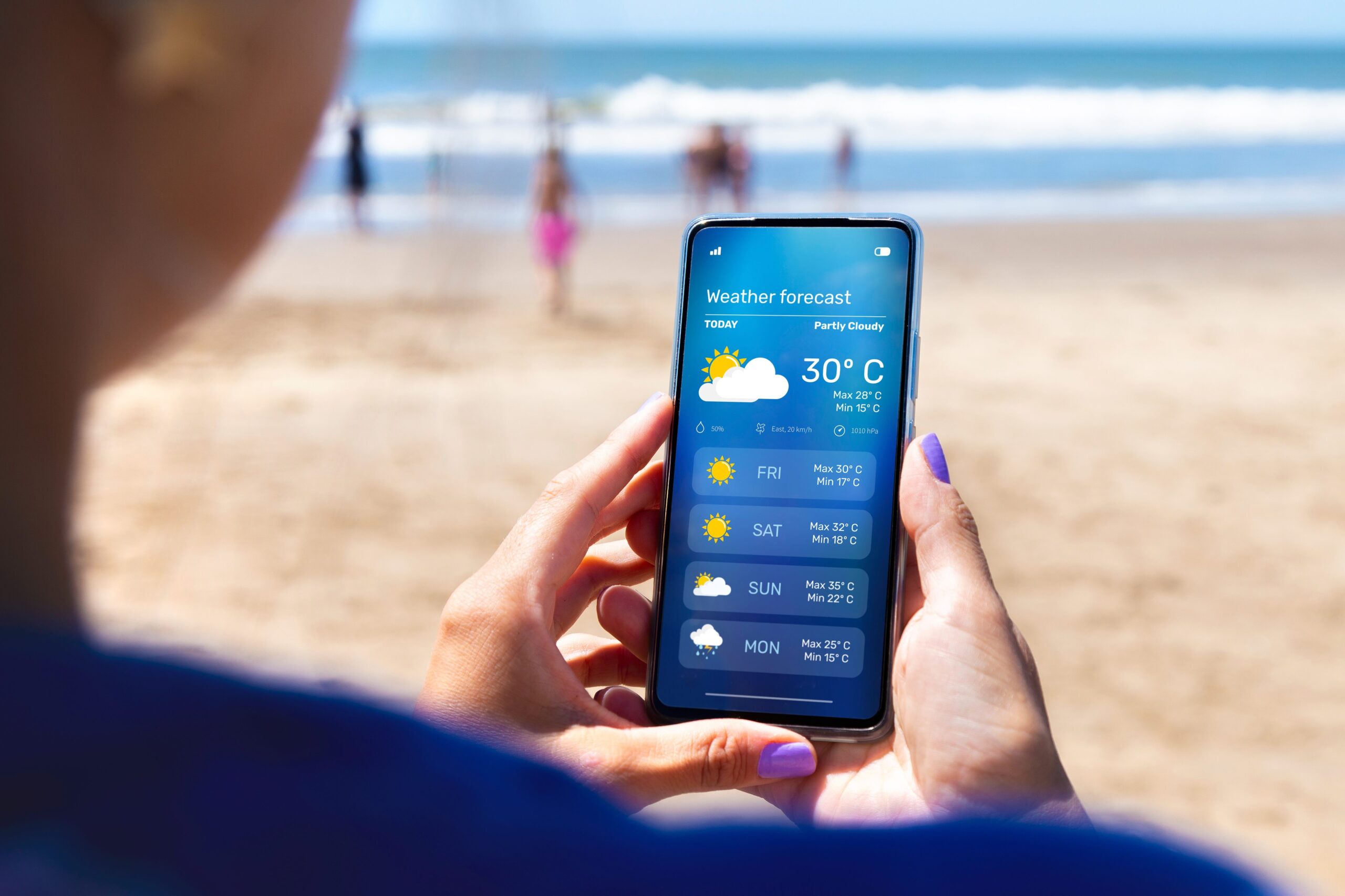
We know: the Weather forecast They do not always hit us. This happens because calculating them is an extremely complex job, which depends on many variables And approximations. For this reason, when we consume the weather forecast, we must always take into account thereliability and of chance associated. As a general rule, it is good not to base your plans on forecasts with reliability of less than 70% or that go over 5 days. If it is planned raincheck the chance On a certain area it can help us understand how high the risk of wetting is.
In this article we see what the percentages in the weather forecast really means.
How the weather forecasts are calculated
Calculating weather forecast is an extremely difficult job, because atmospheric events are complex phenomena, influenced by many variables that act simultaneously. To estimate them, first of all it is necessary to describe the behavior of the atmosphere through physical-mathematical equationswhich form the so -called “mathematical model”. Then they use satellites, radar and weather stations to collect data on current atmospheric conditions: temperatures, pressure, winds, humidity.
Once all these data are collected, it is used as a starting point (or “initial conditions”) to resolve the equations of the model. These, however, cannot be resolved exactly: you can only calculate the Approximate solutionsthanks to Supercomputer capable of performing hundreds of billions of operations every second.
Each passage of the process involves inevitable approximations, which lead us to Dell‘uncertainty in forecasts. But not only! The atmosphere is a chaotic system: Small variations in the initial conditions can lead to great differences in the final result. This is the famous “butterfly effect” and is the basis of the uncertainties related to the weather forecast.
What does it mean that the reliability of the forecast is 70%?
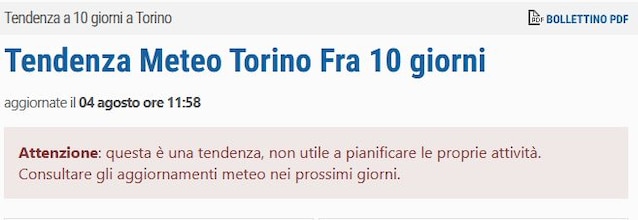
As we said, the atmosphere is a chaotic system. Any variation in the environment, even the smallest, can lead to great variations in the weather. For this, the weather forecast is very reliable in the short term And they are little more than long -term indications. Tendentially, if we need to know the atmospheric time of tomorrow or the day after tomorrow, we will have predictions with high reliabilitybetween the 90 and 95%. If, on the other hand, let’s try to understand what time will do between 5 daysthe reliability will be about the 50%more or less like pulling a coin. If we even try to look for what time will do in 10 days, the settings themselves warn us to the little usefulness of the long -term forecasts.
To be able to establish thereliability of a predictionthe weather centers do dozens and dozens of simulations starting from initial temperature, pressure, lightly different conditions and compare the results. If almost all forecasts lead to the same scenario, the level of trust in the forecast will be high. If, on the other hand, the results are discordant, the uncertainty will be greater. For example, if, making 100 simulations, they get the same scenario (or a very similar one) 70 times they will say that that forecast has a reliability of 70%. If they had seen it only 20 times, the reliability would have been 20%.
This information is also found on weather forecast sites And it can vary from site to site, based on the mathematical model used. In general, reliability below 70% is not too useful for planning your activities.
When the data are too uncertain – for example in case of strong atmospheric instability – some sites show a red label with the wording “Complicated forecast”. In these cases, the forecasts are not available for now, but the temporal bands can be consulted (night, morning, afternoon, evening) waiting for more precise updates.
What does it mean that there is “20% rain”?
Another percentage that we often see next to the predictions is that related to rain. When a weather app shows “20% rain” next to the icon, it does not mean that it will rain little or that it will rain 20% of the time. This percentage is called Pop (probability of precipitation) and is defined by the National Weather Service, the US government agency that deals with weather forecasts, such as the chance than in a certain area And time slot they fall at least 0.01 inches of rain (i.e. about 0.25 mm).
In other words, if on my city there is a pop of 20% for today between 16 and 17, it means that, given the same initial conditions, on the same area and in the same time slot, 20 times out of 100 will rain.
There are many discordant opinions Among the meteorologists themselves on how to calculate and how to define pop and this is why it could be very different from one app to another. The simplest and widespread one to get it is multiply how much you are certain that the rain will occur in a certain area for the percentage of area on which we think it rains. So, for example, if we are 80% sure that it will rain on half (50%) of the city, we will have a pop of 40% (= 80% × 50%). We could get the same pop even if we are 40% sure that it will rain on the entire city (100%).
In any case, when we look at the weather forecast, we always remember that they are extremely complex and that they cannot guarantee us 100%safe answers.
